
A white cloud rolls away from a steel structure and swallows much of the sky. Only a small patch of flame shows near the bottom. There is water and grass in the foreground, but no rocket climbing above the scene. NASA's latest Image of the Day shows an engine working on the ground at Stennis Space Center in Mississippi.
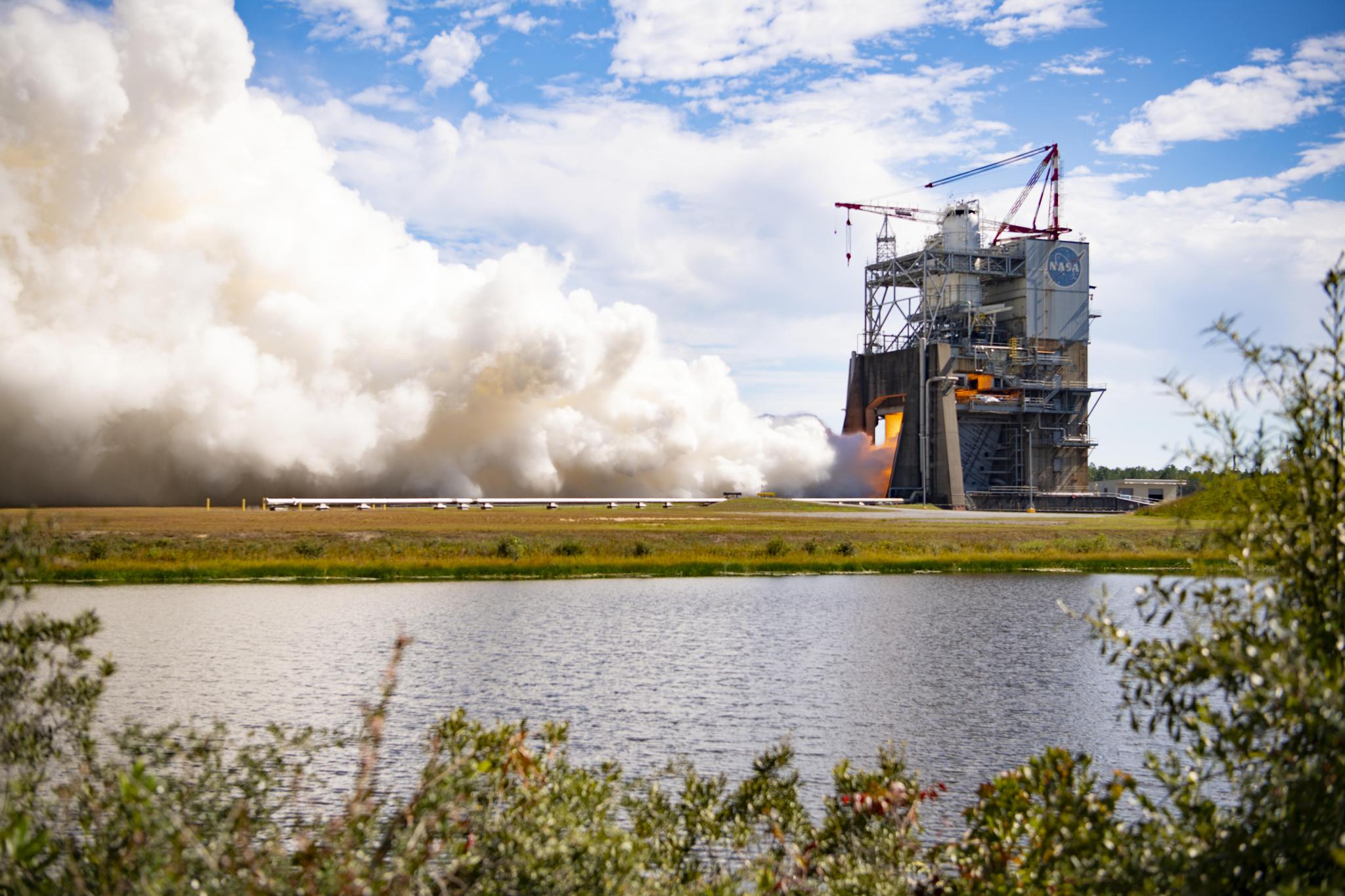
Image credit: NASA/Danny Nowlin. Original page.
A Long Run Without Going Anywhere
The photograph was taken on October 21, 2026, and published on October 23. RS-25 development engine No. 10001 was undergoing a hot fire: an actual firing, beyond checks of valves, pipes or electrical systems alone.
This run lasted 500 seconds, or 8 minutes and 20 seconds, close to the time RS-25 engines operate during the ascent of NASA's Space Launch System rocket. A brief ignition can show that an engine starts. A sustained run gives engineers a chance to record its behavior under a prolonged, demanding workload.
The engine is secured to a ground structure that takes its thrust. Around that stationary machine, engineers can arrange test systems and collect data to improve performance and reliability.
NASA makes one distinction especially clear: this development engine will not fly. Its job is to help other engines work better. An engine firing on a test stand is not automatically the last rehearsal for an imminent launch.
The Cloud Has a Water System Behind It
The RS-25 uses liquid hydrogen and liquid oxygen. Hot gas rushes backward through its nozzle, and the engine experiences thrust in the opposite direction. During a ground test, that force passes into the structure holding it. The exhaust does not need to push against air, which is why rockets can operate in space.
Nor should the enormous white cloud simply be read as smoke. The test stand must handle intensely hot exhaust. NASA's account of its cooling equipment describes high-pressure water sprayed through thousands of small holes in the flame deflector to cool the exhaust and protect the structure. Steam and tiny droplets that form as water vapor cools contribute to the billowing cloud we see.
Lighting the engine is only one part of the task. Supporting the force, supplying water and controlling the equipment are all essential to keeping it running safely on the ground.
Propellant Helps Keep the Nozzle Cool
Outside the engine, the test stand uses water. The nozzle wall has another cooling system. NASA's account of the redesigned RS-25 nozzle describes more than 1,000 tubes carrying extremely cold liquid hydrogen through the wall to remove heat. Propellant intended for combustion also helps protect the engine. The water system behind the white cloud and the tubes inside the nozzle handle different parts of the heat problem.
NASA recorded this test at a 111% power level, using the RS-25's historical rated level as its reference. The agency's engine overview explains the operating levels of earlier and newly produced engines. Here, the more revealing distinction is the engine's purpose: a machine that stays on Earth can still gather evidence for future flights.
Open the original photograph and find the small orange patch first. Then follow the cloud toward the left. The engine doing the work is mostly hidden inside steelwork; the most conspicuous feature shows how the ground installation handles its heat. Next time you watch a test firing, look beyond the countdown: what takes the force, what supplies the propellant, and what carries the heat away?