
A solar wing stretches across the foreground, its edges gleaming white. Above it hangs an irregular comet, with faint streams of dust and gas reaching into the dark. The camera taking this selfie belonged to Philae, the little lander still riding on the Rosetta spacecraft.
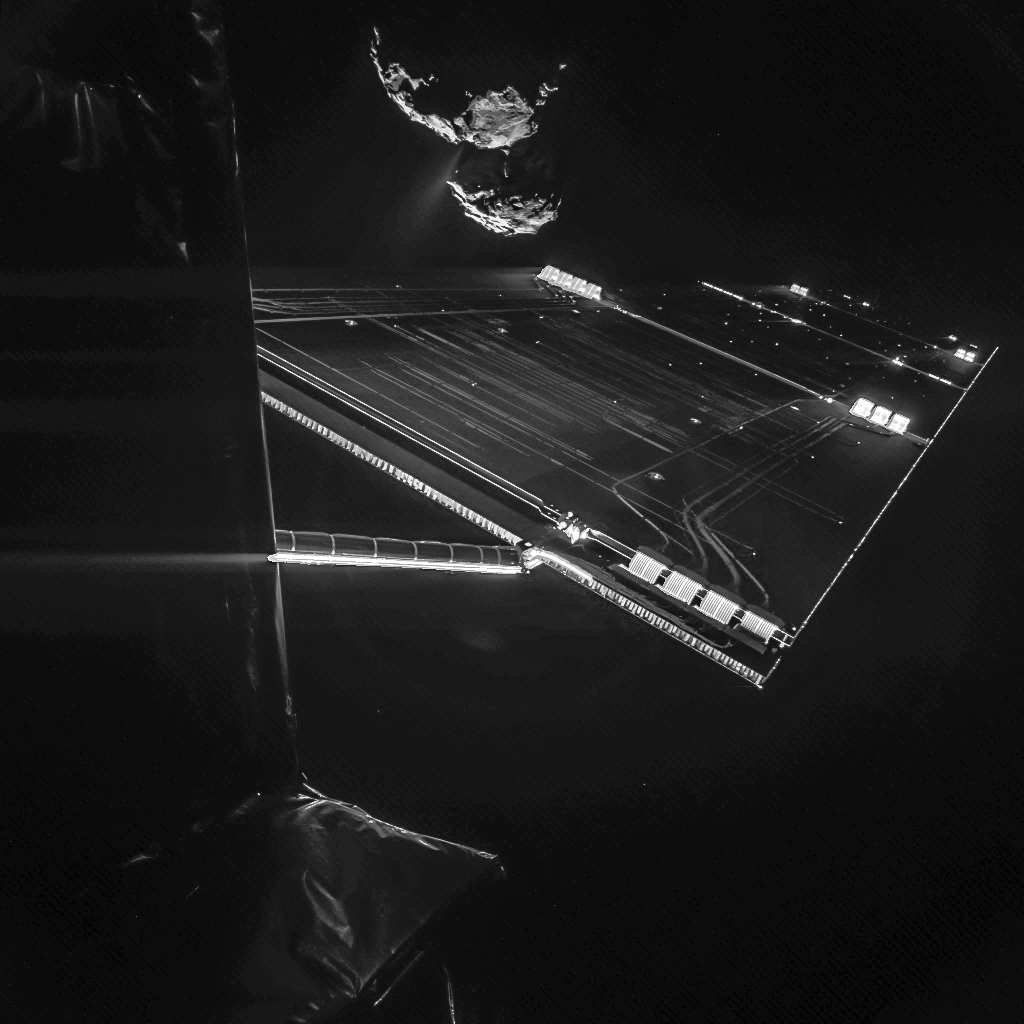
Image credit: ESA/Rosetta/Philae/CIVA. Original page.
Making Room for Bright and Dark
Today's NASA Astronomy Picture of the Day revisits a photograph taken on October 7, 2014. According to ESA's original image description, the spacecraft was about 16 kilometers from the surface of comet 67P/Churyumov-Gerasimenko. The visible solar wing is about 14 meters long, roughly the length of a large bus.
There was a photographic problem. Nearby, the wing reflected strong sunlight. The comet and the unlit parts of the spacecraft were much fainter. A short exposure could preserve bright detail while losing the shadows. A longer exposure could reveal the shadows while washing out the highlights.
The CIVA camera system therefore took two images with different exposure times. Combining them brought details from both ends of that brightness range into one picture. The solar wing and comet were already sharing the camera's view; the processing helped us see them together.
Look between the comet's two lobes for its active "neck," where dust and gas stream away from the surface. Then follow the grid of the solar wing toward its outer edge. Straight lines built by engineers meet the uneven outline of a natural world.
The Passenger Who Later Let Go
Philae was still attached to Rosetta when it took the photograph. Just over a month later, on November 12, 2014, it separated and descended to make the first landing on a comet.
The arrival did not go as planned. The anchoring harpoons failed to fire, and Philae bounced, made further contact with the surface, and eventually stopped in a poorly illuminated location. DLR's later account reconstructs that unexpected journey. This selfie preserves the earlier moment when passenger and carrier were still connected.
You can try a gentler version of the camera's problem at home. Place a toy beside a bright window in daylight. Keep the Sun itself out of view, and never look directly at it. On a phone, tap the bright outdoor scene to set exposure, take a picture, then tap the indoor toy and try again. Which details disappear each time? See whether an HDR mode can retain both. The interesting question is how a camera handles two very different brightness levels in one view.