
Above rolling hills, the Andromeda Galaxy hangs like a luminous tilted oval, dark dust lanes circling its bright center. Today's NASA Astronomy Picture of the Day comes from Mullion, New South Wales, Australia. Photographer Lucy Yunxi Hu brought this northern neighbor into a southern spring landscape on the night of October 10-11.
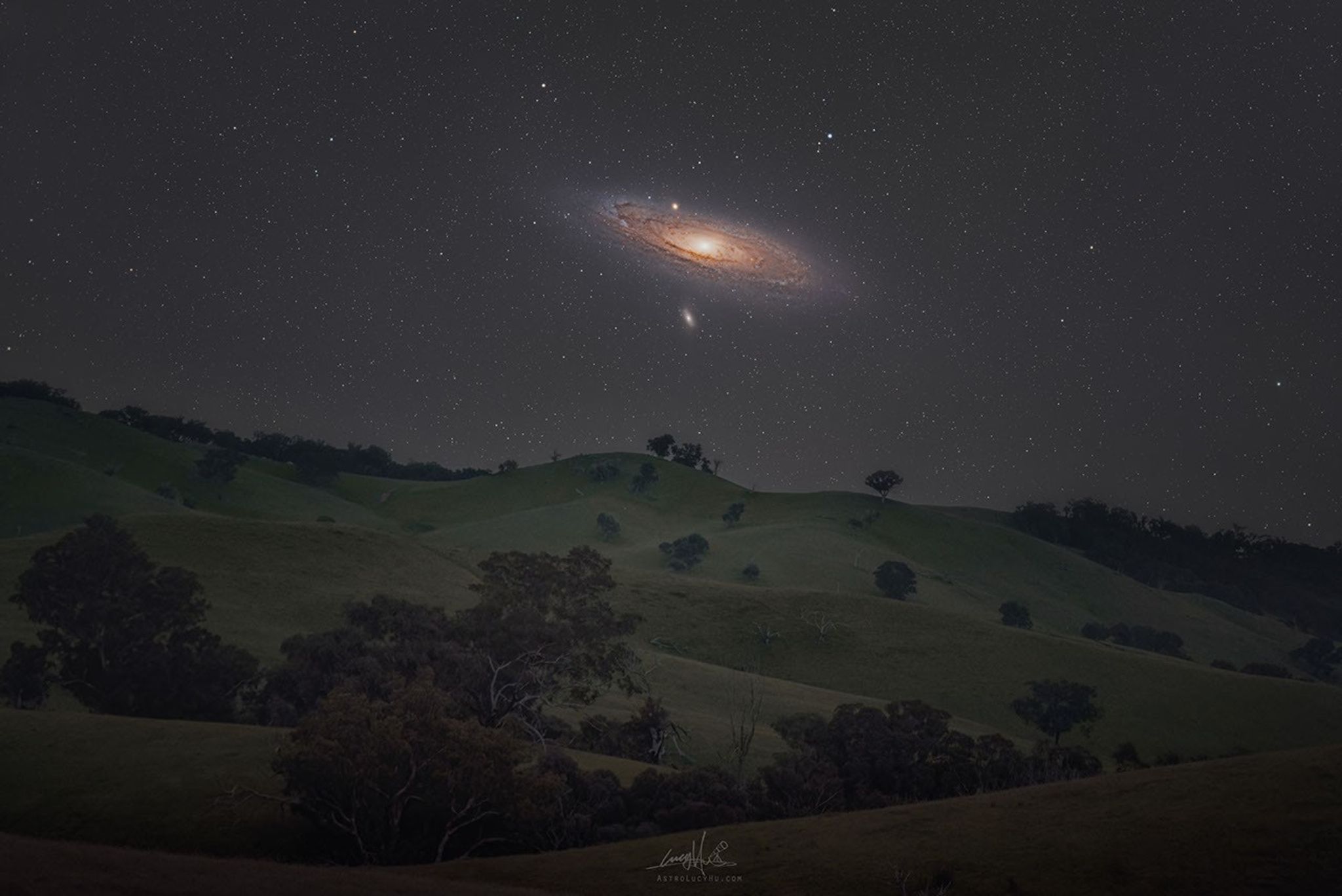
Credit & Copyright: Lucy Yunxi Hu. Tracked and stacked sky exposures combined with a foreground photograph. Original page.
Same galaxy, different path across the sky
Andromeda, also called M31, lies in the northern sky. Travel south around our round planet and northern targets sit progressively closer to the northern horizon. Far enough south, this one never rises at all.
We can calculate the difference. M31's declination is approximately +41.3 degrees: its north-south coordinate on the celestial sphere. At a geographic latitude of 35 degrees south, its center can reach about 13.7 degrees above a flat geometric horizon. At 40 degrees north, it can pass almost overhead. Hills, trees, and the atmosphere complicate the real view.
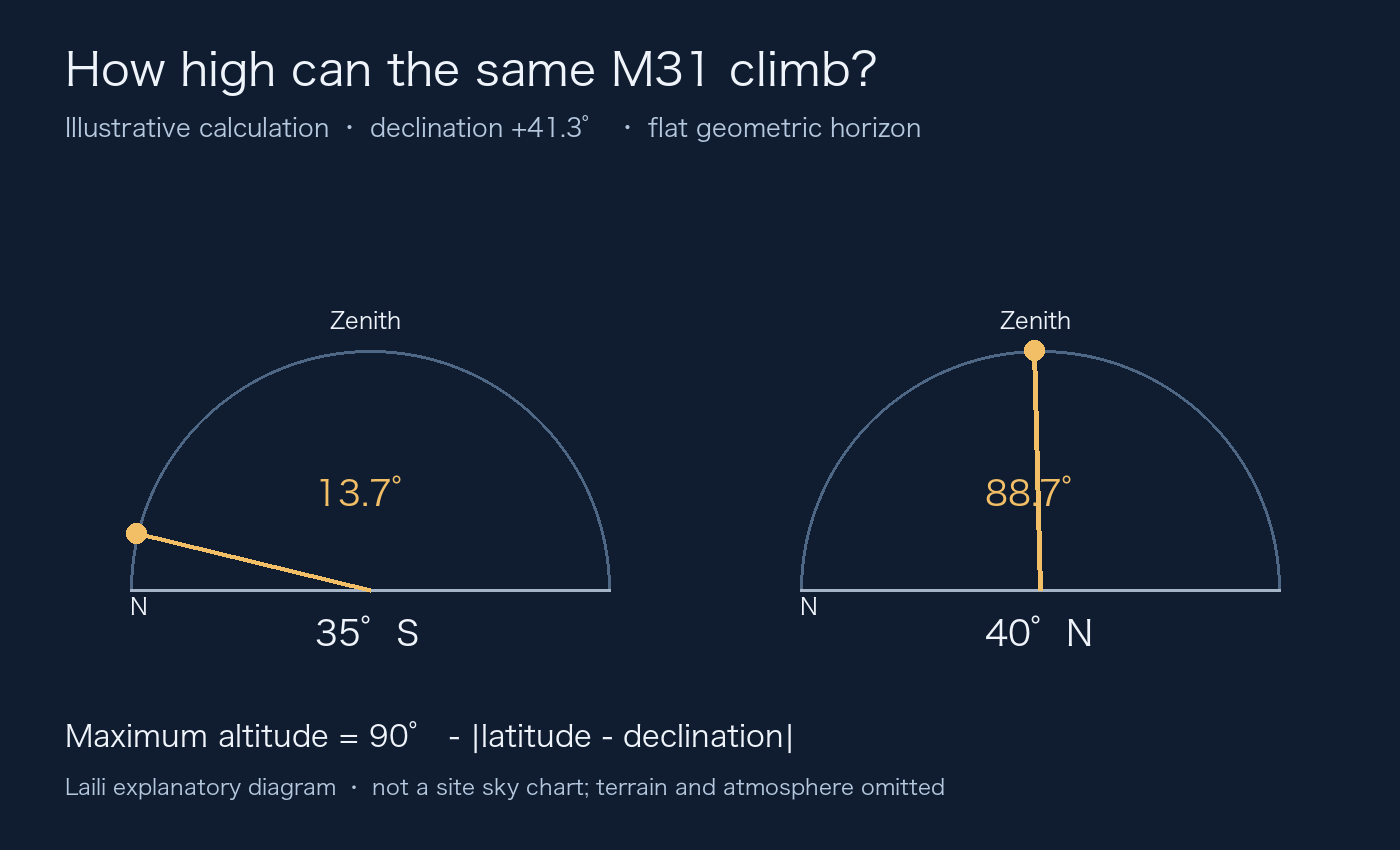
Laili explanatory diagram. Calculated using a rounded declination of +41.3 degrees to compare latitudes; this is not a sky chart for the photographic site.
The planning view linked from APOD shows a simulated altitude of about 2.9 degrees at 03:35 on October 11, 2026, UTC+11. That is a low position at one particular time. It is not the galaxy's maximum altitude for the night, nor the only angle from which it can be photographed.

A faint patch for the eye, a galaxy for the camera
At roughly 2.5 million light-years away, M31 is our nearest large galactic neighbor. Its light spent about 2.5 million years traveling before reaching the camera. That distance belongs to the galaxy, not to the foreground hills or every bright star in the frame.
Under a dark sky, the unaided eye can see M31 as a small, faint, fuzzy patch. A camera needs to accumulate light to reveal those intricate dust lanes and broad outer regions. APOD describes tracked and stacked sky frames combined with a foreground shot. This is neither a single short exposure nor the brightness a person would see standing there.
APOD puts the galaxy's apparent length in this view at nearly six full-Moon diameters. That compares angles on the sky, roughly three degrees. It does not mean the galaxy is physically only six times larger than the Moon. Faint outer regions spread across the photograph while our eyes mainly pick out the brighter center.
To find it yourself, enter M31 into a sky-map app and set your location. Check which part of the sky it crosses and how high it rises. Northern autumn offers favorable viewing from much of China. Choose a clear night with little moonlight, get away from strong lights, and start with binoculars. Expect a faint glow rather than the photograph's colors. Recognizing it is already a look beyond the Milky Way.