
Look up and a flower of blue, red and white glass fills the ceiling. Below it hangs a chandelier, surrounded by tiers of golden railings and walls almost entirely covered in book spines. Today's Bing photograph takes us inside the Royal Portuguese Reading Room in Rio de Janeiro, Brazil.
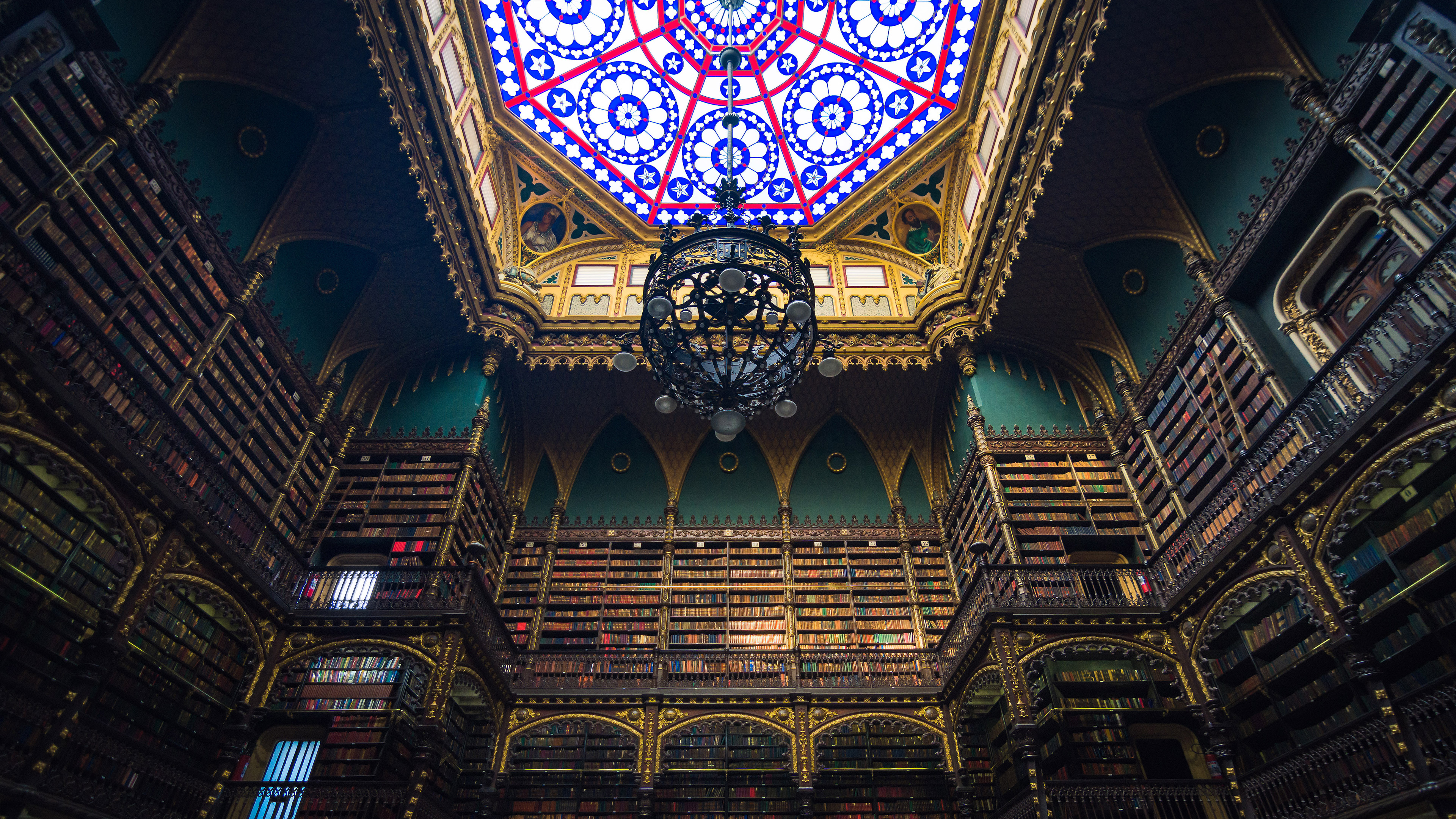
Image: Royal Portuguese Reading Room, Rio de Janeiro, Brazil (© Antonio Salaverry/Shutterstock). Original page.
The Readers Came First
The institution is half a century older than this splendid building. Its own history begins on May 14, 1837, when 43 Portuguese immigrants met in Rio and founded a reading room. Brazil had become independent of Portugal just 15 years earlier. Far from home, the founders wanted books and learning to remain within reach of the city's Portuguese community.
Their organization moved several times. Work on the present building began in 1880, and Princess Isabel inaugurated it in 1887. The library opened to the general public in 1900. In 1906, Portugal's King Carlos I granted it the title "Royal." The dates mark different chapters: an organization founded in 1837, a building opened in 1887, and a royal title bestowed later still.
Architect Rafael da Silva e Castro never visited Brazil; Frederico José Branco oversaw construction on site. According to the library's visitor guide, the design is Neo-Manueline, drawing inspiration from the parts of Lisbon's Jerónimos Monastery rebuilt in the 19th century. Elaborate stonework, arches and ornament carried a vision of Portuguese history across the Atlantic and gave the books a suitably grand home.
The visitor guide adds a tangible detail: the facade uses lioz stone brought from Portugal. More than an architectural style crossed the Atlantic. Some of the building itself did, too.
October 24 also falls within Brazil's National Book and Library Week. Decree No. 84,631 of 1980 sets it from October 23 through 29 each year, ending on National Book Day. It gives a late-October visit to a room full of books another connection to the calendar.
A Glass Flower Above a Growing Collection
The brightest feature in the photograph is the skylight: an octagonal stained-glass rose supported by a metal framework. Beneath it, the chandelier is made of iron and bronze. Follow the balconies around the room and notice how shelves, passageways and daylight share one tall space. The metalwork is part of the spectacle, alongside the stone carving.
New books continue to arrive. In 1935, the Portuguese government granted the institution legal-deposit privileges. The library explains that this arrangement keeps it supplied with Portuguese publications. Legal deposit preserves copies of what a country publishes; here, it helps an old reading room keep growing rather than simply guarding a fixed collection.
Individual readers left their traces, too. Brazilian writer Machado de Assis visited from his youth, and the Brazilian Academy of Letters held formal sessions here before it had a home of its own. In 1880 he wrote the play Tu só, tu, puro amor at the library's invitation. Its manuscript remains in the collection. A room founded around Portuguese culture also became part of Brazilian literary life.
You can visit without joining. The library's current visitor information lists free admission on weekdays, from 10 a.m. to 5 p.m. Rio local time; check holiday arrangements before traveling. Its website also offers a virtual tour. Start with the eight sides of the skylight and the patterns in the railings. If you were designing a room for your favorite book, would you begin with the shelves, or with the light?