
Watch the bright point rising from the horizon, then look toward the top of the frame. About eight seconds into this timelapse, a bright streak enters and heads toward the distance. It is the International Space Station. Below it, a Falcon 9 rocket and Dragon cargo spacecraft are heading for orbit.
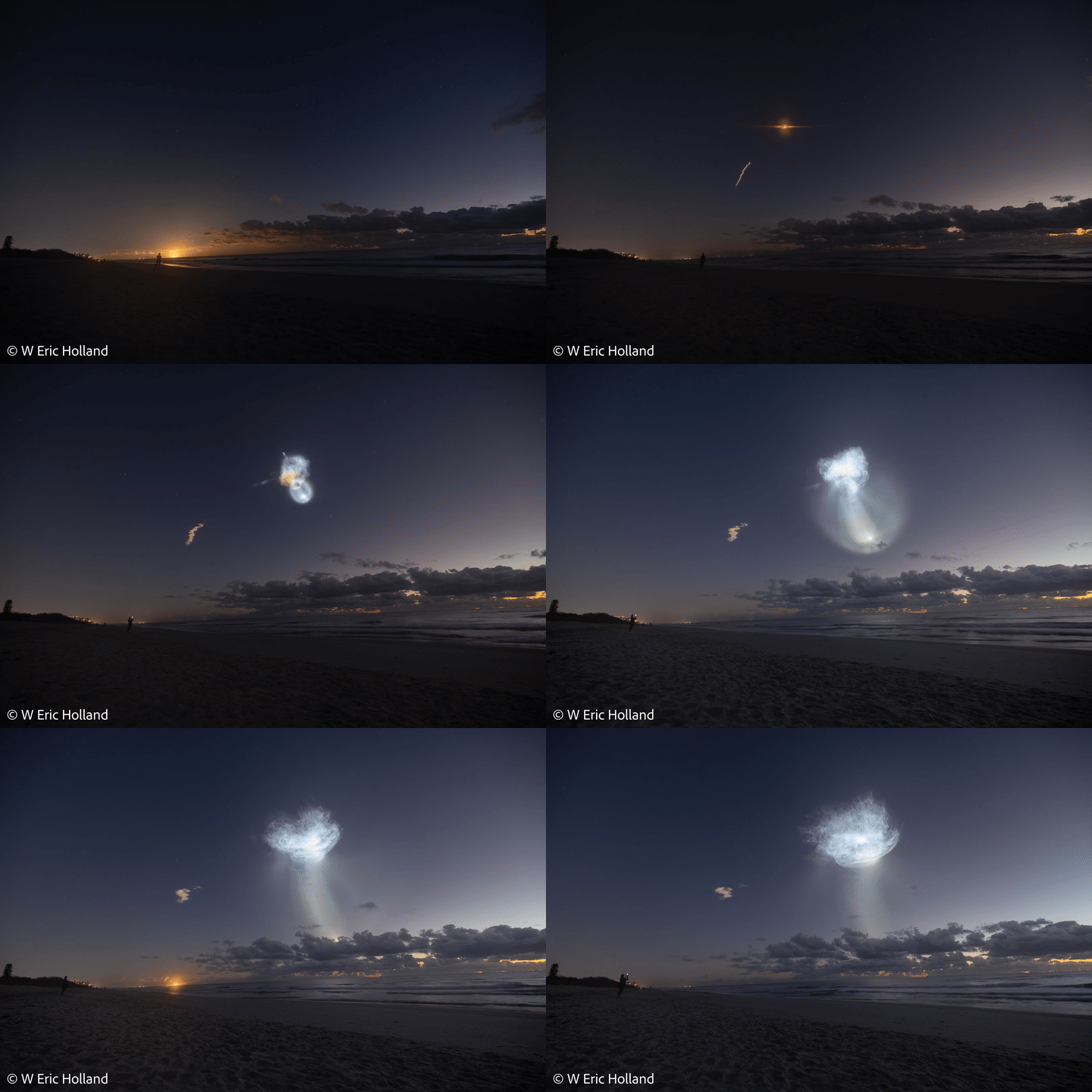
Video and animation frames: Eric Holland; on-screen credit © W Eric Holland. The animation preserves the original video's full 30-second sequence. Original page · Original video.
Selected for NASA's October 16 APOD, Eric Holland's video was filmed from Indian Harbour Beach, Florida. It records the predawn launch on October 13 of NASA's 35th SpaceX Commercial Resupply Services mission, from Space Launch Complex 40 at Cape Canaveral Space Force Station.
The sequence brings together events that usually appear in separate reports. As the rocket climbs, its first and second stages separate and the bright plume spreads outward. Meanwhile, the station passes overhead. Around 20 seconds into the video, the returning first stage begins a visible sequence of boostback, reentry and landing burns. It lands successfully at Landing Zone 40, while the plume continues drifting across the sky.
Thirty seconds is the length of the edited timelapse. The launch and landing did not happen in half a minute. Nor does the apparent closeness of the station and spacecraft in this flat view mean they docked within the frame. Perspective puts paths at different distances together; at launch, rendezvous and docking were still ahead.
Try watching three times. First follow the station. Then follow the returning booster. Finally, watch how the plume changes after the rocket has moved on. Each path has its own destination. To look for a station pass from where you live, use NASA's Spot the Station; visible opportunities depend on your observing location.