
Behind a photograph that looks like luck is a calculation anyone can check.
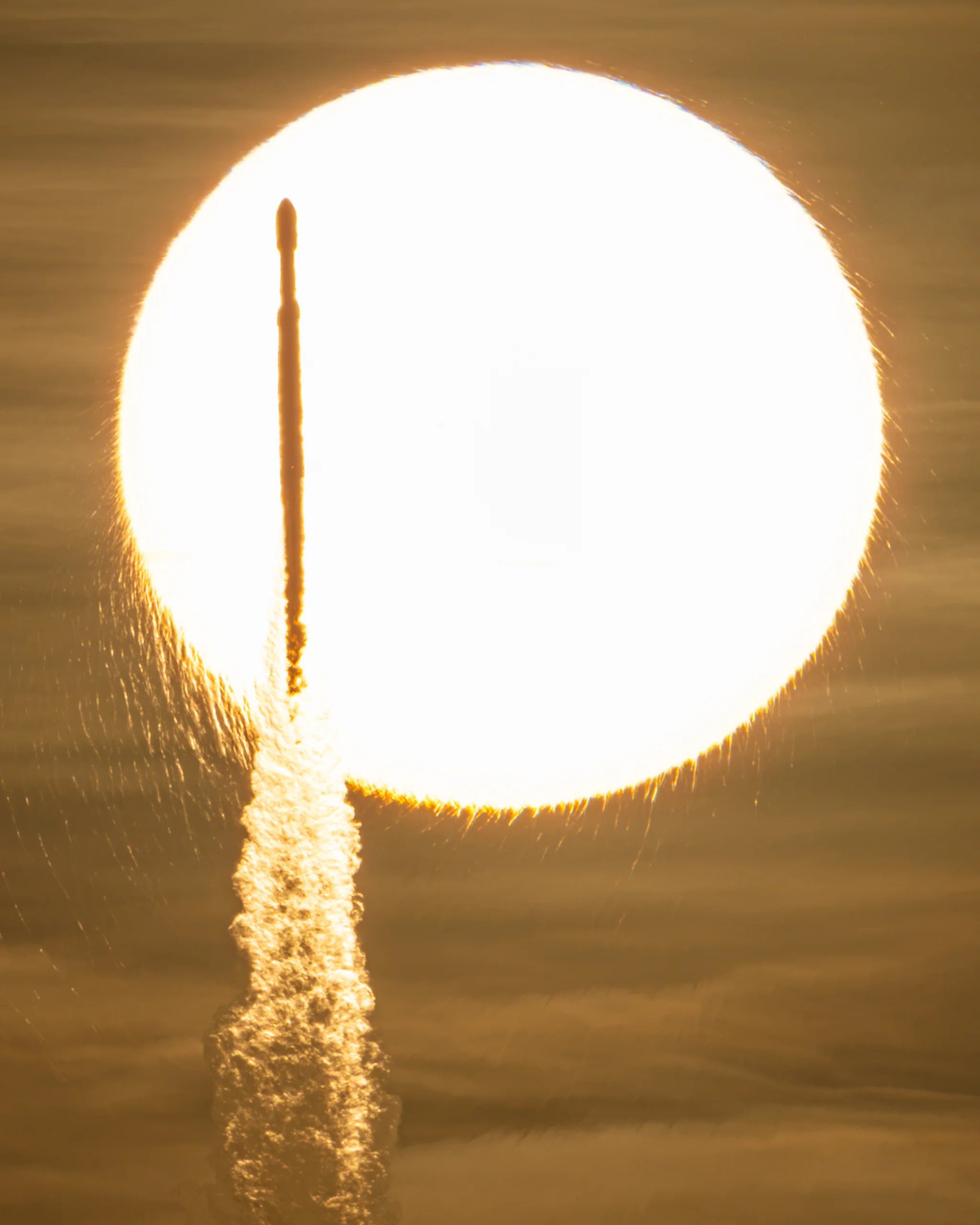
Image: NASA Image of the Day | Image credit: NASA/John Kraus | Image page
Begin with the easiest number to overlook.
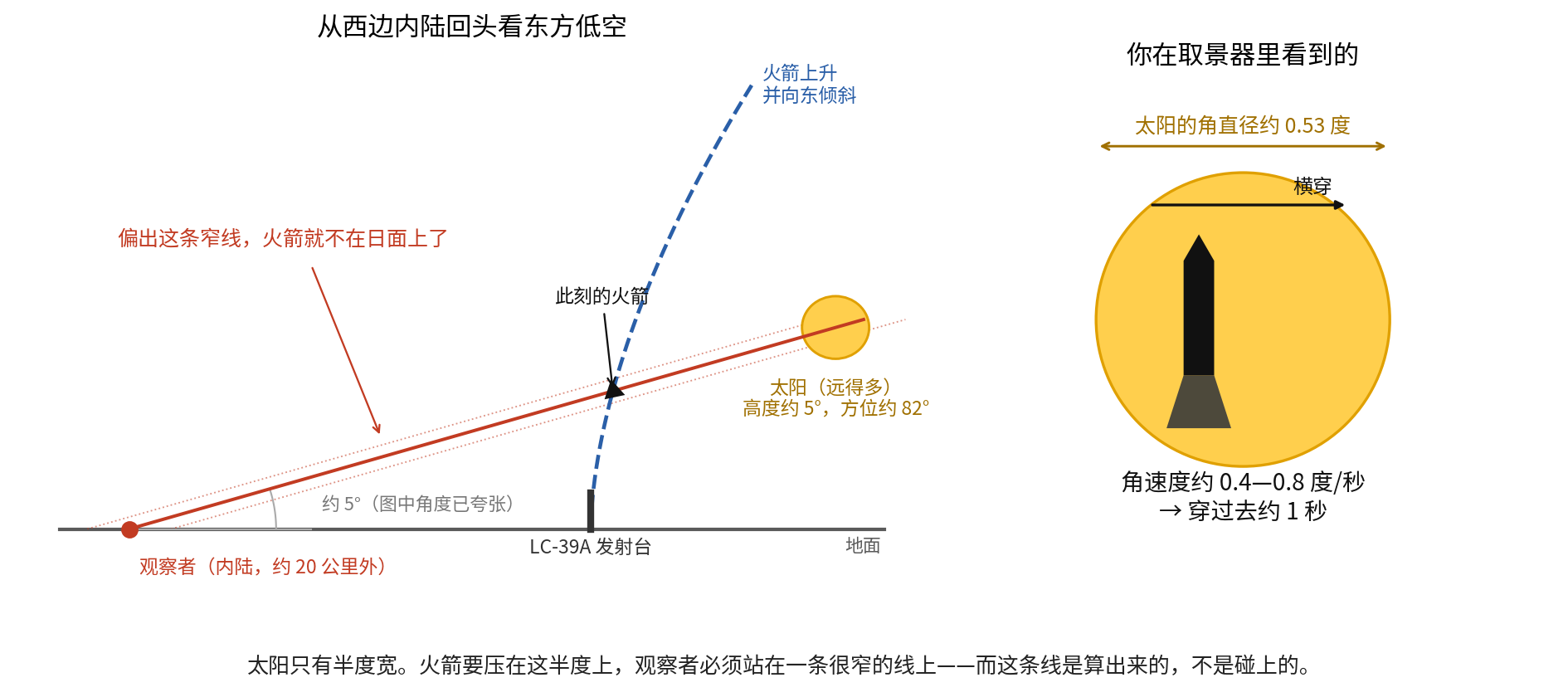
At 7:26 a.m. on Sunday, August 30, 2026, in Florida, the Sun had been up for less than half an hour. Sunrise had come at 6:59. It hung east-northeast, at an azimuth of about 82 degrees, and only about five degrees above the horizon.
Five degrees is low enough to cover with three fingers held together at arm's length.
At that moment, a rocket passed in front of it.
How Long Did the Crossing Take?
The answer needs only one equation.
How long an object takes to cross a field of view depends on its distance and its sideways speed. Distant things appear slow; nearby things appear fast. In equation form:
Crossing time = angular size of the target x distance to the target / transverse speed
The Sun's angular size follows from two NASA figures: a diameter of about 1.4 million kilometers and a distance of about 150 million kilometers. The ratio gives about 0.53 degrees, a little more than half a degree, or roughly 32 arcminutes.
NASA's official eclipse-photography guide contains the same number in another form: the Sun's diameter on film is approximately the focal length divided by 109. With a 400 mm lens, the Sun is 3.7 mm wide on the sensor. A full-frame sensor is 36 mm across, so the Sun occupies only one-tenth of the frame's width. Working backward, 1/109 radian equals 0.53 degrees: the same Sun, expressed two ways.
Now insert plausible values. Because the Sun was only five degrees high, the rocket was still low. If the observer stood 20 kilometers away, a five-degree elevation puts the rocket at an altitude of about 1.7 kilometers, roughly half a minute after liftoff. Its motion would still be mostly vertical, at something on the order of 100 to 200 meters per second.
Across several reasonable assumptions, with a distance of 19 to 40 kilometers and a transverse speed of 120 to 500 meters per second, the result stays in the same range:
0.7 to 1.5 seconds.
The stability of that answer is the interesting part. As the rocket climbs, it becomes both farther away and faster. Distance sits in the numerator and speed in the denominator, so their increases largely cancel. The apparent angular speed remains around 0.4 to 0.8 degrees per second. Nearly every reasonable estimate therefore lands at about one second.
During that second, how far did the Sun itself climb? Its elevation that morning was increasing by about 0.22 degrees per minute. The Sun took two and a half minutes to move by its own diameter; the rocket crossed that diameter in one second, more than 100 times faster.
Send the Camera Where People Cannot Go
Another rarely discussed detail behind launch photographs reveals a second measurable piece of physics.
When a rocket ignites, nobody can remain within several hundred meters of the pad. Launch photographers therefore set up their cameras the day before in places too dangerous for people, then leave the cameras to start themselves.
Sound is the trigger. A photographer fits a camera with an acoustic sensor, adjusts its sensitivity and walks away. When the roar of ignition reaches the camera, the shutter begins firing. One position may produce 70 to 140 frames before the sound fades.
John Kraus, who is credited for this photograph, explains the arrangement plainly on his website. His cameras are sound-activated and must work unattended because a person at that distance "would be seriously injured or killed."
The delay can be calculated. Another credentialed photographer documented three camera positions at the same launchpad: the closest about 366 meters away, the others about 671 and 701 meters away. Sound travels through air at roughly 343 meters per second:
366 / 343 = about 1.1 seconds
671 / 343 = about 2.0 seconds
The memory cards recorded exactly that difference. The nearest camera fired at ignition; the other two did not begin until the rocket had already left the pad. The missing one or two seconds were the time sound needed to cross those few hundred meters.
This was not a theoretical result but one visible in the image timestamps. It is the same delay measured between lightning and thunder: light arrives almost instantly, while sound is slow. At a rocket launch, three cameras can record the difference separately.
Photographing the Sun also requires a dedicated solar filter. NASA's guide gives the scale: such a filter must reduce visible and infrared sunlight by a factor of 100,000. Without one, the camera is damaged first, then the eye.
Luck, or a Calculation?
NASA's caption does not explain how this photograph was made or say whether the transit was predicted. No account by the credited photographer discussing this particular image was found.
One point is certain: a transit like this can be calculated in advance.
Another photojournalist described photographing the same launch. He left the press site about three miles from the pad and drove to a parking lot 12 miles away. Using a lens extended to 400 mm, a borrowed solar filter and a shutter speed of 1/20000 second, he caught the same event. He said it was over "in the blink of an eye." He also admitted that other reporting had kept him busy that morning and he had forgotten to check whether a transit was expected. The implication is clear: launch photographers have trajectory-prediction tools for exactly this purpose.
The precise conclusion is that, for at least some photographers, such an image is not luck. It is a position and a time calculated in advance, with a publicly available method.
That also explains why an observer must stand inland. The Sun was low over the ocean to the east, and the rocket launched eastward from Kennedy Space Center. To place the rocket against the solar disk, the photographer had to retreat west of the flight path and look back toward the eastern horizon. Titusville, where the other photojournalist stood, lies west of the space center across the Indian River.
Three Months in Transit
The payload was the Nancy Grace Roman Space Telescope. It is now headed for the Sun-Earth system's second Lagrange point, L2.
NASA places L2 about 1.5 million kilometers from Earth, in the direction away from the Sun. There, gravity reaches a balance that lets an object maintain a stable orbit with very little intervention.
That distance is about four times the Earth-Moon distance. Light takes five seconds to cross it, compared with 1.28 seconds to the Moon.
Roman is not making the trip quickly. Covering 1.5 million kilometers in three months averages less than 700 kilometers per hour. The International Space Station travels about 40 times faster. Roman was thrown outward and is coasting to its destination.
On August 31, the day this image was published, it completed its first midcourse correction: an engine burn lasting about three minutes to keep it on course for L2. Three minutes determined where it would arrive after 1.5 million kilometers.
Why go so far? At L2, the Sun, Earth and Moon all remain on the same side of the telescope, so one barrel-shaped sunshade can block all three. NASA says the thermal stability there will make much of Roman's data 10 times better than Hubble's.
NASA says the observatory will be fully operational in 2027. It has not specified a month, so neither does this article.
There is another notable detail. The astronomical community nominated and selected the subjects for Roman's earliest public images. NASA plans to devote about 12 to 24 hours of commissioning time to these "first look observations," choosing three to five proposals. What a new telescope sees on its first day is being decided collectively, a moving tradition in astronomy.
Blocking the Brighter Object
Roman also carries something classified at launch not as an instrument, but as an experiment.
The coronagraph is meant to do something that sounds impossible: directly photograph planets beside other stars.
An Earth-like planet can be about 10 billion times fainter than its star, a difference of 25 astronomical magnitudes and one of the most extreme contrast problems in astronomy. NASA compares the challenge to seeing a small patch of glowing algae beside a lighthouse from 3,000 miles, or about 4,800 kilometers, away.
The coronagraph's first job is therefore not to see the planet, but to remove the star. Small circular masks block the starlight, "like a car visor blocking the Sun," in NASA's phrase, while the system also handles diffraction around the masks' edges. Then comes the most intricate part: two deformable mirrors only five centimeters across, each backed by more than 2,000 tiny actuators that move the surface in real time to cancel errors in the optical path.
NASA says those movements can correct imperfections smaller than the width of a strand of DNA.
NASA describes the coronagraph as 100 to 1,000 times more capable than any previously flown, an improvement of two to three orders of magnitude. Its public pages do not give a more specific contrast figure, so none is supplied here.
Its status is a technology demonstration. It must prove itself during the mission's first 18 months before it may be opened to the astronomical community. Its results are intended for NASA's proposed Habitable Worlds Observatory, which NASA describes as the first telescope designed specifically to search for signs of life on exoplanets. The goal is to image at least 25 Earth-like planets directly and use spectra to look for biosignatures such as oxygen and methane. The project remains at an early engineering-architecture stage, and NASA has given no launch year.
One detail shows how quickly the story moved: NASA's own Habitable Worlds Observatory page still says Roman is "scheduled to launch by May 2027." The page had not been updated before the rocket flew.
Watching the Same Sun
Two Chinese satellites belong in this story because they encounter the same physical problem as Roman's coronagraph.
Xihe, launched on October 14, 2021, is described by the China National Space Administration as China's first solar exploration science and technology test satellite. It operates in a Sun-synchronous orbit averaging 517 kilometers high. Its main payload is a solar H-alpha imaging spectrometer. It has achieved five international firsts, observed nearly 100 solar eruptions, and makes its scientific data openly available worldwide.
Kuafu-1, formally the Advanced Space-based Solar Observatory, or ASO-S, launched from Jiuquan at 7:43 a.m. on October 9, 2022. It orbits at about 720 kilometers. Its scientific objective is summarized as "one magnetic field, two eruptions": studying the solar magnetic field and the formation, interaction and relationship of flares and coronal mass ejections. The Chinese Academy of Sciences says the concept was developed independently by Chinese solar physicists. One of its three instruments is the Lyman-alpha Solar Telescope.
That telescope blocks the Sun's disk to see the much fainter corona around it.
Roman's coronagraph blocks a star to find its planets. Kuafu-1's Lyman-alpha telescope blocks the solar disk to reveal the corona. One looks outward at other suns and the other inward at our own, but they face the same problem: finding faint light beside overwhelming light.
A common confusion is worth stopping here. China's Queqiao relay satellite operates around the Earth-Moon L2 point, not the Sun-Earth L2 point to which Roman is traveling. CNSA calls it the world's first communications satellite to operate at the Earth-Moon L2 point. Both locations are called L2, but one lies beyond the Moon, hundreds of thousands of kilometers from Earth, while the other is 1.5 million kilometers away, more than 20 times farther.
Return to the photograph.
Reduce sunlight by 100,000 times so a rocket's silhouette appears. Block a star so the planet beside it can emerge. Cover the solar disk so the corona becomes visible.
All three acts follow the same rule: deal with the brightest object first, and the object beside it can be seen.
Sources: NASA Image of the Day and its image page; NASA's Roman mission website and mission blog; NASA's Sun fact sheet; NASA/GSFC's Eclipse Photography reference publication; NASA Jet Propulsion Laboratory reporting on the coronagraph; NASA's official Habitable Worlds Observatory page; NASA Spot the Station and its FAQ; NASA's Space Station Sails Across the Sun; NASA Astronomy Picture of the Day, September 12, 2015; John Kraus's website; Kevin Lisota's account of sound-triggered remote cameras; Space.com's first-person report on photographing the same transit; the China National Space Administration on Xihe and Queqiao; and the Chinese Academy of Sciences on Kuafu-1.