
A jaguar in a tree, beneath the stars. Below it lies a wetland that can burn.
National Geographic's Photo of the Day for October 8, 2026 is "The Watcher." In Brazil's Pantanal, a jaguar rests on a branch, its tail hanging down amid a lattice of wood and stars. Steve Winter made the photograph, which also appears in his book Big Cats.
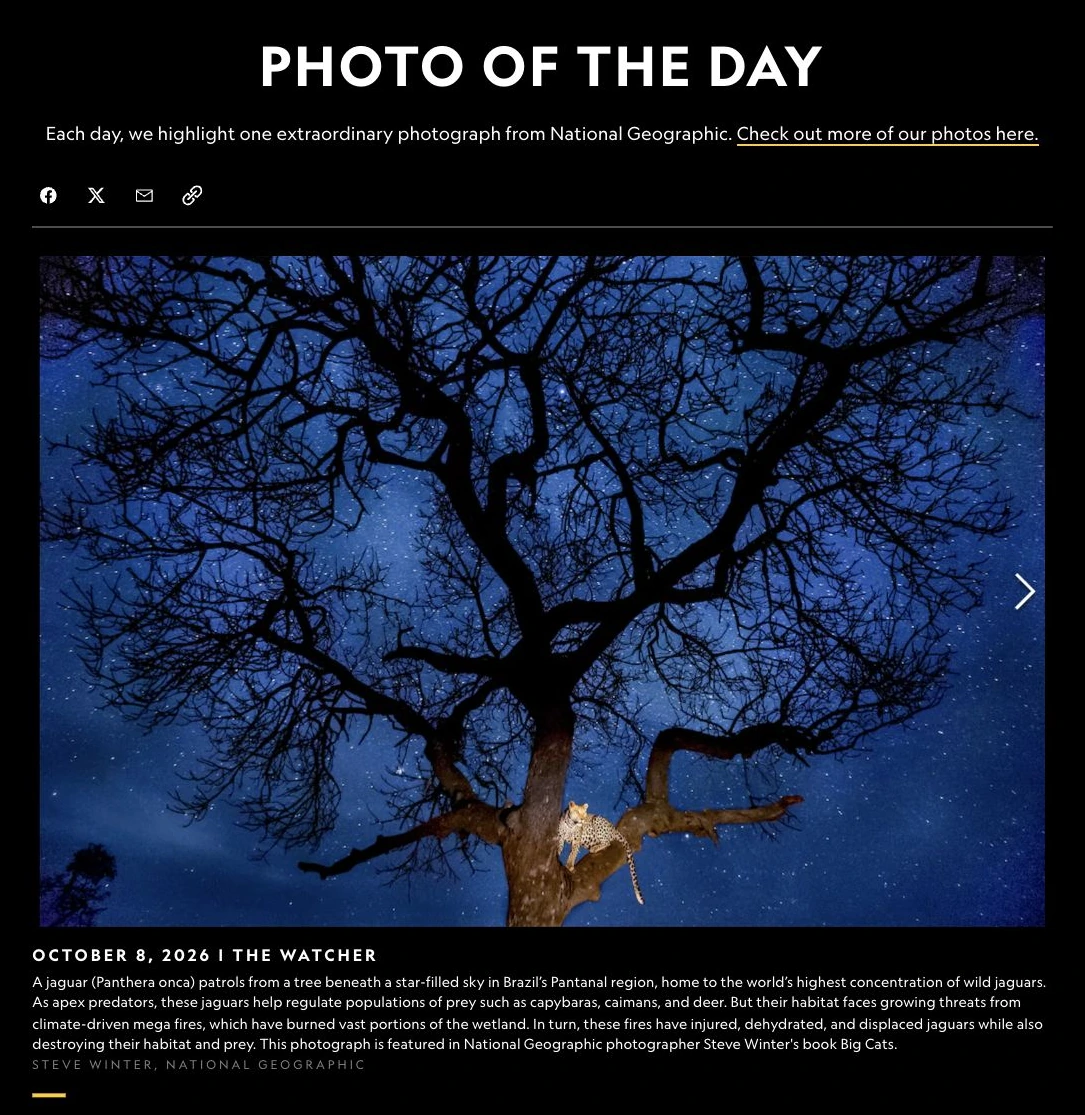
Image: screenshot of National Geographic's webpage. Photograph: Steve Winter, National Geographic. Photograph copyright remains with its rights holder. Original page
More Than One Way to Hunt
Jaguars prey on caimans as well as capybaras, deer and other animals. National Geographic's caption describes these apex predators helping regulate prey populations in a region with the world's highest concentration of wild jaguars.
One striking hunting technique involves the skull. A study of jaguar prey preferences, drawing on 25 studies and 3,214 kill records, cites earlier observations of jaguars knocking prey such as capybaras down and biting the back of the neck to puncture the skull. But their techniques vary with the prey. Large cats cannot be sorted into tidy camps of throat-biters and skull-biters.
Nor does that behavior establish that a jaguar's jaws evolved specifically to eat caimans. The prey study found important relationships with prey abundance and herd size. An impressive kill is an observation; an evolutionary explanation requires considerably more evidence.
This jaguar is not hunting in the photograph. The caption does not tell us how it reached the branch or whether a camera trap made the image. A compelling photograph need not come with an invented account of its making.
Three Percentages, Three Different Questions
The caption turns from the night sky to fire. Large fires in the Pantanal have injured and displaced jaguars, left them dehydrated, and destroyed habitat and prey. The Photo of the Day date is not the date of a fire, or evidence that this particular animal survived one.
A 2022 study in Communications Biology analyzed fire data from 2005 through 2020. In 2020, fire affected about 31% of the Pantanal's area.
Overlaying fire locations with estimated jaguar densities, the researchers calculated that areas occupied by about 746 jaguars were affected: roughly 45% of an estimated population of 1,668. That is an estimate of spatial exposure. It is not a count of 746 animals killed, injured or individually found in the field.
A different calculation used home ranges, the areas in which individual animals normally move. Thirty-eight of 48 GPS-derived home ranges overlapped the 2020 fires, or about 79%. The tracking data came from 2005-2016. Comparisons across years assumed stable densities and home ranges; researchers were not following all 48 animals through the fires in 2020.
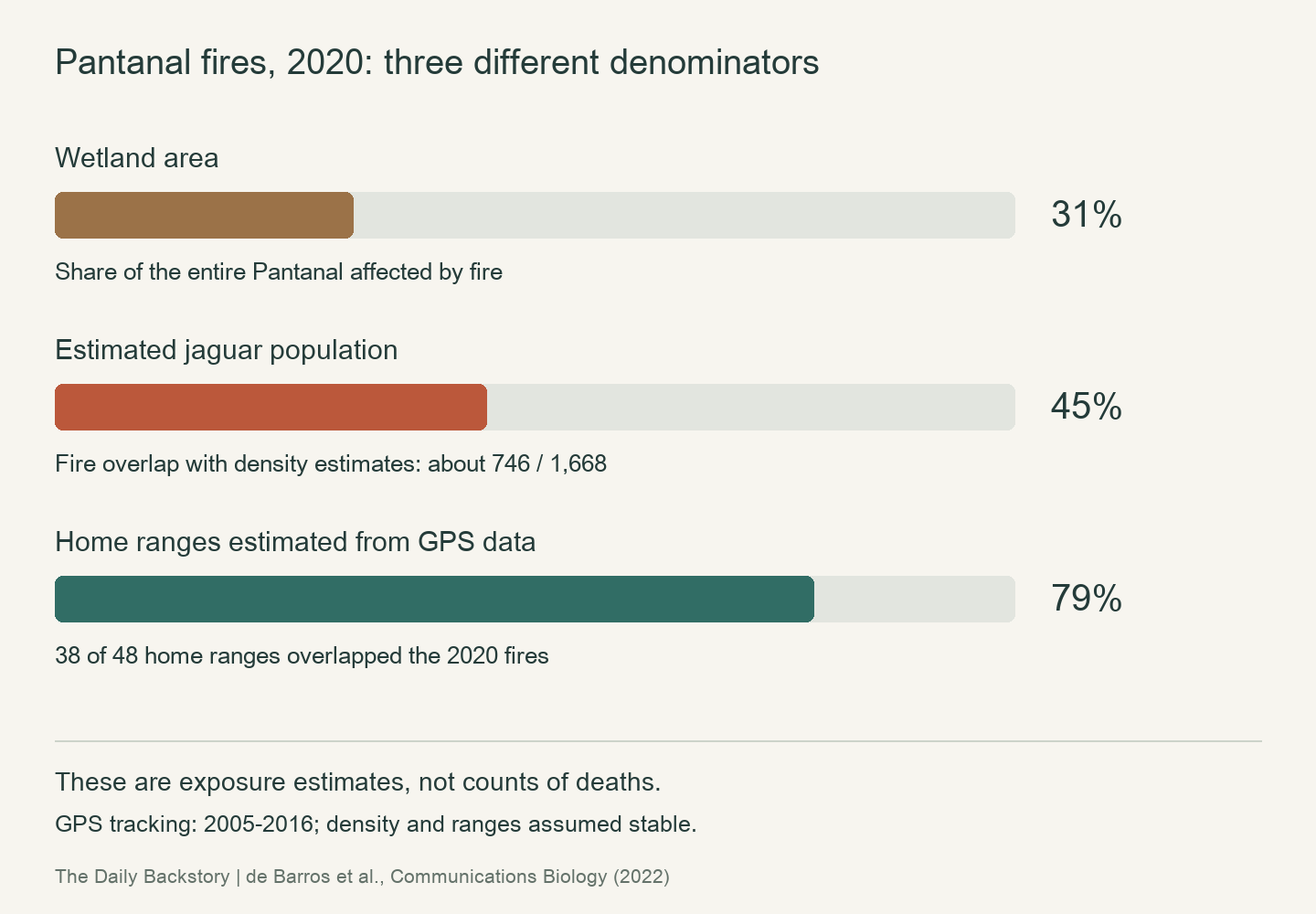
Illustration: The Daily Backstory, based on de Barros and colleagues' 2022 study. The percentages have different denominators; none is a mortality rate.
Fire was not spread evenly across the landscape. It overlapped places important to jaguars disproportionately. Protected status did not guarantee refuge, either: in the northern Brazilian Pantanal, an average of about 91% of protected land within the studied home ranges was affected by fire. That figure applies to a particular region and set of ranges, not all protected areas throughout the wetland.
Escaping the flames is only the first problem. The researchers discuss increased territorial conflict after displacement, reduced prey, dehydration and possible effects on reproduction. Those are risks and mechanisms, not outcomes measured in every exposed animal. Their recommendations include protecting water sources, expanding protected areas, regulating fire use and organizing fire brigades before the dry season.
Seeing an Animal, Following a Landscape
China offers another window into big-cat monitoring. An April 2025 report hosted by the National Forestry and Grassland Administration describes Northeast China Tiger and Leopard National Park combining ground-based infrared cameras, satellite remote sensing and drone patrols. The system supports species monitoring, patrols, wildlife alerts and forest-fire prevention.
A camera recording a leopard does more than deliver a rare sighting. Repeated observations help reveal where the animal moves and how it uses the land. A photograph lets us see an animal; sustained monitoring helps us see its relationship with a landscape.
The jaguar beneath these stars has formidable jaws. They cannot preserve its water, prey or forest. That work falls to people.
Sources and Context
The photograph, location and credit come from National Geographic's Original page. Hunting behavior and diet draw on the jaguar prey-preference study. Fire statistics and methodological limits come from the Pantanal jaguar fire study. The Chinese monitoring example is from the explicitly dated April 2025 report.