
A long exposure puts the motion of the sky and a night shift at sea into one frame.
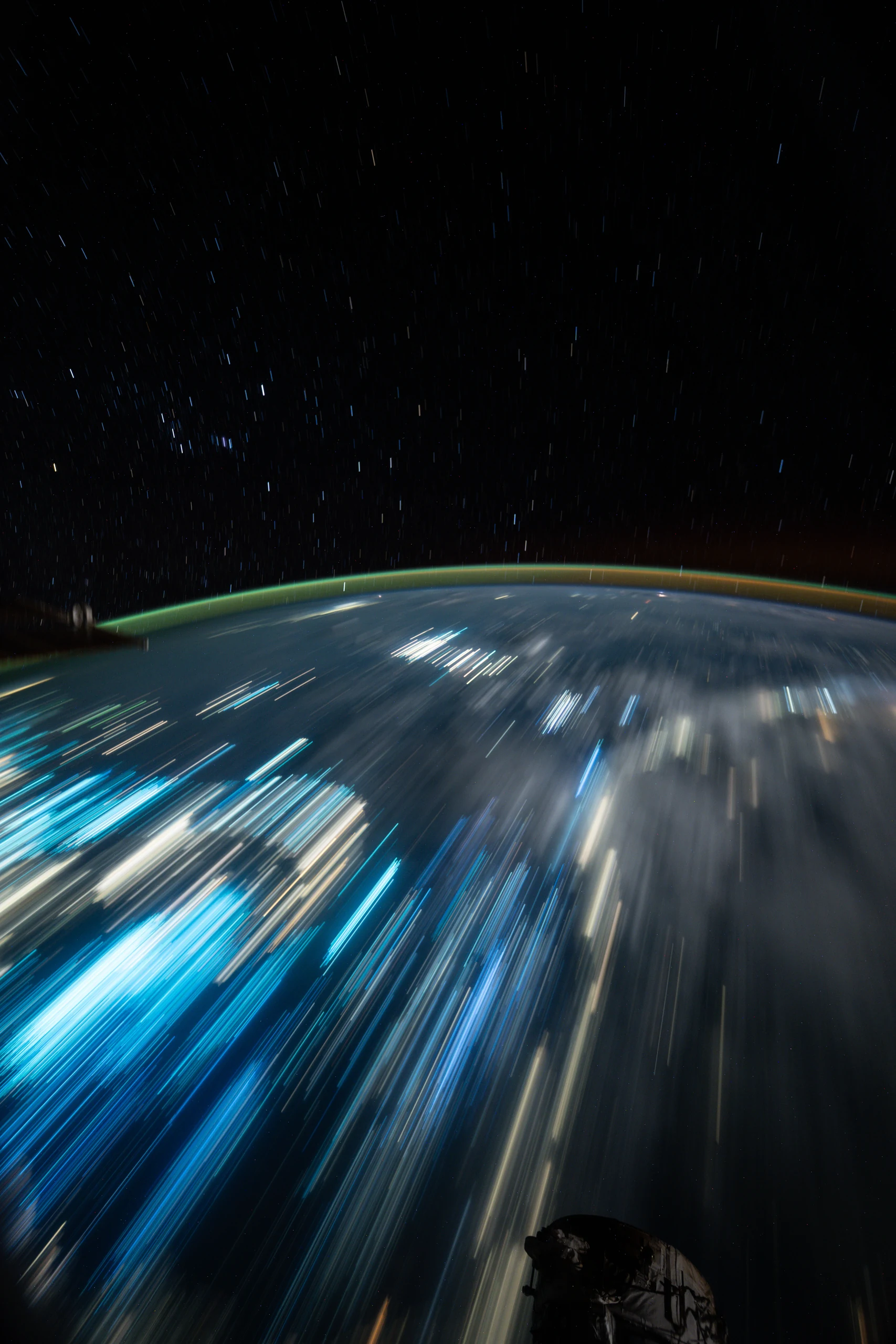
Image: NASA Image of the Day | Credit: NASA/Anil Menon | Original page
The photograph was taken on September 20, with the space station about 258 miles, or 415 kilometers, above the Banda Sea. NASA identifies the blue lights as fishing boats and the yellow ones as Indonesian cities.
The Camera Mount Is Moving
A camera fixed to the ground changes its direction in space as Earth rotates. Stars trace arcs across a long exposure. Point toward the north celestial pole and those arcs often appear to circle a point near Polaris.
The space station orbits Earth about once every 90 minutes. If a camera maintains an Earth-relative orientation as it travels, its direction also turns with the orbit. Comparing about 24 hours with about 90 minutes gives an angular-rate ratio of roughly 16 to one.
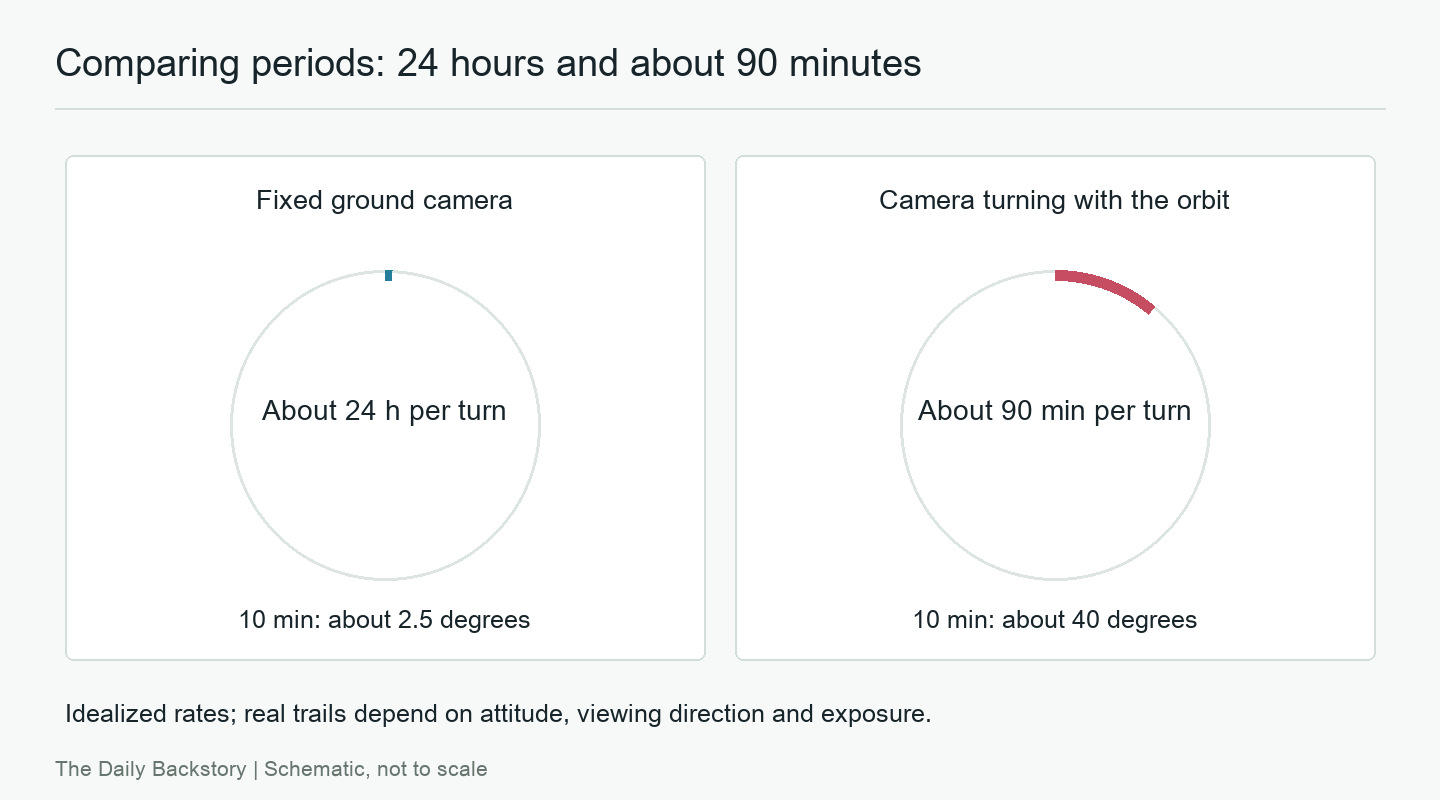
Diagram: The Daily Backstory; idealized periods, not a measurement of this photograph's exposure time.
That is not a universal multiplier for every station photograph. Stellar pointing, spacecraft attitude, exposure and stacking methods all change the trails. NASA's caption does not give the total exposure time, so the image cannot establish that a few minutes reproduced a whole night's ground-based photography.
What the Lights Are Doing
Fishing lights can attract fish or squid. They may affect plankton and prey concentrations, or directly influence the target animals' behavior. Not every light fishery follows the same sequence through a food chain.
The photograph shows illuminated boats. By itself, it does not reveal their nets, target species or catches.
A Seasonal Pause in Chinese Waters
China uses seasonal marine fishing closures. A 2023 agriculture ministry notice set different end dates by latitude for the Bohai, Yellow and East China seas and the South China Sea north of 12 degrees north. The closures began at noon on May 1.
The specified period ended on September 1 north of 35 degrees north, September 16 between 35 degrees and 26 degrees 30 minutes, and August 16 in the corresponding waters farther south. The notice also provided for special permits for certain methods and species, with additional arrangements for small fixed nets. It is a 2023 policy document, not a substitute for current local notices.
These lights are not direct evidence of a closure's effects. They do offer another scale of observation: individual decisions aboard boats accumulate into a pattern visible from orbit. A nightscape includes livelihoods at sea, not just streets on land.
Sources
NASA: Original page; China's 2023 notice adjusting seasonal marine fishing closures.