
Today's Bing wallpaper in China features Chinese lanterns celebrating the Mid-Autumn Festival. A paper-covered lantern is a remarkably inefficient source of illumination. Yet it has ruled East Asian nights for more than a thousand years.
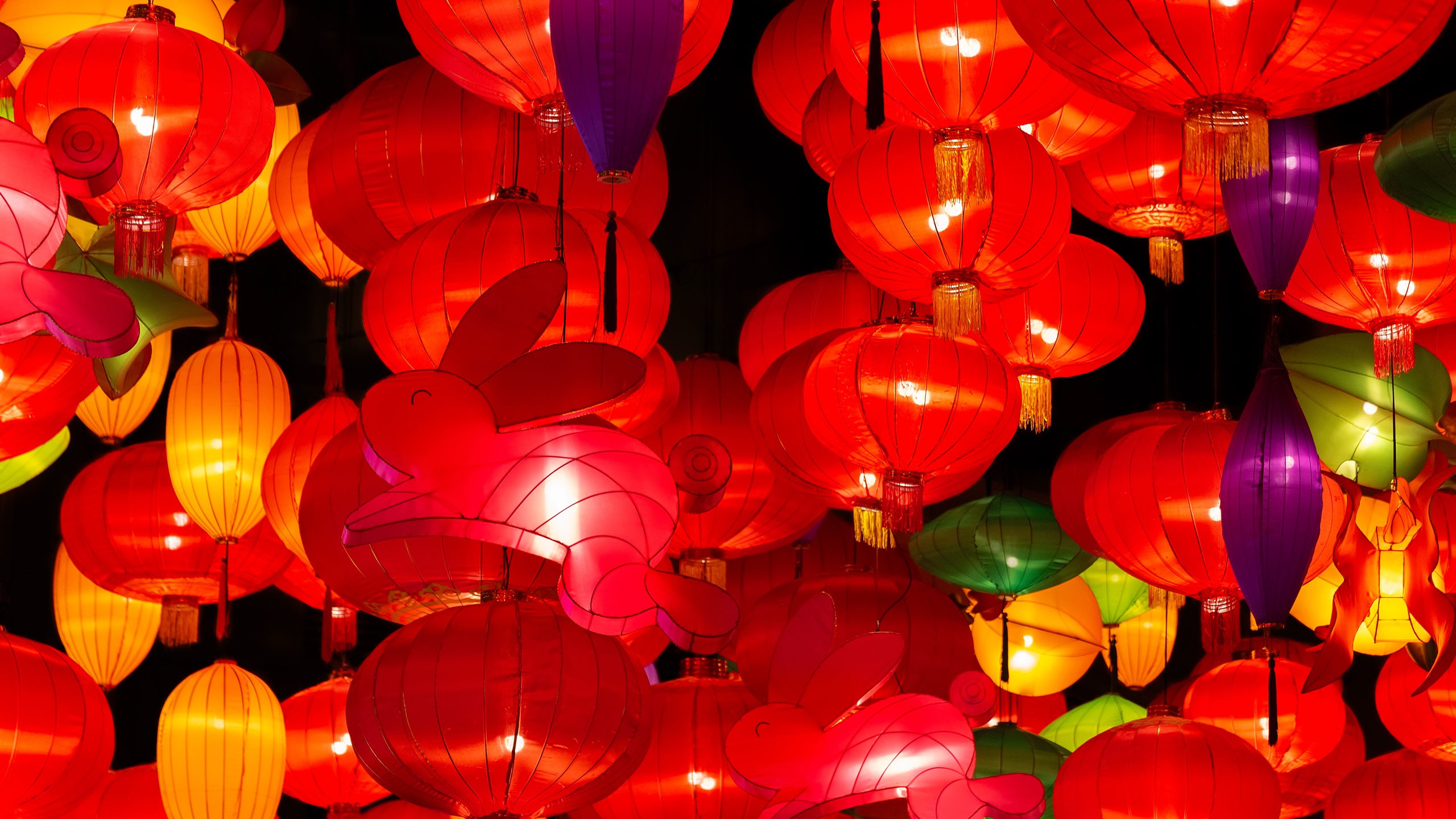
Image: Bing Daily Wallpaper | Chinese lanterns celebrating the Mid-Autumn Festival (© LeeYiuTung/Getty Images) | Original page

A string of red lanterns fills Bing's Chinese homepage today. Bing calls the picture "When the Moon Joins the Gathering."
Today is the Mid-Autumn Festival. Tonight, the lanterns will be lit. There is something curious about that: on the night when the moon receives the most attention, and the sky offers the most light, we insist on lighting more lamps below it. Dim lamps, at that. Wrap a candle in paper and much of its light is lost. As a lighting strategy, it is a poor bargain.
But illumination was never the whole point.
What Paper Does: Turning a Point into a Globe
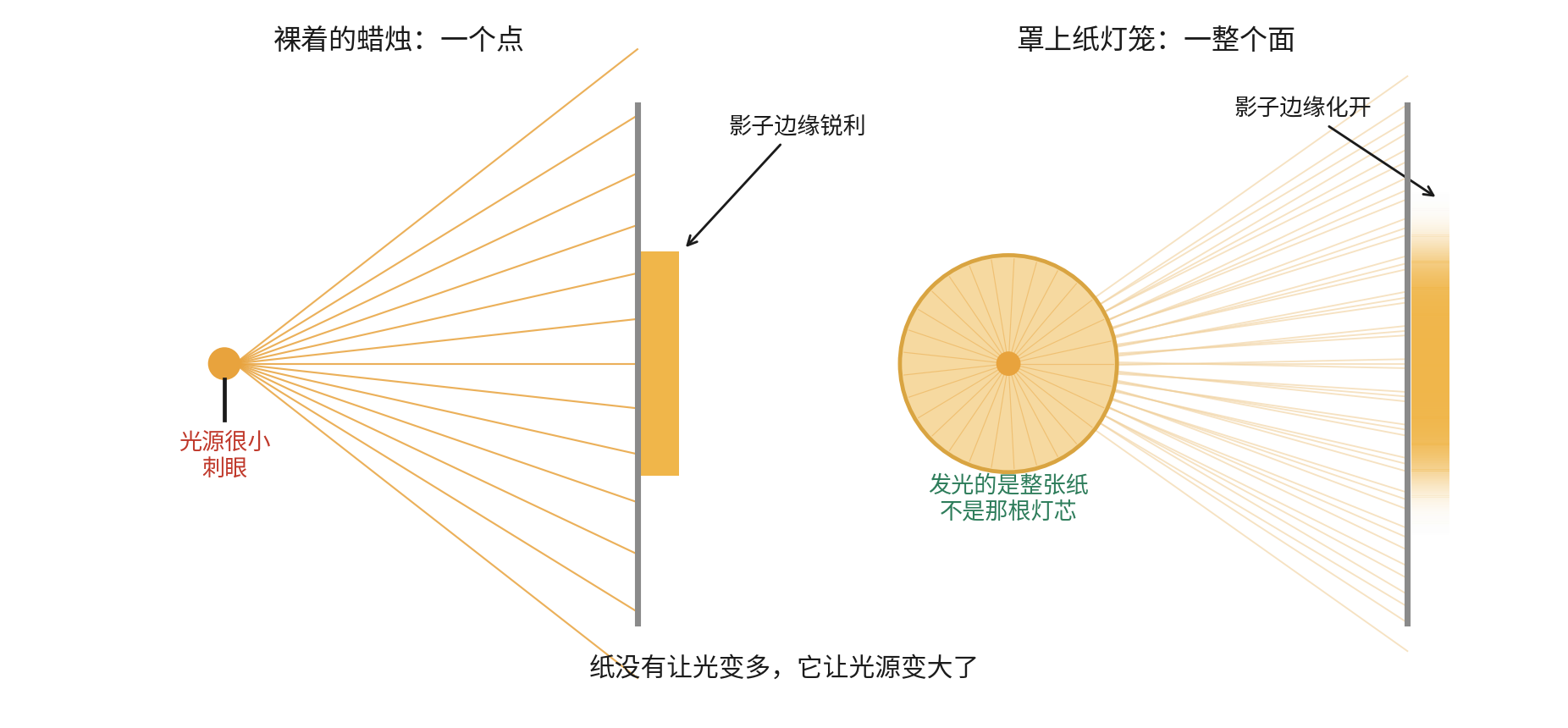
A bare candle is effectively a point of light. It casts shadows with edges as sharp as scissor cuts, and its illumination falls with the square of the distance: double the distance and only a quarter remains. Close up, it dazzles; a little farther away, things become hard to see.
Add a paper covering and something changes.
Paper does more than block light. It scatters it. Rays enter the fibers, scatter repeatedly, and emerge on the other side, a process called diffuse transmission. The apparent light source is now the entire surface of the lantern, rather than just its wick. A source the size of a pinhead has become one the size of a face.
Looking at a lantern, we see paper lit from within. The flame is hidden, leaving a whole surface of gentle light.
Photography textbooks describe the softness of light in terms of three variables: the size of the emitting surface, its distance from the subject, and the thickness of the diffuser. A lantern changes two at once. It enlarges the source and wraps it in a diffusing layer. Light from an extended source also does not fall away as quickly as light from a point source. The result is a glow comfortable to look at directly, with enough substance to flatter a face.
This is more than a retrospective explanation. Film lighting crews still buy paper lanterns to use as fixtures, calling them "china balls." Professional equipment makers sell spherical diffusers under the name "lantern softbox." After a long effort to develop the softbox, we found we already had one.
There is a lovely extension of this idea. In the spring of 1951, sculptor Isamu Noguchi visited Gifu, Japan, where he saw lanterns hanging from the bows of cormorant-fishing boats. Their washi paper was made from paper-mulberry bark, their frames from finely split bamboo. The Akari series he subsequently developed grew to more than a hundred designs over his lifetime. His aim was, in essence, to have a lamp retain about as much light within itself as it released. Half its accomplishment lay in holding light back.
How a Lantern Is Built
The official intangible cultural heritage description makes the process sound simple: bamboo strips are tied into a frame with twisted paper, then cut paper or silk is sprayed with water, stretched, and pasted onto it.
Two steps, with an entire craft between them. The Xiashi lantern tradition of Haining divides the work into eight operations: drawing, bending, cutting, binding, needle-piercing, mounting, pasting, and knotting. The official description praises the result as exquisitely intricate and translucent.
Even more surprising are the needle-pierced, frameless lanterns of Xianju in Zhejiang. There is no internal frame at all. Paper panels of different shapes and sizes are folded, fitted together, and glued into a lantern. Patterns are cut and pricked into the surface as tiny holes, rather than painted on. These are popularly known as "Tang lanterns."
A conventional paper lantern turns a point of light into a surface. The needle-pierced lantern reverses the process, breaking that surface into thousands of points, each hole a separate little source of light. When the lamp is lit, the pattern itself glows. A sheet of paper becomes a field of stars.
Quanzhou in Fujian has its own clear line of craftsmanship. Li Yaobao pioneered cut-paper lanterns, which later developed into lanterns with glass filaments fitted into their openwork patterns. In 1978, Cai Binghan made Quanzhou's needle-pierced, frameless lanterns.
Quanzhou lanterns, Xianju lanterns, and Xiashi lanterns all entered China's first national intangible cultural heritage list in 2006, under the same project number, VII-50, in the traditional fine arts category. Nanjing's Qinhuai Lantern Festival belongs to a different category: folk customs, project X-50. The first three recognize how an object is made; the fourth recognizes how a community celebrates.
The Lantern That Turns Itself
In Meng Liang Lu, the Southern Song writer Wu Zimu listed the goods sold at Lin'an's night markets. Among them were "running-horse lanterns." The book dates to around 1274, or 752 years ago.
The mechanism is as neat as a physics exercise. A candle heats the air around it. Rising air pushes a ring of paper vanes at the top of the lantern, turning a shaft fitted with paper figures of people and horses. Their shadows fall on the lantern wall, where a procession begins to circle.
No electricity, no wound spring: a candle supplies the heat, and moving air supplies the motion.
A widely repeated claim, attributed to Joseph Needham, calls the running-horse lantern an ancestor of the gas turbine or hot-air balloon. That attribution has been misquoted in several places. Needham's original discussion concerned its relationship to moving-image devices. The demonstrable mechanical fact is that rising hot air drives the vanes. Calling it an ancestor of a heat engine is a later analogy, rather than a statement established by the historical record.
The Most "Traditional" Red Lantern Is Surprisingly Young
For many people in China, the definitive red lantern is one of the eight hanging from Tiananmen Gate.
Their history begins much later than many assume. In 1949, Zhang Ding, Zhong Ling, and Zhou Lingzhao drew renderings for the gate's decoration. The finished lanterns measured more than two meters across. Carpenter Yin Zuobin led their construction, but lanterns also required a bamboo craftsman, so Li Dongxue of Huameizhai was brought in to help build the frames. Those eight lanterns remained in place until 1994, when they were replaced with versions using folding steel frames.
That supposedly timeless image was a modern design, barely a few months older than the People's Republic itself.
The most telling detail is the craftsman. Even for an entirely new design, even for objects more than two meters across, someone who knew how to split bamboo still had to be called in. The old skill remained indispensable.
One Idea, Many Forms
Bamboo, paper, a little fire: materials available across East Asia gave the same idea different local forms.
Gifu lanterns use thin Mino washi paper and exceptionally fine bamboo strips. Official accounts describe a history of more than 300 years; they were designated a traditional craft in 1995. Noguchi's Akari grew from this tradition.
Korea's Yeondeunghoe, the lantern lighting festival, entered UNESCO's Representative List of the Intangible Cultural Heritage of Humanity in 2020. It takes place in a different season, on the eighth day of the fourth lunar month, the Buddha's birthday. Colorful lotus lanterns fill the streets, and participants carry lanterns they have made themselves in a procession. The official account describes lighting them as illuminating the hearts of individuals, communities, and society as a whole.
Different seasons, beliefs, and shapes, with the same thought at their center: make the light gentler.
Sources
China Intangible Cultural Heritage Network entries on Quanzhou lanterns, Xianju lanterns, Xiashi lanterns, and the Qinhuai Lantern Festival; the Noguchi Museum's official Akari history; the Japanese government's Highlighting Japan, on Gifu lanterns; UNESCO's Representative List entry for Yeondeunghoe; People's Daily's Communist Party of China News website, on the Tiananmen Gate lanterns; Handian, citing the Hanyu Da Cidian entry quoting Meng Liang Lu on running-horse lanterns; Hong Kong SAR government press releases on the Mid-Autumn lantern carnival and road closures around Tai Hang; Hong Kong's Intangible Cultural Heritage Office, on the Tai Hang fire dragon dance; the General Office of China's State Council, 2026 public holiday arrangements; and Science Buddies, "Black in the Spotlight."