
An animation, a star discovered only three years ago, and a hole that no human being can ever see.
Open NASA Astronomy Picture of the Day today and the object in the center of the page moves.
It is not a photograph but a 23-second animation: a tiny black patch of sky where several bright points circle at an unhurried pace as observing dates tick forward in one corner. One point behaves unlike the others. As it approaches the middle, it suddenly accelerates, as though something had yanked it hard, flinging it onward before it slows again. The thing pulling it is completely absent from the frame.
The point is S301, a star. The empty place at the center is Sagittarius A*, the supermassive black hole at the center of the Milky Way. The animation assembles four years of observations into an orbit. The European Southern Observatory released it on August 19 alongside a paper. That same day, Nature published the GRAVITY+ Collaboration's paper with the direct title "Discovery of a Star Sensitive to the Spin of Sagittarius A*."
The Invisible Ruler in the Frame
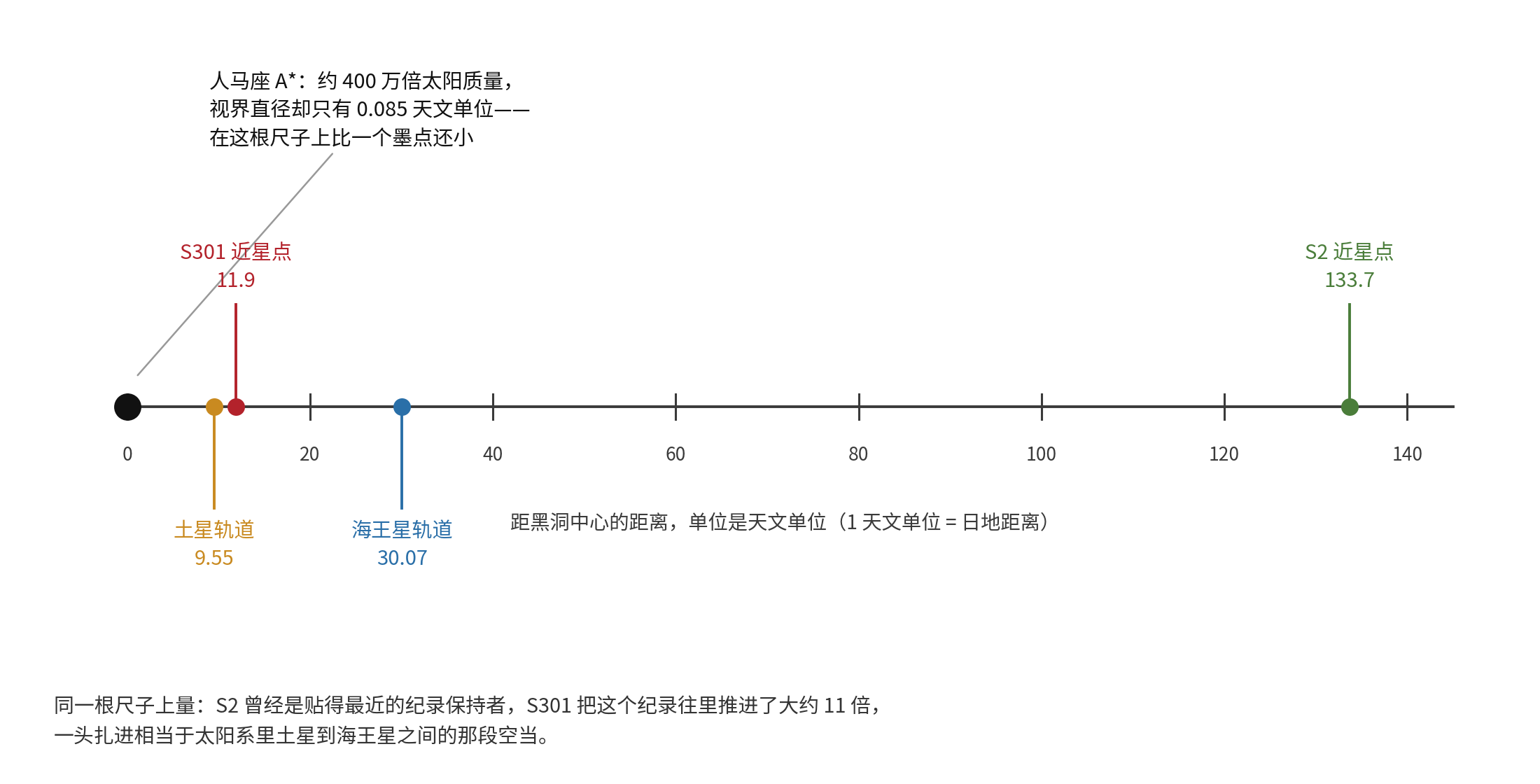
The reference scale in the animation is worth noticing. ESO explains on the video page that other stars orbit the same black hole, but none comes as close as S301. To show how small its orbit is, the makers drew in the size of Neptune's orbit.
That is a restrained comparison. Neptune lies about 30 astronomical units from the Sun, the very idea of the Solar System's outer reaches. At its closest approach to the black hole, S301 comes within about 1.78 billion kilometers, or roughly 12 astronomical units, according to ESO's release. That is less than half the radius of Neptune's orbit.
Three descriptions can be set side by side. APOD compares the distance with that from Saturn to the Sun. ESO gives 1.78 billion kilometers, or roughly 12 astronomical units. The paper gives 136 to 142 Schwarzschild radii. Saturn actually lies at 9.55 astronomical units, so APOD's wording is a slightly tight approximation; all three descriptions agree in scale, while the paper provides the firmest figure. For a mass of four million Suns, Sagittarius A* has a Schwarzschild radius of about 12.7 million kilometers, less than 0.09 astronomical units. S301, in other words, dives to about 140 times the black hole's "size."
Why a Little Closer Is So Valuable
To understand why this star matters, begin with its predecessor.
The tiny region around the Galactic center contains a population of stars numbered S1, S2, S3, and so on, collectively called the S-star cluster. The best known is S2, with an orbital period of about 16 years. In May 2018, S2 made its closest approach at more than 25 million kilometers per hour, nearly 7,000 kilometers per second. ESO described that as "close to 3% of the speed of light." It passed within 20 billion kilometers of the black hole. In July 2018, ESO announced that the passage had produced humanity's first measurement of gravitational redshift in a star orbiting a supermassive black hole: the gravitational field stretched the wavelength of the starlight. The team had observed continuously for 26 years to await that moment.
Two years later, the same team announced that S2 does not trace a closed ellipse. Its orbit makes a rosette, with the ellipse's long axis turning slightly on each circuit. The effect is called Schwarzschild precession, predicted by Einstein's general theory of relativity a century ago. In October 2020, the Nobel Prize in Physics went to Roger Penrose, Reinhard Genzel, and Andrea Ghez. Penrose received half for showing that black-hole formation is a robust prediction of general relativity. Genzel and Ghez each received a quarter for discovering the supermassive compact object at the center of our galaxy.
Now it is S301's turn. Its orbit has a semimajor axis on the sky of only 83 milliarcseconds, a period of 8.7 years, and an eccentricity of 0.9832. It follows an extremely long, narrow ellipse, spending most of its time moving slowly at a distance before sprinting through periapsis at a peak speed of about 25,000 kilometers per second.
This is the mechanism behind the whole result. One number explains it: 25,000 kilometers per second is 8.34 percent of the speed of light, or about one-twelfth. The paper's abstract says that already measured relativistic effects, gravitational redshift, transverse Doppler shift, and Schwarzschild precession, appear at second order in v/c, while corrections caused by the black hole's spin appear at third order. With v/c about one-twelfth, every additional factor makes the effect twelve times smaller. The only way to extract that signal from the noise is to raise v/c itself by finding a star that moves faster and comes closer. S2 reached 134 astronomical units; S301 reaches 12, an inward leap of roughly eleven times.
A spinning black hole drags the surrounding spacetime with it, an effect called frame-dragging or Lense-Thirring precession. The orbital plane of anything circling the black hole is slowly carried around. The paper gives a curious figure: S301's orbital plane would take about 58,000 years to make one complete turn. That sounds impossible to measure, but astronomers do not need the full turn. They need the tiny accumulated offset at each passage through periapsis. ESO judges that continued monitoring of S301, combined with future spectroscopy from the Extremely Large Telescope, could directly measure the spin of Sagittarius A* within about a decade. One participant put the practical difference plainly: without this star, the same measurement would take many more decades.
S301's next periapsis passage will occur in 2031. Its previous one came in early 2023, and the star was first seen in spring 2023. Humanity discovered it just after its sprint past the black hole.
How did it enter such an orbit? The paper offers an equally dramatic hypothesis. Its extreme eccentricity suggests that S301 was once one member of a binary. The black hole's tidal force tore the pair apart, ejecting one star and capturing the other on this narrow orbit. This is called the Hills mechanism. S301 is the one that remained.
Four Telescopes Become One Eye
The Galactic center lies more than 20,000 light-years away, in a tiny patch of sky crowded with stars. How can one of them be isolated and its position recorded year after year?
The answer is interferometry. At ESO's Paranal Observatory in Chile stand four 8.2-meter Unit Telescopes of the Very Large Telescope. They do not have to work independently. The Very Large Telescope Interferometer combines their light and lets the waves interfere. ESO says the four 8.2-meter telescopes can provide the resolving power of a 130-meter telescope. With the four movable 1.8-meter Auxiliary Telescopes, which can occupy 30 positions around the site, the theoretical equivalent can reach 200 meters. The longest baseline currently used is about 140 meters, depending on where the auxiliary telescopes stand. In practical terms, the system resolves detail about seventeen times finer than a single 8.2-meter telescope. ESO's comparison is the ability to separate the two headlights of a car parked sideways on the Moon.
GRAVITY is the instrument built for this work. It operates in the near-infrared K band from 2.0 to 2.4 micrometers. Its imaging resolution is about 4 milliarcseconds, while its astrometric precision, its ability to measure celestial positions, reaches tens of microarcseconds. One microarcsecond is one 3.6-billionth of a degree. That precision turns the question "how far did a star move across the sky?" into a quantity that can be recorded year by year.
How difficult is S301 to see? The paper gives its K-band magnitude as 19.3. This main-sequence star is so faint that only the upgraded GRAVITY+ can follow it reliably. Its four-year orbit was accumulated one frame at a time by four eight-meter-class telescopes working together.
The Brightest Milky Way Hides an Invisible Hole
There is something strange about this direction in the sky.
From Earth, the Galactic center lies in the brightest, thickest, busiest part of the Milky Way, where stellar density far exceeds that in other directions. Yet the naked eye, an ordinary telescope, or any visible-light instrument cannot see a single star at the true Galactic center, much less its black hole.
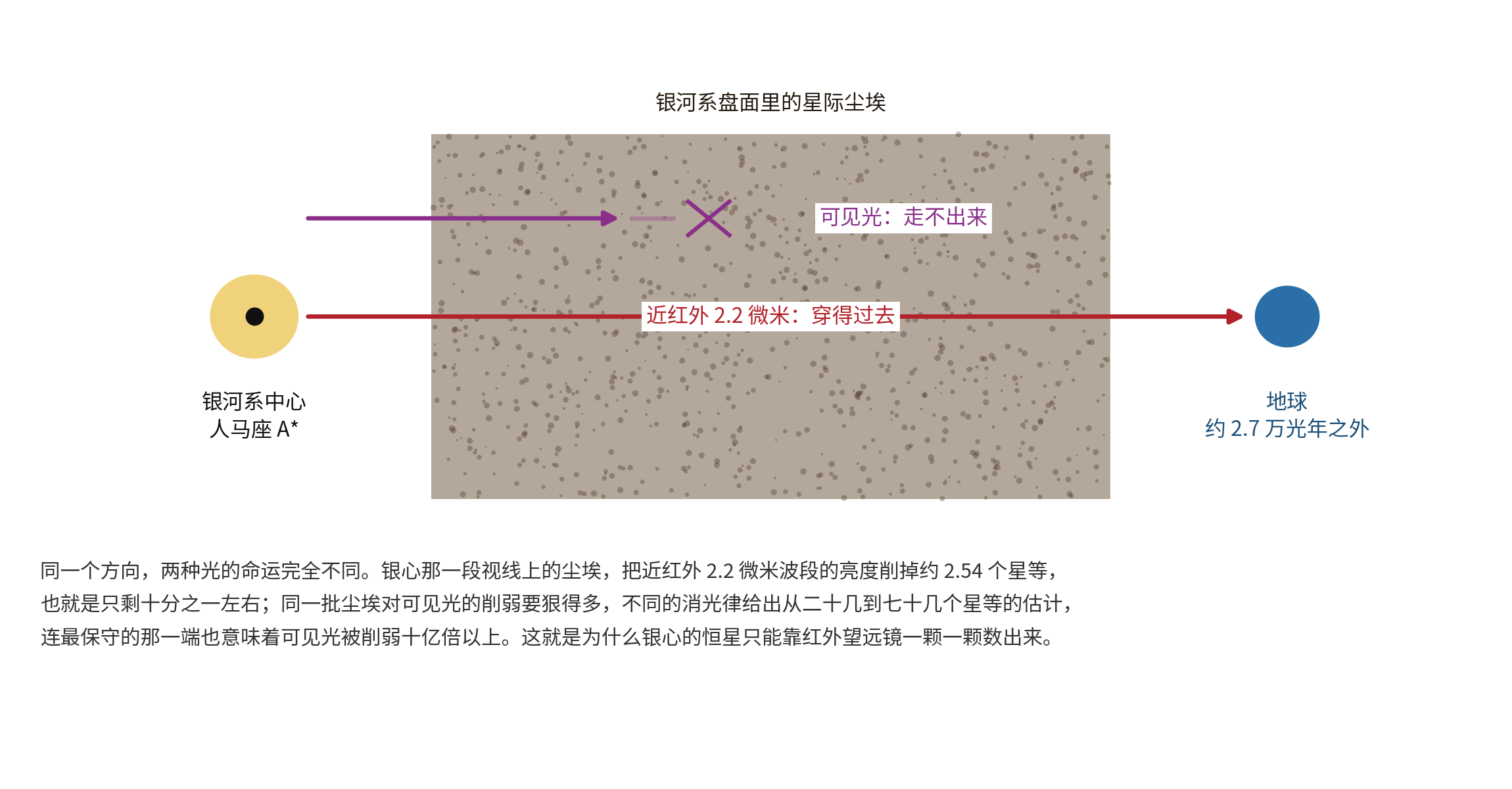
Dust gets in the way. Interstellar dust fills the Milky Way's disk, and we sit inside that disk. Looking toward the center means looking sideways through more than 20,000 light-years of dusty material. The layer is nearly opaque to visible light.
How severe is it? A 2010 measurement by Schödel and colleagues in Astronomy & Astrophysics found 2.54 magnitudes of extinction in the near-infrared Ks band within one parsec, about 3.3 light-years, of the Galactic center. Roughly one-tenth of the light gets through. For visible light, the same paper says that the ratio between visible and K-band extinction remains disputed: published figures include about 9, 16, and 29. Those extinction laws imply visible-light extinction from the twenties to more than seventy magnitudes. Even the most conservative end weakens visible light by more than a billion times. At the aggressive end, the factor takes dozens of digits to write. The estimates differ enormously, yet their conclusion is identical: visible light cannot get through.
The history of Galactic-center research is therefore a history of changing wavelengths. Near-infrared light penetrates dust, so GRAVITY counts stars around 2.2 micrometers. Radio wavelengths are longer and more penetrating still. On May 12, 2022, the Event Horizon Telescope used eight radio observatories around the world to image Sagittarius A* itself: a bright ring surrounding a dark central shadow.
That picture belongs beside its predecessor. On April 10, 2019, EHT released the first image of a black hole, M87* at the center of galaxy M87, 55 million light-years away and about 6.5 billion times the mass of the Sun. Sagittarius A* has only four million solar masses and is more than a thousand times smaller. The two objects inhabit entirely different kinds of galaxy. Yet close to their event horizons, the images look remarkably alike. EHT Science Council co-chair Sera Markoff's assessment, in essence, was that the edges of black holes looked astonishingly similar.
From China: A Great Ear and a Public Correction
No mainland Chinese station participated in EHT's 2017 observing array for Sagittarius A*, but Chinese telescopes have contributed in this direction by a different route.
Shanghai Astronomical Observatory's 65-meter Tianma radio telescope belongs to the East Asian VLBI Network, or EAVN, an interferometric network of 21 radio telescopes in China, South Korea, and Japan. According to the National Astronomical Data Center, the network observed Sagittarius A* at 1.3-centimeter and 7-millimeter wavelengths in April 2017. The Instituto de Astrofísica de Andalucía in Spain led the study with participation from Shanghai Astronomical Observatory, and the results appeared in The Astrophysical Journal. After removing the effects of interstellar scattering, the researchers found the intrinsic structure of Sagittarius A* to be nearly circular and inferred that the rotation axis of the accretion flow points almost directly at Earth. The account gives Tianma a specific role: it is the network's largest millimeter-capable dish, with a collecting area greater than those of all the network's other telescopes combined.
But another story better captures the other side of today's animation.
The most classical way to measure a black hole's mass is not to look at the hole but at a star pulled around by it. This is how the Galactic center's S stars are used, including S301. On November 28, 2019, a team led by Liu Jifeng at the National Astronomical Observatories of the Chinese Academy of Sciences published a paper in Nature. Using the Large Sky Area Multi-Object Fiber Spectroscopic Telescope, or LAMOST, survey, they found an unseen companion in the binary LB-1 and inferred a mass of about 70 Suns. Stellar-evolution theory at the time said that a stellar-mass black hole this heavy should not exist in the Milky Way. The result drew international attention.
Then came the best part of science. On April 29, 2020, Nature published two papers in the same issue. In one, Abdul-Masih and colleagues from KU Leuven, the Royal Observatory of Belgium, and other institutions challenged the result. They argued that the shift in the Hα line used to infer the black hole's mass was actually caused by the B-type companion's own orbital motion, leaving no evidence of a massive black hole in the data. The other was a response from Liu's team. They did not entirely abandon their original interpretation but revised the preferred mass range to 23 to 65 Suns and said that distinguishing the explanations conclusively would require more astrometric data from Gaia.
In 2021, El-Badry and Quataert offered a new picture in Monthly Notices of the Royal Astronomical Society. The similar system HR 6819 contained no black hole but a rapidly rotating Be star paired with a stripped helium star that was still contracting. They argued that LB-1 was likely the same kind of system. The prevailing astronomical view no longer treats LB-1 as an example of a 70-solar-mass black hole.
There is no villain in this story. One team used a telescope it had built to propose a bold result. Other teams publicly dismantled and checked it point by point. The original team responded publicly and revised its numbers. The exchange appeared in one issue of the same journal. Measuring the spin of the Galactic-center black hole follows exactly the same rules: state how small the predicted effect is, state the precision of the instrument, then patiently observe for ten years.
Sources: NASA APOD for August 21, 2026, text by Cecilia Chirenti, NASA GSFC/UMCP/CRESST II; ESO release eso2612 and video page eso2612b; the GRAVITY+ Collaboration paper "Discovery of a Star Sensitive to the Spin of Sagittarius A*," Nature, August 19, 2026; official ESO pages for the Very Large Telescope Interferometer and GRAVITY; ESO releases eso1825 (2018) and eso2017 (2020); the official Nobel Prize page for the 2020 physics prize; ESO releases eso1907 (2019) and eso2208 (2022); Schödel et al.'s 2010 Astronomy & Astrophysics measurement of Galactic-center extinction; the GRAVITY Collaboration's 2019 Astronomy & Astrophysics measurement of the distance to the Galactic center; the National Astronomical Data Center's account of Tianma and EAVN observations of Sagittarius A*; LAMOST's official November 28, 2019, release; the April 29, 2020, Nature challenge and author response concerning LB-1; El-Badry and Quataert, Monthly Notices of the Royal Astronomical Society (2021); US Naval Observatory lunar phase and rise-set data; and NASA eclipse tables.