
One still pool, two kinds of bubbles, and a craft that began 250 years ago.
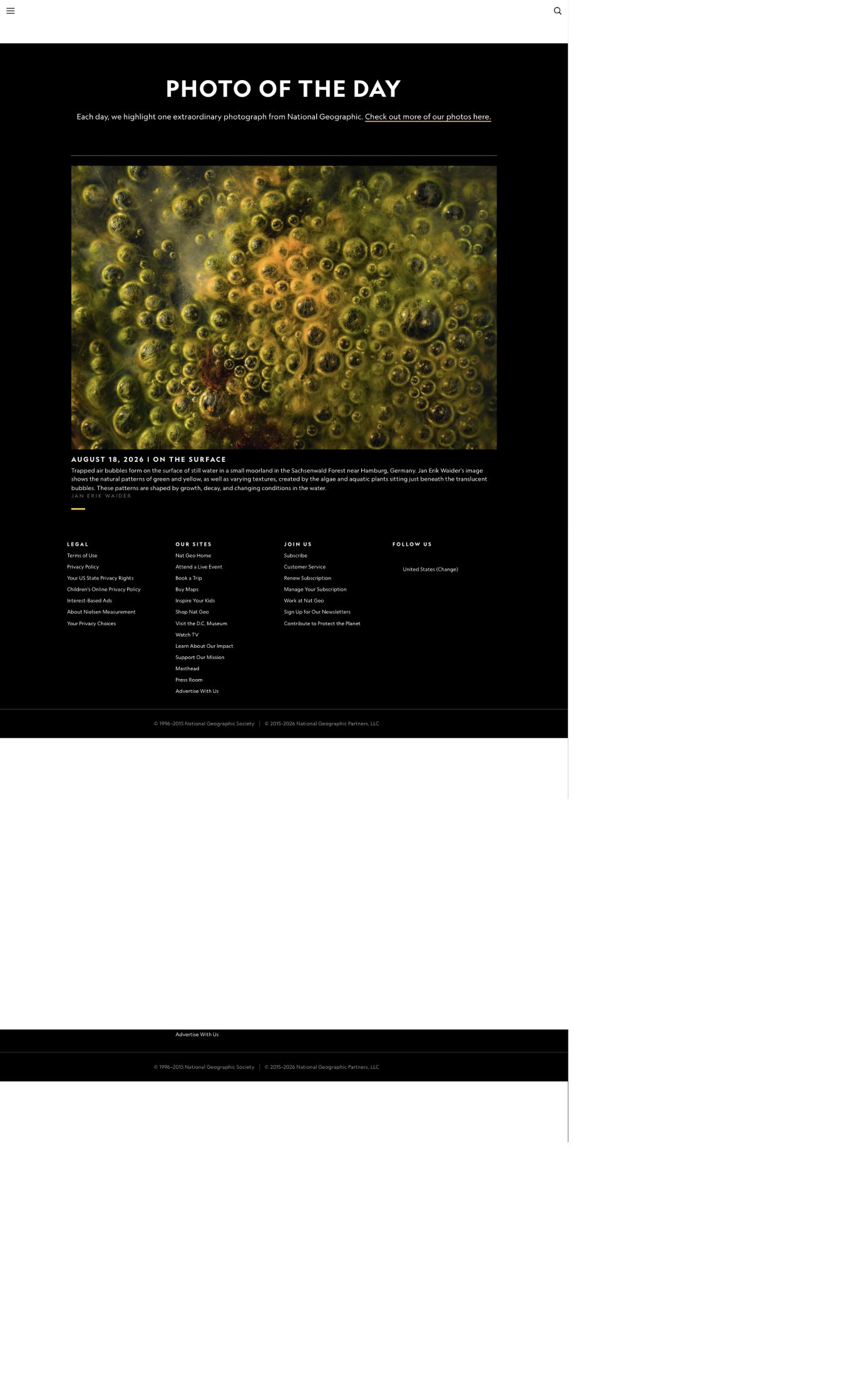
Screenshot: National Geographic Photo of the Day | Photograph: Jan Erik Waider | Original page
Today's National Geographic Photo of the Day has no mountain, no animal, and no faraway view. It contains only a small patch of water.
Jan Erik Waider photographed a small bog in the Sachsenwald forest near Hamburg, Germany. According to the caption, a translucent layer of trapped bubbles floats on still water. Beneath it, algae and aquatic plants show through in green and yellow patterns and textures of varying depth. The caption offers a fine summary: the patterns were shaped by growth, decay, and constantly changing conditions in the water.
It is a photograph in which almost nothing seems to happen. Once the bubbles are understood, however, the water becomes a machine in motion.
The Bubbles Have at Least Two Sources
The first is the bog burping.
Peat remains waterlogged, leaving almost no oxygen below the surface. Fallen leaves, broken branches, and dead moss sink into it. Instead of decomposing through oxidation as they would in forest soil, they are slowly fermented by anaerobic microorganisms. The products include methane, or marsh gas, as well as carbon dioxide. Measurements of peat bubbles have found an average composition of 45 percent methane, 12 percent carbon dioxide, and more than 40 percent nitrogen. Bog bubbles are never pure methane.
Wetland science has a name for the process by which bubbles break free from the mud and rise in strings: ebullition. It is not normally the main route of methane emissions. In three years of measurements at a northern Finnish raised bog, ebullition accounted for only 2 to 8 percent of total methane emissions during the growing season. But it can abruptly take over when atmospheric pressure falls. In one experiment, ebullition supplied 67 to 95 percent of total emissions during five episodes of falling pressure. It occurred almost entirely while the pressure was dropping, and a larger drop produced more bubbling.
That measurement supports a useful inference: bogs and pond bottoms bubble most vigorously before a storm.
The second source is aquatic plants in sunlight.
This matches the caption's observation that algae and aquatic plants lie just beneath the translucent bubbles. During the day, submerged plants and algae photosynthesize and release oxygen. At a depth of 0.3 meters, measurements have found oxygen concentrations of 21 to 45 percent in these photosynthetic bubbles. They are not pure oxygen either, because dissolved nitrogen diffuses into them. Curiously, no bubble formation was observed below a depth of 4.5 meters, while raising the concentration of carbon dioxide in the water sharply increased bubbling.
Which kind appears in this photograph? The honest answer is that we cannot know. The caption says only that the bubbles were trapped; no gas analysis was performed. Both kinds commonly coexist in still water.
Why do they not burst? A still surface often carries a thin biofilm, a mat of filamentous algae, or duckweed. Rising bubbles press against that layer and become trapped, clustering like bubble wrap made of water. Research has also found that oxygen-rich bubbles can be stabilized by an algal mat, while the bubbles in turn shape the mat. Pattern and gas shape each other. That is the physical meaning of the caption's phrase about growth, decay, and changing conditions.
Three Ways to Tell Them Apart
First, consider the time. Bubbles that appear only in sunlight, stop after dark, and rise directly from green leaf surfaces are oxygen from photosynthesis. It is the same principle as the familiar school experiment in which an aquatic plant releases oxygen, relocated from the laboratory to a pond.
Second, consider the path. Strings of bubbles rising from bottom mud, especially after the sediment has been disturbed, are more likely to contain methane. They are most abundant in late summer and during wet, low-pressure weather.
Third, consider winter. Strings or columns of white bubbles frozen into northern lake ice contain methane. A column of bubbles insulates the ice immediately above it, slowing its growth and leaving a water-filled depression beneath the bubble channel. These structures can even be identified by satellite radar.
Smell is not a reliable test. Methane itself is odorless. A bog's foul smell comes from trace constituents such as hydrogen sulfide. Teaching that a bad smell identifies methane substitutes a false criterion for a real one.
Why the Water Is Tea-Colored and Barely Decays
Bog water gets its tea-brown color from humic acids and tannins, which also make it acidic. Water in a sphagnum bog often has a pH of 3 to 5.
Much of that acidity is made by sphagnum moss itself. The plant takes mineral cations from the water and releases hydrogen ions into its surroundings, making the water increasingly acidic and hostile to competitors. There is an important caveat: the claim that cation exchange is the principal mechanism of peatland acidification remains disputed, and a paper has specifically challenged it.
Acidity, lack of oxygen, scarcity of nutrients, and a sphagnum compound called sphagnan, which can suppress nearly all microbial activity, combine to bring decomposition almost to a halt. Dead plants do not rot away. They accumulate in layers and become peat.
How quickly? Less than one millimeter a year, or about one meter per millennium. Europe's oldest peatlands are 11,000 to 12,000 years old, with peat more than 10 meters deep.
Sphagnum is also remarkably good at holding water. It can retain more than 20 times its dry weight in liquid, twice the absorption capacity of cotton. The reason is straightforward: about 90 percent of its cells are dead, empty chambers specialized for water storage.
The Same Chemistry Saved Soldiers and Preserved a Face
Human beings have used sphagnum's combination of absorbency, acidity, and antimicrobial action in two very different directions.
One was on the battlefield. During World War I, a shortage of cotton dressings led combatant countries to sphagnum, which absorbed more and brought its own antimicrobial properties. In 1916, the Ontario Division of the Canadian Red Cross produced more than one million dressings in a single year. By 1918, Britain was sending one million moss dressings each month to hospitals in Europe, Egypt, and Mesopotamia. Newspapers published calls for "moss drives." Women and children gathered sphagnum from bogs, then forced out its water by "dancing" on sacks of it.
The other use happened beneath a bog. In 1950, a body was dug from a peat bog on Denmark's Jutland peninsula: Tollund Man. He died by hanging between 405 and 380 BCE, more than 2,400 years ago. He was in his thirties or forties and stood about 1.6 meters tall. His final meal remained in his stomach: barley porridge mixed with wild seeds, flax, and fish. Most unsettling of all, his face survived, down to his eyebrows and the creases around his mouth. The lack of oxygen, high acidity, and the acidic sugar molecules released by sphagnum that deprive microbes of nutrients pressed pause on decay.
The same chemistry staunched soldiers' wounds and preserved the expression of a man from the Iron Age.
Another Danish bog body offers a correction worth remembering. Grauballe Man, discovered in 1952, was initially believed to have suffered ritual violence because his skull showed severe damage. Modern analysis supplied another explanation: the weight of the surrounding peat caused the injuries. A bog preserves evidence, but it can also manufacture it.
A Forest Given Away by an Emperor
The place where the photograph was made has its own history.
Sachsenwald covers about 70 square kilometers and is the largest continuous woodland in the German state of Schleswig-Holstein. It consists mostly of broadleaf forest. On June 24, 1871, Kaiser Wilhelm I gave it to Otto von Bismarck as a reward for bringing about German unification. Most of it remains in the hands of Bismarck's descendants.
Bismarck himself is buried at Friedrichsruh in the forest. His Romanesque mausoleum was modeled on the chapel at the Mausoleum of Theodoric in Ravenna. On March 16, 1899, he and his wife, Johanna, were interred in marble sarcophagi in the upper chapel. The epitaph he chose was only one sentence: a faithful German servant of Kaiser Wilhelm I.
The S2 line terminates at Aumühle, on the forest's western edge.
The forest contains protected transition mires, Natura 2000 habitat type 7140. A small sphagnum-rich example is recorded in the management plan for the habitat area "Woodlands of the Sachsenwald and the Schwarze Au." National Geographic's caption does not identify the particular pool, so there is no basis for doing so here.
Waider is from Hamburg. His portfolio, Northlandscapes, concentrates on overlooked abstract details in landscapes, especially water and ice. Over the past decade he has spent about 30 months traveling, mostly alone, through remote northern regions, principally Iceland and Norway. His website makes a statement that matters especially now: "None of my images are generated or enhanced by AI." Each records a real encounter with nature. He has also described standing on exposed moraine where a vast ice cave had existed only a few years earlier: the feeling was not frightening, he said, but calming.
A Small Pool Holding One-Third of the World's Soil Carbon
The United Nations Environment Programme's Global Peatlands Assessment gives the global scale. Peatlands cover only 3 to 4 percent of Earth's land, yet store nearly one-third of its soil carbon, twice as much carbon as all the world's forest biomass.
Once drained, the storehouse becomes a smokestack. Humanity has drained about 50 million hectares of peatland, roughly 12 percent of the area that remains, and those degraded lands account for about 4 percent of annual human-caused emissions worldwide. Another 500,000 hectares are still being destroyed each year. One number fixes the scale: draining a soccer field's area of peatland releases as much carbon dioxide as driving a car 145,000 kilometers.
Germany's balance sheet is sharper still. Peat soils cover about 5 percent of the country but produce roughly 7.5 percent of its greenhouse-gas emissions. The national peatland protection strategy aims to cut annual emissions from peat soils by at least five million metric tons of carbon dioxide equivalent by 2030. Schleswig-Holstein's nature conservation foundation has spent more than 40 years rewetting bogs by the plainest method available: blocking, one by one, the drainage ditches dug in the past.
China has peatlands of global importance too. The Ruoergai Plateau in Sichuan contains the world's largest and best-preserved plateau peat bog. Official figures put its peat reserves at 1.9 billion metric tons and its greatest depth at more than 20 meters. Its average rate of accumulation is one centimeter every ten years. The area became a national nature reserve in 1998 and a Ramsar wetland of international importance in 2008. Recent restoration has produced a visible return: the black-necked crane population rose from just over 400 in 1997 to 2,000. Dajiuhu in Shennongjia is likewise a sphagnum bog and joined the Ramsar list in 2013.
One centimeter in ten years: a single footprint can destroy decades of growth.
Sources
National Geographic Photo of the Day, August 18, 2026, "On the Surface"; Science Popularization China on biogas; three peat-methane flux studies in Biogeosciences (2014, 2019, and 2022); an experiment on methane ebullition from peat during falling atmospheric pressure; measured oxygen content of photosynthetic bubbles via DOAJ; NASA Earth Observatory, "Satellites Measure Methane Bubbles in Lake Ice"; IUCN UK Peatland Programme, key definitions of peat bog ecosystems; Encyclopedia of the Environment on peatlands and bogs; the Bavarian State Environment Agency's Natura 2000 habitat guide; the Lower Saxony nature information center on sphagnum; the Irish Peatland Conservation Council; Smithsonian Magazine on World War I sphagnum dressings; Encyclopaedia Britannica on bog bodies; National Geographic on Tollund Man; Germany's Federal Environment Ministry and FNR on peatland protection; Schleswig-Holstein's nature conservation foundation; official histories of Sachsenwald and the Bismarck Mausoleum; Schleswig-Holstein Natura 2000 management plan 2428-393; the United Nations Environment Programme's Global Peatlands Assessment release; a review of peatland carbon in Natural Resources Popular Science and Culture; China's National Forestry and Grassland Administration reports on Ruoergai and Dajiuhu; research on Ruoergai peatlands in Frontiers in Ecology and Evolution; the Museo Galileo's methane history; and the Northlandscapes website and Parley interview.