
Grass and trees grow across this bridge, but no person walks over it. Bing's title is admirably direct: built for paws, not pedestrians.
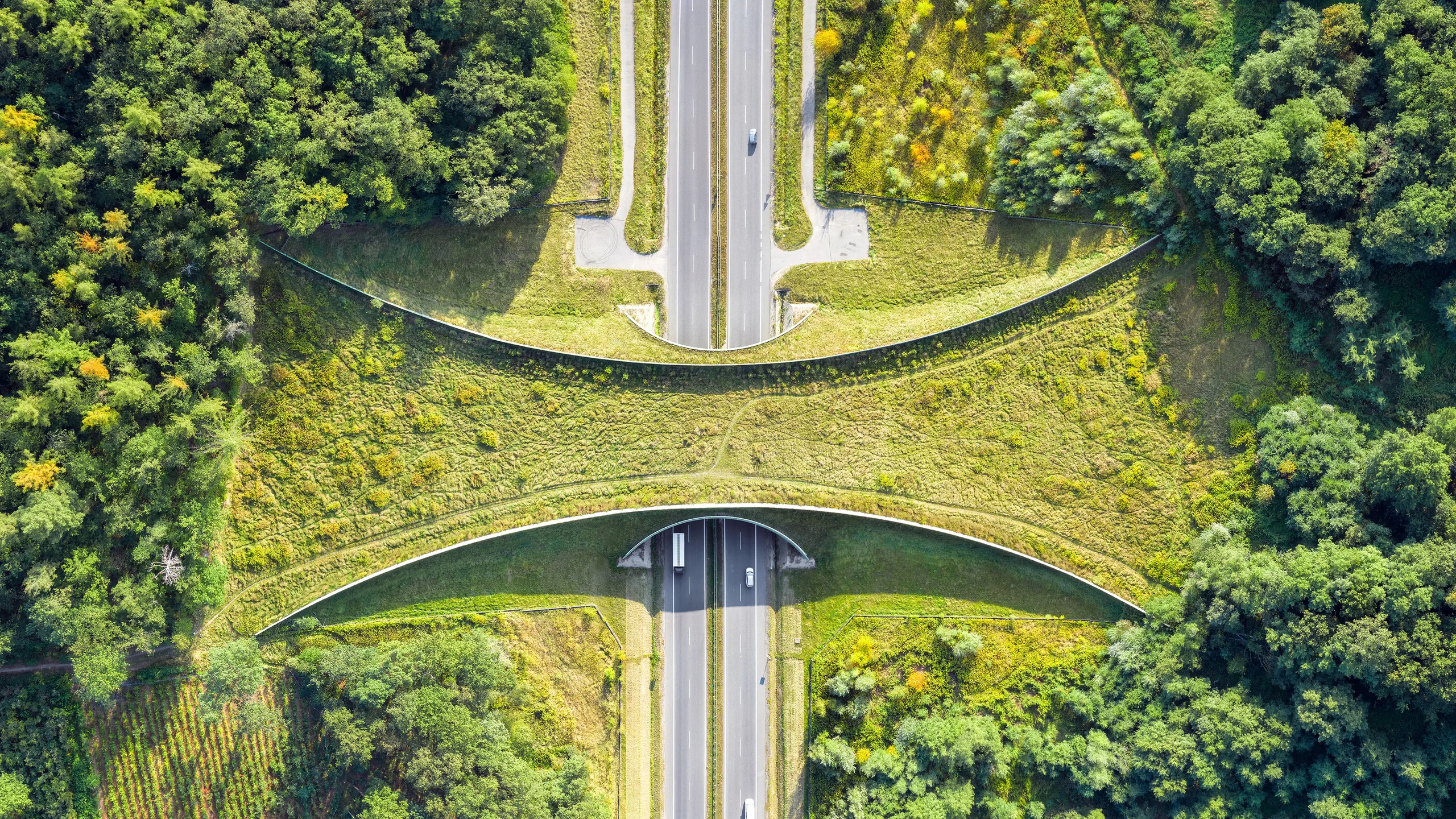
Image: Bing Daily Wallpaper · Wildlife crossing near Zakrzów, Poland (© bbsferrari/Getty Images) · Bing homepage
Open Bing today and the homepage shows a bridge.
That sounds unremarkable until you notice that it has no lane markings, no break in the guardrails and not a person in sight. Grass covers the deck, along with shrubs and perhaps a few young trees. Below it, traffic races along a highway. Most of those drivers may never realize they have just passed beneath a bridge, much less whom it was built for.
Bing's English caption is spare: an aerial view of a wildlife crossing near Zakrzów, Poland. Its Chinese title is blunter: Built for Paws, Not Pedestrians.
The Location the Photograph Does Not Reveal
Poland has 17 villages named Zakrzów, scattered across seven voivodeships, including Lower Silesia, Lesser Poland, Opole and Lublin. Bing gives neither a route number nor coordinates, and the image library supplies no further details. The available information therefore cannot establish this bridge's exact location, construction date or span. Everything else online simply repeats Bing's single sentence.
More important, an anonymous wildlife crossing is an entirely ordinary thing in Poland.
5,624 Crossings
Poland's General Directorate for National Roads and Motorways, or GDDKiA, has published its own count. Between 1995 and 2024, the national road network gained 4,187 culverts and passages for amphibians and small animals, 1,202 underpasses for medium and large animals, and 226 wildlife overpasses for medium and large animals. That makes 5,624 crossings in all. Roads opened in the most recent year alone added another 306.
Two figures from the same accounting are revealing when placed together. Environmental protections make up about 11% of the total cost of an expressway, with wildlife crossings accounting for more than 6.5%. A wildlife overpass costs about 11 million zlotys on average. That sounds immense until compared with the roughly 36 million zlotys it cost, over the same period, to build one kilometer of expressway. One bridge costs less than a third of a kilometer of road. A Polish science outlet has also offered a higher estimate of about 20 million zlotys; both figures are worth noting.
Why does Poland have so many? Polish specialists repeatedly point to the country's relatively late start in building a motorway network. Large-scale construction took off only after Poland joined the European Union in 2004, so modern road ecology and EU environmental-assessment requirements were in the plans from the outset. The crossings were drawn along with the roads, rather than added as repairs after the damage was done.
Poland had already learned how much that order of operations matters. A 2005 Polish conference paper put it plainly: when an overpass on the A4 opened in 2001, hardly any animals used it. Retrofitting a crossing built in the wrong place cost three times as much as choosing the right location at the start.
What a Road Kills Is Not Just the Animal It Hits
Our instinctive picture of the harm roads do to animals rarely extends beyond the pavement: the deer, badger or cat struck by a vehicle. That picture is not wrong, and the scale is appalling. Poland recorded more than 135,000 road incidents involving animals from 2001 to 2010, while the annual count more than doubled from 8,423 to 17,678. Across Europe, collisions between vehicles and hoofed animals number about 500,000 a year, injuring roughly 30,000 people and killing about 300.
But that is not the deadliest layer of the problem.
Imagine an eight-lane motorway cutting through a forest. A population that once moved, met and mated throughout the woods is split in two: one group north of the road, another south. Both halves are alive. Both halves are too small.
What does "too small" look like? There is a brutally concrete answer.
In March 2020, National Park Service biologists captured a subadult male mountain lion in the Santa Monica Mountains north of Los Angeles. Known as P-81, he was about 18 months old and weighed 95 pounds. The end of his tail bent into an L, and only one testicle had descended. Biologist Jeff Sikich called it something they hoped never to see.
A kinked tail and an undescended testicle are not injuries. They are inbreeding made visible on the body. The last mountain lions to show the same signs were Florida panthers more than two decades earlier. That population had fallen to just 20 to 30 animals, many with kinked tails, reversed hair whorls on their backs, atrial septal defects and poor sperm quality. A 1992 model predicted extinction within 24 to 63 years. The turn came in 1995, when eight female mountain lions from Texas were introduced in a "genetic rescue." Defects declined sharply, and the adult and subadult population grew to more than four times its 1995 size. The principal results appeared in Science in 2010.
The Santa Monica Mountains population is boxed in by several freeways, including US 101. In 2016, researchers from UCLA, the National Park Service and other institutions published its possible future in Proceedings of the Royal Society B:
- If inbreeding depression reached the level seen in Florida panthers, the population faced a 99.7% chance of extinction within 50 years, with a median time to extinction of just 15 years.
- If one outside mountain lion entered every two years, that probability fell to 2.4%.
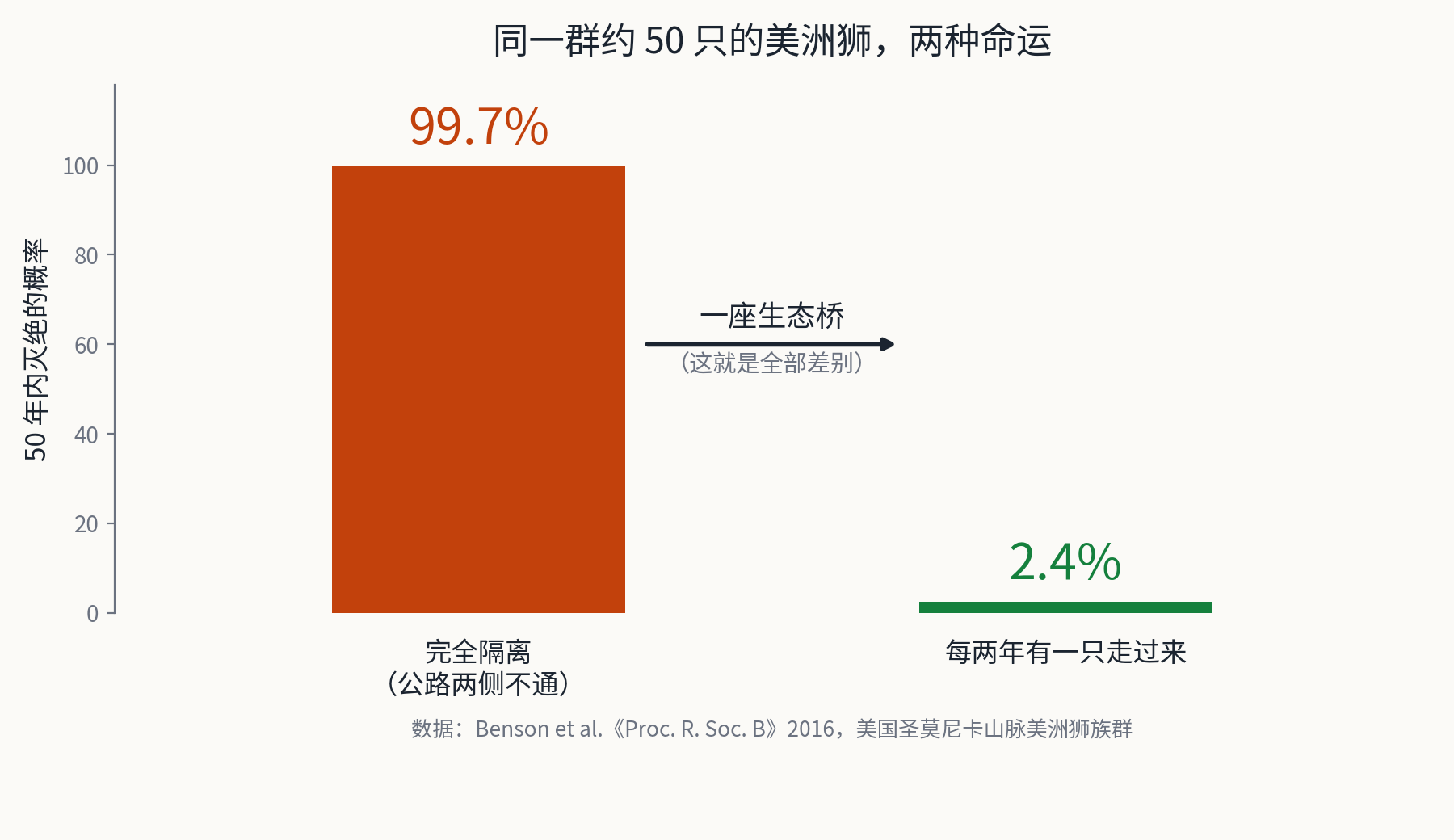
The entire difference between 99.7% and 2.4% is one animal successfully reaching the other side of a road every two years.
That is what the Polish bridge does. A safer road crossing is only the side benefit. Its real work is restoring the flow of genes. What ultimately kills a population is often not a wheel, but inbreeding.
Nor is the idea that roads form genetic barriers merely an inference. It has been measured. The title of a 2006 paper in Molecular Ecology states the finding plainly: a Southern California freeway is both a physical and a social barrier to carnivores.
Once the Bridge Is Built, Do the Genes Really Move?
They do. Researchers have proved it with hair.
The Trans-Canada Highway through Banff National Park offers some of the world's strongest evidence. Parks Canada reports 44 wildlife crossings along the road - 6 overpasses and 38 underpasses - paired with 82 kilometers of fencing and monitored continuously since 1996. It calls this the world's longest-running wildlife-crossing research program. Eleven large mammal species have used the structures more than 150,000 times. Wildlife-vehicle collisions have fallen by more than 80%, and collisions involving elk and deer by more than 96%.
The most elegant study counted not crossings but parentage. From 2006 to 2008, researchers collected hair at 20 of 25 passages, gathering 1,317 samples at the crossings alone. DNA identified 113 grizzly bears and 101 black bears. Of those, 15 grizzlies and 17 black bears had used a crossing; among the animals that crossed, 27% of the grizzlies and 47% of the black bears reproduced. Most tellingly, the researchers found parent-offspring pairs on opposite sides of the highway. Some cubs existed because their parents had crossed the road and met.
Published in Proceedings of the Royal Society B in 2014, the study concluded that wildlife crossings enabled enough gene flow to prevent genetic isolation.
No person walked across that bridge. An entire bloodline did.
Why a Wildlife Bridge Must Be Wide and Messy
Building an ecological bridge is not simply a matter of laying a lid over a road and covering it with soil. That was the mistake made on the A4 in 2001.
Road ecology has a disarmingly simple measure called the openness index:
Openness = width x height / length
It turns an animal's reluctance to enter a tunnel into mathematics. Polish design standards set minimum values accordingly: at least 1.5 for underpasses serving large animals, 0.7 for medium animals and 0.07 for small animals. Overpasses are governed directly by width. A crossing for large animals must be at least 35 meters wide, 50 meters is recommended, and at least 60 meters is recommended for the highest class of landscape bridge. Its width-to-length ratio should exceed 0.8, meaning the bridge should be nearly as wide as, or wider than, the distance it spans.
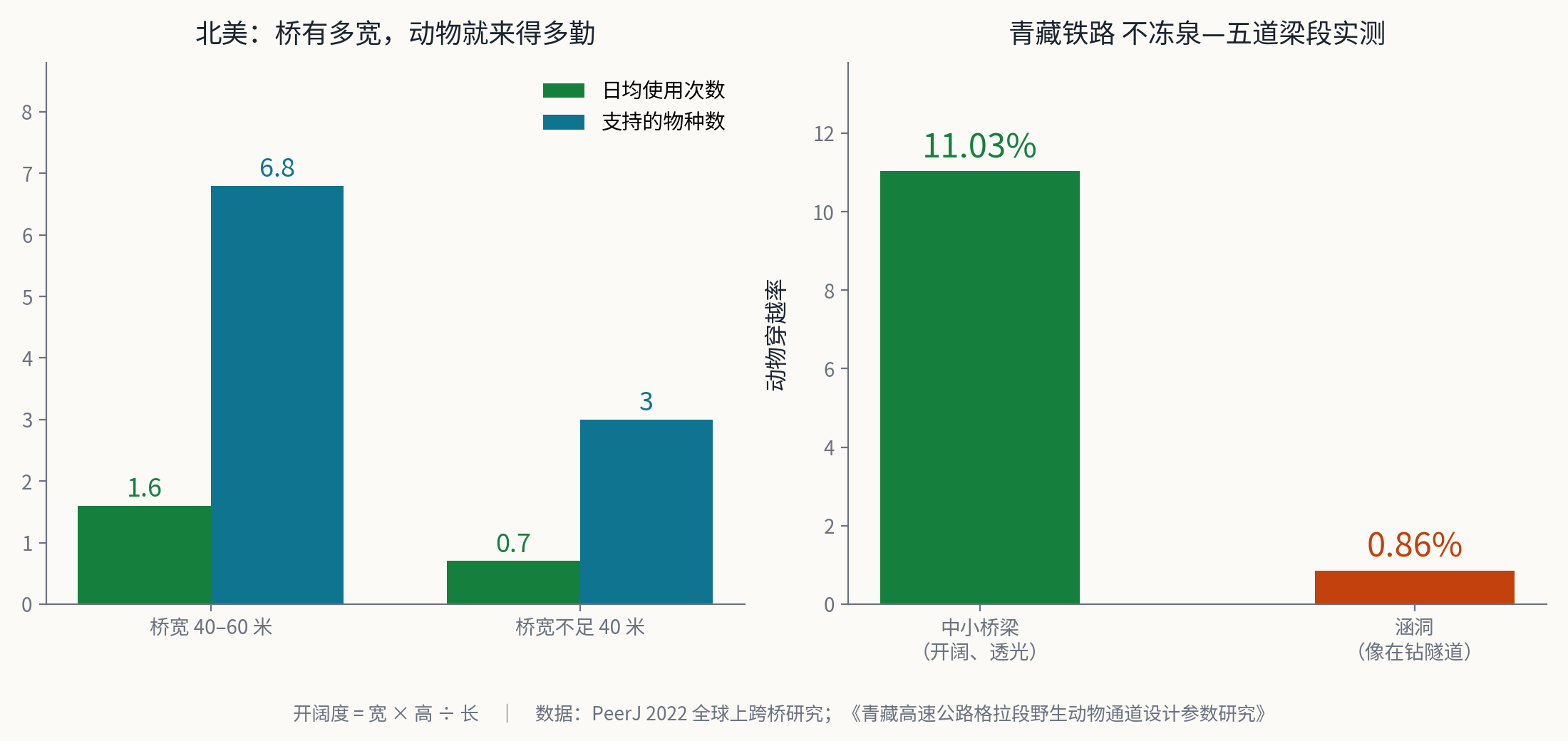
That may sound extravagant, but the data support it. A 2022 PeerJ study examined 120 monitored wildlife overpasses worldwide. Only 29% of those in North America met the expert recommendation of at least 50 meters, only half of those in Europe reached 40 meters, and the global average was just 34 meters. The performance gap was direct: North American overpasses 40 to 60 meters wide averaged 1.6 crossings a day and supported 6.8 species; narrow bridges under 40 meters averaged 0.7 crossings and supported only 3 species. Width did not quite double, but use and species counts more than did.
Some details in the Polish standards read almost like animal psychology.
The deck should widen smoothly from the center toward both ends, forming a funnel whose vertical projection traces a double parabola. It is not a flat slab but a flared opening, visible from a distance as a place to cross. Earth banks or sound barriers along the sides screen headlights, noise and movement. In forests, deadwood is deliberately scattered across the deck - logs, heavy branches and root plates that give small mammals sheltered microhabitats. Depending on the intended habitat, the soil layer ranges from 30 centimeters to more than a meter deep. Guide fencing generally extends 100 to 200 meters from each side, funneling animals toward the entrance.
Different animals want different things. Long-term monitoring in Banff found that grizzly bears, wolves, moose, elk and deer prefer broad, open structures with long sightlines. Mountain lions and black bears favor smaller, more sheltered passages. Bat overpasses need a clear width of 8 to 20 meters and must not be lit. Amphibian tunnels lose much of their effectiveness beyond 40 meters and must retain natural moisture and contact with soil, or juveniles can dehydrate. Guide fencing should stand at least 40 centimeters high and turn back in a U at the end, keeping frogs from following it straight onto the road. Tree-dwelling squirrels and dormice use another solution altogether: rope bridges between canopies.
The Part Most Easily Forgotten: Animals Must Learn
One finding in Banff's long-term report is more affecting than any engineering specification.
Animals take an average of four to six years to begin using a new crossing in large numbers. Grizzly-bear crossings rose from 5 in 1996 to 177 in 2008 - a 35-fold increase.
China has an almost identical curve. Yunnan's 97.75-kilometer Simao-Xiaomengyang Expressway opened in 2006, with 18 kilometers passing through the Xishuangbanna Nature Reserve. Its 25 wildlife crossings comprise 23 bridges and 2 tunnels. Asian elephants used 8 of them in 2006, or 32%; 10 in 2008, or 40%; and 18 by 2019, or 72%. Researchers found that elephants favored passages aligned with their established migration corridors.
A bridge does not begin working the day it opens. Animals need time to trust it, and people need to accept a more fundamental point: the task is not to teach animals to use our bridges, but to build bridges where they already travel.
The Qinghai-Tibet Railway offers the sharpest version of that lesson. From August 2014 to October 2016, 39 infrared cameras monitored 26 small and medium-sized crossings between Budongquan and Wudaoliang. Small and medium bridges had a crossing rate of 11.03%; culverts, just 0.86%. More striking still, the three most-used bridges accounted for 62.54% of all crossings.
The difference between bridge and culvert is, in effect, the difference in how much each feels like a tunnel. And when three structures account for nearly two-thirds of all use, choosing the right location matters more than simply building more. It is the same lesson behind Poland's finding that correcting a misplaced overpass costs three times as much.
There is good news, too. The Tibetan antelope population in Hoh Xil has recovered from fewer than 20,000 animals at the height of poaching in the late 1990s to more than 70,000. The time they need to cross the Qinghai-Tibet Highway has fallen from two or three days more than a decade ago to somewhere between a dozen minutes and a few hours.
Who Uses Poland's Bridges?
Poland sits on one of Europe's most important ecological corridors. The Carpathians hold about 7,200 brown bears, 42% of Europe's population outside Russia; roughly 3,000 wolves; and about 2,300 to 2,400 lynx. Between 1990 and 2015, the total length of motorways across the Carpathian countries grew from 1,118 kilometers to about 5,500 - a fivefold increase.
Wolves gained protection in parts of Poland in 1995 and nationwide in 1998; today they are strictly protected. Estimates of their numbers conflict. A 2001 national census counted 463 to 564. Poland's General Inspectorate for Environmental Protection put the 2019 population at about 2,000. The IUCN's Large Carnivore Initiative for Europe extrapolated 2,866 to 4,270 for 2022-2023 from population density. The figures disagree, but one fact does not: a wolf pack ranges across 200 to 400 square kilometers. No single protected area can contain a viable wolf population indefinitely. Corridors must connect them - precisely why Poland's 226 wildlife overpasses exist. In 2005, wolves began resettling western Poland after an absence of several centuries.
Fewer than 200 lynx remain in Poland. They have been protected nationwide since 1995, and captive-bred animals have been reintroduced in the west since 2019. Brown bears are a living illustration of fragmentation. After the Second World War, Poland had only two populations left, in the Tatra and Bieszczady mountains, with an estimated 10 to 14 bears between them. The estimate had risen to about 95 by 2007. Their present range covers 5,400 square kilometers, while the "favorable reference range" is 9,800. The starkest conclusion is that connectivity between the western and eastern sections remains "very limited": even where suitable habitat lies between them, bears have not settled it.
The bridges do record real visitors. Cameras captured a lynx crossing the Kalinowo-Raczki section of the S61 in October. On the A4 between Krzyżowa and Zgorzelec, which passes through the Lower Silesian Forest, monitoring has recorded wolves using the crossings.
Sources: Poland's General Directorate for National Roads and Motorways (GDDKiA), "Modern Road Infrastructure for Animals" and its 2019 explanation of crossing costs; the korytarze.pl Polish wildlife-crossing design guidelines by Rafał T. Kurek; Parks Canada's Banff wildlife-crossing page; Sawaya et al., Proceedings of the Royal Society B (2014) on gene flow in Banff bears; Clevenger et al., 2009 Banff wildlife-crossing project report; Benson et al., Proceedings of the Royal Society B (2016), and the US National Park Service's Santa Monica Mountains news release on P-81 and extinction risk; Florida Fish and Wildlife Conservation Commission page on panther genetics; Riley et al., Molecular Ecology (2006); 2022 PeerJ study of wildlife-overpass dimensions worldwide; TRANSGREEN, Wildlife and Traffic in the Carpathians (2019); polskiwilk.org.pl materials on wolves and lynx; Carpathian Brown Bear Project; zwierzetanadrodze.pl; Brodziewska, ICOET (2005); "Study on Design Parameters of Wildlife Crossings in the Golmud-Lhasa Section of the Qinghai-Tibet Highway"; IUCN Asian Elephant Transport Working Group case study of the Simao-Xiaomengyang Expressway; China News Service report on Tibetan antelope in Hoh Xil; California governor's office news release on the Wallis Annenberg Wildlife Crossing; the Netherlands' Compendium voor de Leefomgeving data on defragmentation; Vista landscape architecture's Natuurbrug Zanderij Crailoo project page; iNaturalist GLOBAL Roadkill Observations.