
A coal-age behemoth built in 1941, on a tour celebrating America's 250th birthday, threads its way through the very kind of plant that produces the fuel which replaced it—and a photographer presses the shutter.
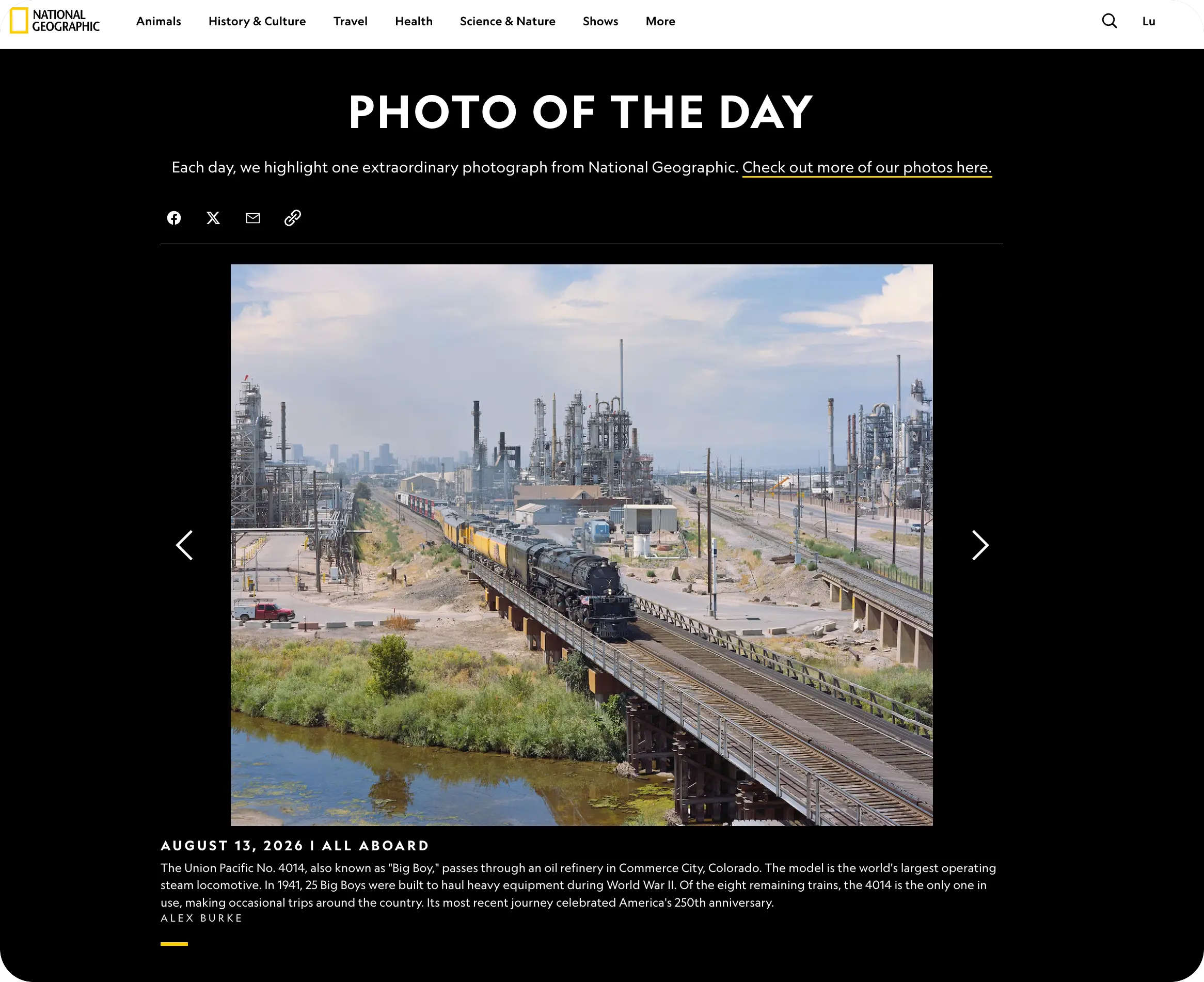
Image: Nat Geo Photo of the Day · Photography by Alex Burke, Nat Geo Image Collection · Original page
On Thursday, August 13, National Geographic's Photo of the Day featured a train picture simply titled "All Aboard." In the frame, Union Pacific's No. 4014 steam locomotive exhales white steam as it passes between the piping and storage tanks of a refinery in Commerce City, Colorado, the city skyline visible in the distance.
All the tension in this photograph lives in the word "through." The golden age of coal-fired steam locomotives was ended by diesel—and diesel is refined from petroleum. In other words, this old wave is rolling right through the factory of the new wave that killed it. There's an even more delicious layer: to survive into the present day, No. 4014 was converted from coal to fuel oil during its restoration overhaul—the giant defeated by petroleum eventually got back on its feet by drinking its rival's beverage.
Just How Big Is It
National Geographic's caption says 25 Big Boys were built in 1941. That's broadly correct, but the ledger needs half a sentence more: 25 units came in two batches—20 in 1941 (Nos. 4000–4019) and 5 more in 1944 (Nos. 4020–4024)—all manufactured by the American Locomotive Company in Schenectady, New York, exclusively for Union Pacific.
Let the numbers sink in: including the tender, overall length is roughly 132 feet (about 40 meters)—longer than a regulation basketball court. Total weight: approximately 1.2 million pounds, over 540 metric tons. It was built for one job: hauling heavy freight trains over the Wasatch Range between Utah and Wyoming. Before the Big Boys, trains on that mountain stretch routinely needed helper engines; Big Boy's design brief was to do the whole climb alone. According to Union Pacific's official records, these locomotives spent their working lives shuttling along the mainline between Ogden, Utah, and Wyoming.
How Does Forty Meters of Steel Round a Curve
For a 40-meter locomotive, the first physics problem isn't pulling power—it's turning. Lay a 40-meter straightedge on a curved track: the ends might just touch the rails, but the wheels in the middle would be flung right off.
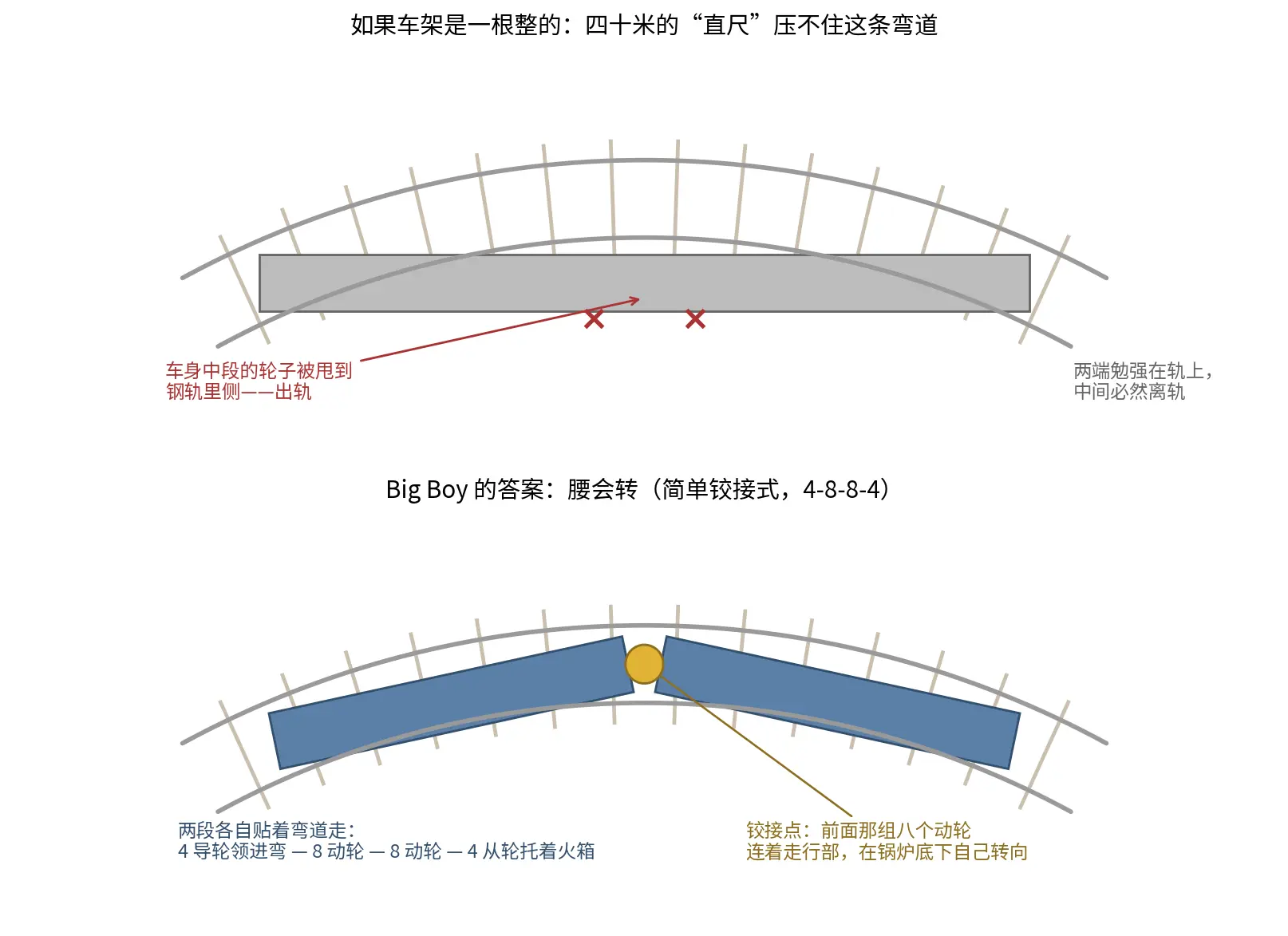
Big Boy's answer is written in its wheel arrangement: 4-8-8-4. Four leading wheels guide the front end into the curve, followed by two sets of eight driving wheels each, with four trailing wheels supporting the massive firebox at the rear. The key lies between those two sets of drivers—according to Union Pacific's official description, because the locomotive is so long, its frame is "articulated": the front group of eight driving wheels and their entire running gear are hinged beneath the boiler like a trailer, free to pivot relative to the main body. So when rounding a bend, this 40-meter colossus is really two halves, each following the curve on its own. The engineering solution has a philosophical flavor: what lets something enormous get around a bend isn't more rigidity—it's the willingness to yield.
The Name Came from Anonymous Graffiti
A locomotive of this class was originally meant to bear a different name. According to accounts from Trains magazine and Union Pacific, management had planned to christen it the "Wasatch Class"—named for the mountain range it was built to conquer, dignified and proper. But in the Schenectady shops, a worker whose identity remains unknown to this day looked at the steel monster growing ever larger before him, reached up, and chalked two words on the smokebox door of No. 4000: Big Boy. He added a "V" beside it—the wartime victory sign.
The photo made the papers, the name spread, and the public and workers alike refused to call it anything else. Management went with the flow; "Wasatch Class" was never adopted. The most famous locomotive name of the twentieth century came from a piece of anonymous graffiti—history occasionally has a taste for street-level wit.
One Million Miles, Fifty-Two Years on Display, Then Resurrection
No. 4014 was retired in December 1961. According to Union Pacific's records, it logged 1,031,205 miles in its lifetime—approximately 1.66 million kilometers, enough to circle the Earth along the equator 41 times. The following month it was donated to a museum. For the next 52 years it stood motionless on a display track in Pomona, California, a colossal exhibit at the Los Angeles County Fairgrounds that children clambered over.
In 2013, Union Pacific made a decision that stunned railfans across America: buy it back and bring it back to life. In May 2014, No. 4014 was transported to the steam shop in Cheyenne, Wyoming. Years of overhaul followed—boiler flues, bearings, and braking systems were replaced, and the firebox was converted from coal to fuel oil. In May 2019, it blew steam again—the timing perfectly calibrated: the 150th anniversary of the first transcontinental railroad's completion. Its resurrection maiden voyage ran to Ogden, Utah, for the Golden Spike celebration. From that day on, it has been the only operational Big Boy in the world. Of the 25 built, eight survive; the other seven stand silent in museums.
2026: Heading East for the First Time in 85 Years
This year's journey is its largest since restoration. To celebrate America's 250th birthday, Union Pacific scheduled No. 4014 for an unprecedented transcontinental tour: departing April 10 from the "Mile Zero" marker in Sacramento, California—the spot where the Central Pacific Railroad broke ground eastward in 1863 to begin building the first transcontinental railroad. The eastern leg was a collaboration with Norfolk Southern Railway, taking No. 4014 east of the Mississippi River for the first time ever. According to Union Pacific, this is the first time it has returned to the East since being shipped west from the Schenectady factory in 1941—85 years. It entered Indiana, Ohio, New York, and Pennsylvania for the first time, spent the Fourth of July in Philadelphia, then looped back to Cheyenne via Altoona, Pennsylvania; Fostoria, Ohio; and St. Louis, Missouri. The National Geographic photo was taken during the Colorado leg of this tour. The tour has now concluded; if you want to chase its next outing, keep an eye on Union Pacific's official steam schedule page.
A gentle bit of arithmetic: a machine born for wartime freight, 85 years later reprising its journey across America as a guest of honor at the nation's birthday, with dozens of small towns clearing their crossings for it. Machines don't understand commemoration—but people do.
If You Want to See the Steam Age Alive, China's Ticket Is in Tieling
Chinese railways have a precise date for their formal farewell to steam: according to China Media Group (CMG), December 9, 2005, was the day steam locomotives exited the stage of Chinese rail transport history. But "out of service" doesn't mean the fires have gone out.
In Diaobingshan, a city under the administration of Tieling in Liaoning Province, there's a hidden gem: the Tiemei Steam Locomotive Museum. Twenty-one steam locomotives of four types, with manufacturing dates spanning from 1943 to 1999—the last four domestically built steam locomotives in China are preserved here, and they're not static exhibits. They still run on a 220-kilometer mine-area tourist railway. The most remarkable unit in the collection is KD6-487: built in 1943 by the Lima Locomotive Works in the United States—an American locomotive born in the same war as Big Boy—sent to China as postwar aid. It served in Zhengzhou, Liuzhou, and elsewhere for half a century, was overhauled and returned to service in 2004, and is reportedly the only operable example of its type left in the world. Every January, Diaobingshan hosts an International Steam Locomotive Tourism Promotion Festival where visitors, under the guidance of professional engineers, can operate a steam locomotive with their own hands. Over a hundred films and TV dramas, including The Grandmaster and A Lifelong Journey, have borrowed these locomotives' white plumes. As for the Sandaoling mining district in Hami, Xinjiang—once called "the last holy land of steam" by photography enthusiasts—The Paper (Pengpai News) has reported that in recent years the final locomotive there has also had its fire dropped. If you want to see them alive and steaming, don't wait.
Steam locomotives offer children something no other machine can: everything is on the outside. Wheels, connecting rods, the breathing of steam—where force comes from and where it goes—you can understand it all just standing on the platform. A machine that wears its cause and effect on its body. If you happen to pass through northeastern China this winter, go to Diaobingshan and watch one move. If you can't make it, next time you encounter a steam locomotive in any museum, remember to walk around to the side and find the connecting rod linked to the big wheel—that's the same sentence Big Boy speaks with all 544 tons of its body.
Sources: Nat Geo Photo of the Day: All Aboard, Union Pacific Official: Big Boy No. 4014, Union Pacific: Big Boy Northeast Tour Announcement, Union Pacific Steam Schedule Page, Wikipedia: Union Pacific Big Boy, American Locomotive History: Trains magazine account of the name's origin (via Atlas Obscura et al.), CNR: Diaobingshan International Steam Locomotive Tourism Promotion Festival, Beiguo Net: China's Last Four Domestically Built Steam Locomotives Preserved in Diaobingshan, The Paper (Pengpai News): The Last Steam Locomotive's Fire Dropped2026-08-13-natgeo-diagram-articulated.png