
NASA Astronomy Picture of the Day (APOD): Spokes on Saturn's B Ring, August 5

Image: NASA Astronomy Picture of the Day (APOD) · Image Credit & Copyright: Brad Croslin · Today's page. Photo copyright belongs to the photographer; linked here for reference.
Today's Astronomy Picture of the Day is an animated image. Stare at it for a few seconds: on the left side of Saturn's rings, a dusty gray shadow materializes, slanting across the ring, then fades away again. The APOD editors went so far as to call it a "ghost"—don't worry, this isn't a paranormal event, but it genuinely was an unsolved mystery for decades.
First, the image itself. This is a time-lapse spanning nearly two hours, compressed into a few seconds of looping playback. Saturn completes one rotation in only about ten and a half hours—its "day" is less than half of ours—so in just two hours, it has already turned roughly a fifth of the way around, and the shadow on the rings appears and disappears accordingly. There's also a detail worth noting in the credit line: this animation wasn't captured by any spacecraft. The credit goes to a photographer by name—Brad Croslin—and the copyright is his. Capturing this shadow from the ground is itself a remarkable feat—and to understand why, we need to go back fifty years.
A Young Man Nobody Would Believe
In the 1970s, there was a young American named Stephen O'Meara, famous for his extraordinary eyesight. According to Astronomy magazine, by age 14 his intimate knowledge of the night sky had earned him a key to the Harvard College Observatory, where he could freely use the facility's classic refracting telescope. It was during those nights behind the eyepiece that he saw dark, radial streaks running across Saturn's B ring—the brightest and densest of Saturn's rings—like spokes on a bicycle wheel. He meticulously sketched them and submitted his drawings to professional journals.
No one would publish them. It wasn't that the editors were arrogant—it was that planetary science at the time had a line of reasoning that sounded airtight: Saturn's rings are not a solid disk but countless individual chunks of ice, each orbiting Saturn independently; the closer to Saturn, the stronger the gravity, and the faster the orbit—the inner edge always outpaces the outer edge. So if you were to "draw a line" radially across the rings from a spaceship, within hours the difference in orbital speed between the inner and outer portions would shear it, stretch it, and smear it into nothing. Radial features simply could not survive on such a ring, and therefore they could not exist—anyone who claimed to see them must have been fooling themselves.
The logic was seamless. Except the conclusion was wrong.
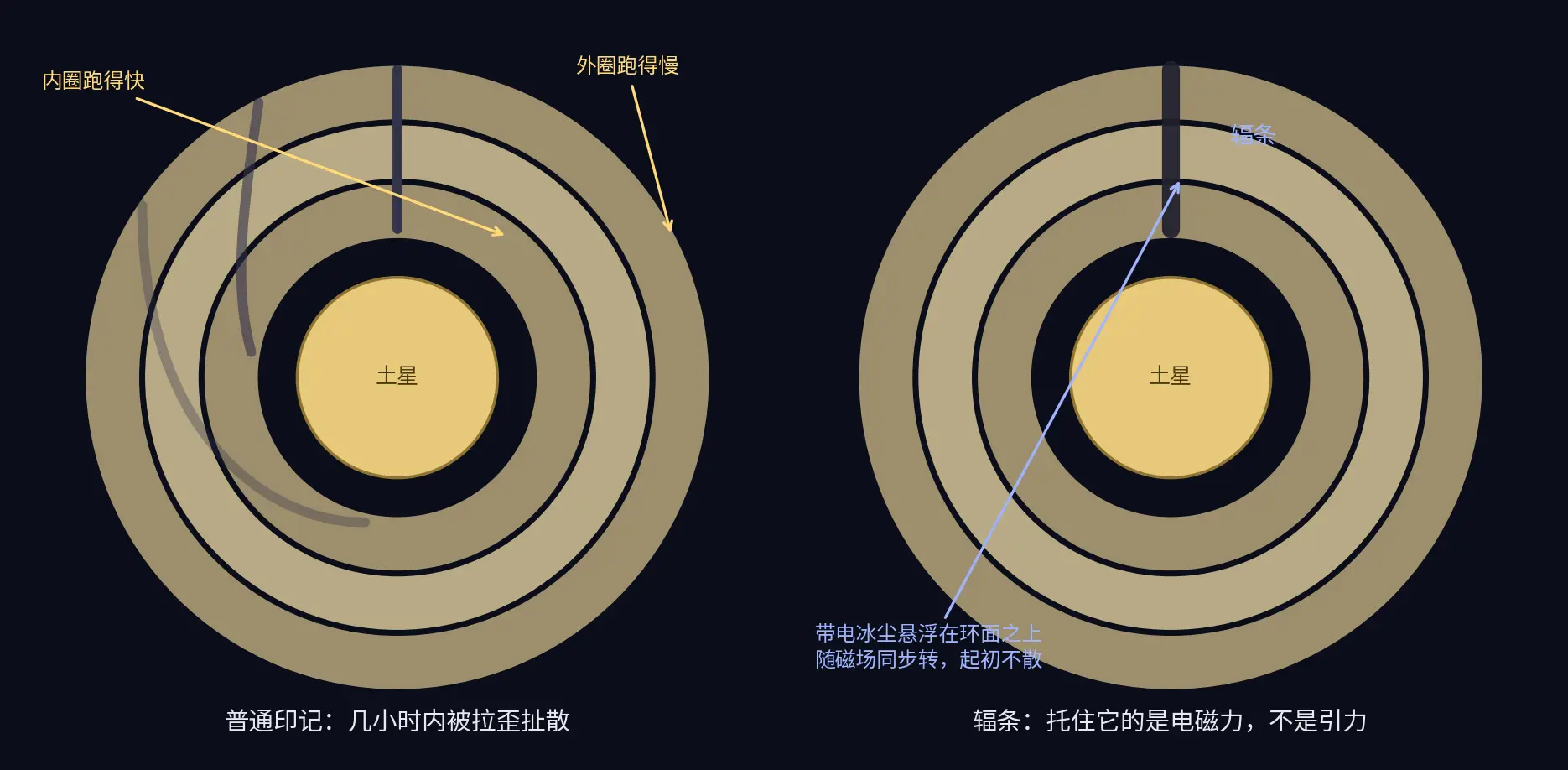
In 1980 and 1981, the Voyager probes flew past Saturn one after the other and sent back close-up photographs of the rings. There they were, plain as day: dark spokes draped across the B ring, exactly as O'Meara had drawn them. Only then did the scientific community look back and acknowledge that the young man had been seeing something real. Later, the International Astronomical Union named asteroid 3637 "O'Meara," recognizing this and other visual observations among his achievements.
The Rule-Breaking Shadow Is the Clue
Once the spokes were confirmed in photographs, the mystery only deepened: if patterns on the rings should be sheared apart, how could these shadows exist?
The key to the answer lies precisely in their rule-breaking behavior. Freshly formed spokes don't immediately disintegrate the way ordinary ring material should—which means they aren't made of the same ice boulders and rocks at all, but something else entirely: a layer of micron-sized ice dust suspended just above the ring plane. According to NASA and the ESA/Hubble team, the leading hypothesis is this: the solar wind—a stream of charged particles blown outward from the Sun—interacts with Saturn's powerful magnetic field, imparting a static charge to these tiniest dust grains that briefly "lifts" them off the ring plane. Think of rubbing a balloon on your hair on a dry winter day and watching it pick up scraps of paper from a distance. What holds the spokes together isn't gravity but electromagnetic force, which is why they can defy gravity's rules. As the charge gradually dissipates, the dust settles back onto the ring plane, and the spokes fade away—according to ESA, a single spoke typically "lives" only two or three Saturn days, roughly one to two Earth days.
Don't be fooled by "tiny dust." The Hubble team has specifically pointed out the scale: these shadows may look small against Saturn, but the length and width of a single spoke can each exceed the diameter of the entire Earth. To get a sense of the stage: Saturn's main ring system spans about 280,000 kilometers in diameter, yet in most places is only around 10 meters thick—if you scaled it down to a sheet of paper 0.1 millimeters thick, that "paper" would need to be 2.8 kilometers wide. The drama of the spokes plays out on the surface of that sheet.
Still, the mystery remains only partially solved. Hubble's ongoing monitoring has revealed that the spokes' rotation rate neither perfectly matches the ring's orbital motion nor perfectly matches the magnetic field's rotation—it falls somewhere in between. Amy Simon, the NASA scientist overseeing the monitoring program, has said that after decades of study, no theory can perfectly predict when spokes will appear or what shape they'll take. Half a century ago they were "things that cannot possibly exist"; now they are "things that exist but nobody can fully explain"—and for science, that's already enormous progress.
Why Now, of All Times
There's one final piece of the puzzle: spokes aren't permanent fixtures. They pick their season to take the stage.
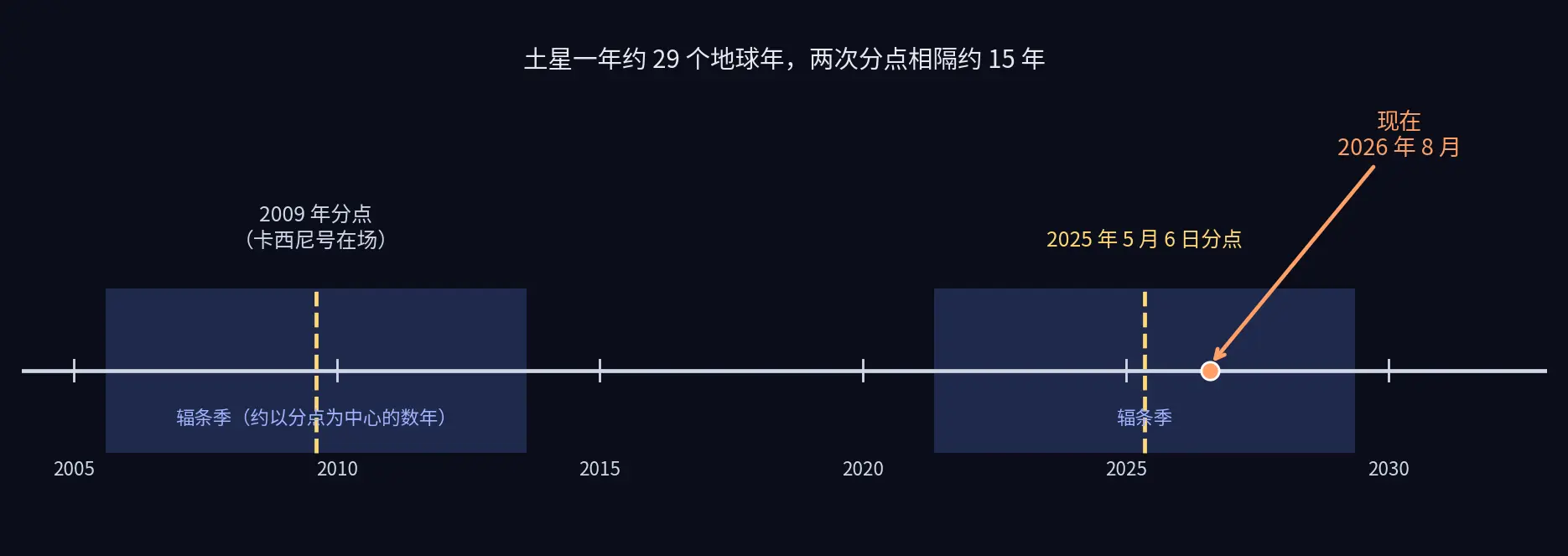
Saturn, like Earth, orbits the Sun tilted on its axis, so it too has seasons—except that Saturn takes over 29 years to complete one orbit, making each season roughly 7 Earth years long. Decades of observation (a relay effort by Voyager, Cassini, and Hubble) have uncovered a pattern: spokes appear frequently only in the years around equinox and vanish near solstice. Equinox is the moment when sunlight strikes the ring plane edge-on; at these times, the interplay between the solar wind and the magnetic field is especially vigorous—ideal conditions for charging the dust.
Saturn's previous equinox was in 2009, when Cassini was on-site watching the show; the most recent equinox was May 6, 2025. In other words, right now—August 2026—we are deep within spoke season. This also explains why a ground-based photographer can capture them today: it's not just because amateur equipment has advanced enormously over the decades, but also because Saturn is in one of its most "haunted" years.
And so the story comes full circle in a satisfying way: fifty years ago, an amateur observer said he saw spokes on Saturn's rings, and nobody would believe him; fifty years later, the spokes' "official portrait" once again bears an individual photographer's name, hanging on NASA's Picture of the Day. The universe hasn't changed—what's changed is that we've finally learned to trust those who look carefully.
Following APOD's Reminder: Mid-August, Look Up
At the end of today's APOD, the editors added a special reminder: this August, find a dark sky and look up for the Perseid meteor shower—this year there's no moonlight to interfere. Here are the details:
- Peak time: After nightfall on August 12 (Wednesday) through dawn on August 13 (Thursday); the second half of the night is best (according to NASA's What's Up August edition; the meteor shower peak spans several nights across the date line, and local nighttime hours apply for all time zones—Chinese observers likewise watch from the evening of August 12 to the predawn hours of August 13)
- This year's unique advantage: August 12 coincides with a new moon, meaning no moonlight interference all night; NASA calls the viewing conditions ideal—incidentally, that same new moon produces a total solar eclipse over the North Atlantic during the daytime (visible from Iceland, northern Spain, and other locations; not visible from China), so in a single day it stages a solar eclipse and then clears the way for the meteor shower. Busy day.
- How to watch: After full dark, face the northeast and wait for Perseus to climb above the horizon; don't fixate on the radiant point—meteors will streak across the entire sky. Find a dark, open location and give your eyes 30 minutes to adapt to the darkness. Naked eyes are all you need—no equipment required.
- Bonus: In NASA's observing diagram, Saturn is marked high in the sky near the radiant point—while waiting between meteors, a small telescope will let you clearly see Saturn's rings themselves (though don't torture yourself trying to spot the spokes—that requires long-exposure photography and image stacking).
- Official pages: NASA Perseid Meteor Shower · What's Up August 2026 Skywatching Guide
As it happens, today—August 5—the Moon reaches last quarter. Starting tonight, the first half of the night will grow darker with each passing day, as if clearing the stage for the meteor shower a week from now. If you do find yourself lying on some patch of grass on the night of the 12th, waiting between meteors, spare a thought for that ringed planet overhead: at this very moment, "ghosts" longer than Earth are flickering in and out of existence on its rings. Half a century ago, the first person to see them was about your age, with nothing but a telescope and a pair of eyes willing to look carefully.
Sources: APOD 2026-08-05 page, ESA/Hubble: Saturn spoke season observations (2023-12), NASA: Hubble captures the start of a new spoke season at Saturn, NASA What's Up August 2026, PBS Seeing in the Dark: Saturn and its rings, NASA NTRS: Hubble detects the start of a new spoke season, Astronomy.com: Stephen O'Meara profile