
NASA Image of the Day: Artemis III Orion Crew and Service Models Joined, August 5
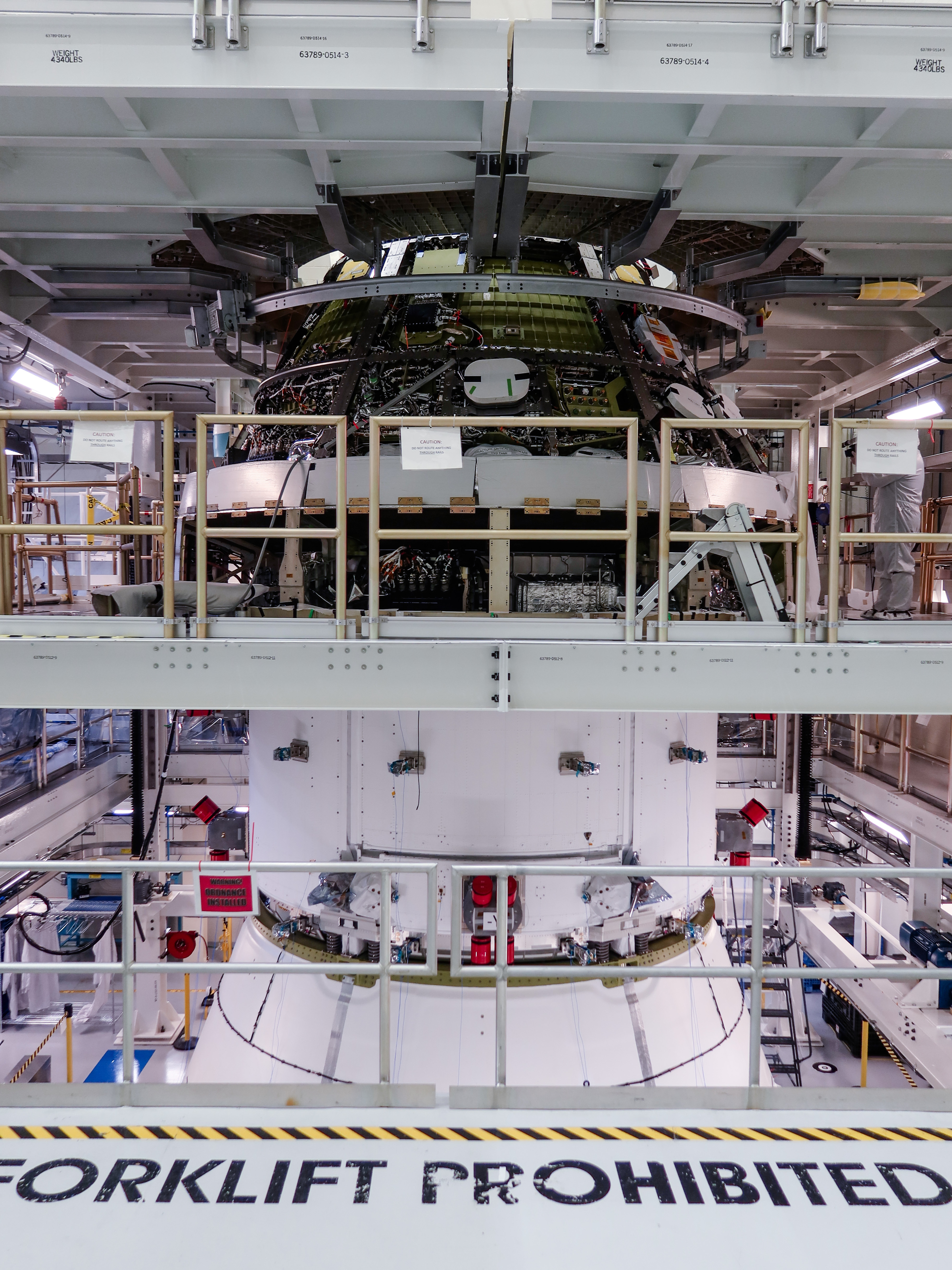
Image: NASA Image of the Day · Image credit: NASA/Amanda Stevenson · Image page nasa.gov
Start with the floor.
On the concrete in the foreground, a painted message reads: NO FORKLIFTS. Look up, and a conical capsule sits squarely atop a cylinder, ringed by tier after tier of walkways and yellow safety railings. This is America's next crewed spacecraft, Orion. On July 30, technicians bolted its two halves into a single whole, and today NASA chose that moment as its Image of the Day.
Its destination was changed just five months ago.
Why build a spacecraft in two halves
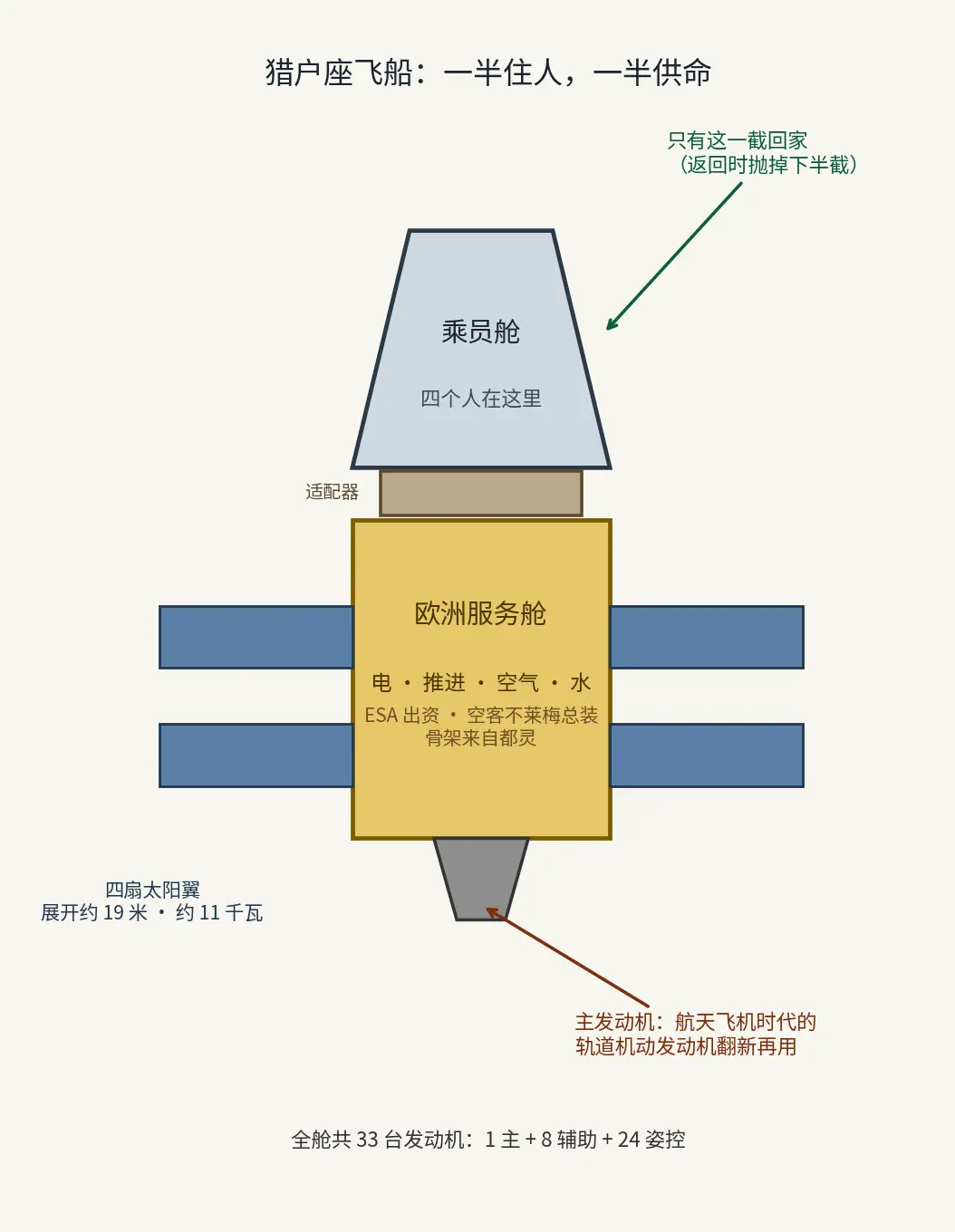
The upper half is called the crew module—where people live. The lower half is called the service module—responsible for power, propulsion, air, and water. Before the spacecraft returns to Earth, this lower half is jettisoned and burns up in the atmosphere. It never comes home.
The lower half is built in Europe. Funded by the European Space Agency (ESA), it is assembled by Airbus in Bremen, Germany, with the core structural framework manufactured by Thales Alenia Space in Turin, Italy. Mounted onto that framework: 11 kilometers of cabling, four tanks each holding 2,000 liters of propellant, and a total of 33 engines—1 main engine, 8 auxiliary thrusters, and 24 attitude control thrusters. Four solar arrays span roughly 19 meters when deployed, generating approximately 11 kilowatts of power.
The most storied component is the main engine. This generation of service module doesn't use a newly manufactured engine; instead, it reuses refurbished hardware from the Space Shuttle era—an Orbital Maneuvering System engine that once sat on the back end of a shuttle, now reassigned to a new ship after retirement.
The two halves are built separately so they can be tested separately. This spring, each half went through an acoustic test: over a hundred speakers blasted the module at nearly 140 decibels—equivalent to standing next to a jet engine at takeoff—to see if anything came apart. Only after mating do the two halves become a single machine for the first time. According to NASA, the next step is to power up the complete spacecraft for the first time.
The service module itself has already traveled a long way. In August 2024 it left Bremen aboard the cargo vessel Canopée—a ship whose usual job is ferrying Ariane rockets to the Kourou launch site in South America—and arrived in the United States 12 days later. In September 2025, ESA formally handed it over to NASA. When the contract was signed in 2020, the mission statement read simply: crewed lunar landing.
The destination changed
On February 27 of this year, NASA Administrator Jared Isaacman announced the biggest restructuring of the Artemis program in a decade, at Kennedy Space Center. His rationale was straightforward: jumping from a single loop around the Moon straight to a landing on the surface was too great a leap—especially when the entire SLS rocket and Orion stack flies only once every three-plus years, leaving little opportunity to practice in between.
So Artemis III, originally the lunar landing mission, became a roughly two-week low Earth orbit demonstration in 2027. Four astronauts will ride Orion into orbit and rendezvous and dock with lander "test articles" provided separately by SpaceX and Blue Origin. The landers will be launched first on commercial rockets; Orion follows, and the two vehicles will remain docked for approximately two days. Up to two astronauts, wearing their orange launch-and-entry suits, will open the hatch and float into the Blue Origin test article for a hands-on evaluation.
The actual lunar surface landing has been pushed to Artemis IV in 2028—targeting the lunar south pole.
The previous leg of the relay only just finished. On April 1 of this year at 18:35 Eastern, Artemis II lifted off from Pad 39B. Four astronauts swung behind the far side of the Moon and splashed down off the coast of San Diego on April 10 at 20:07 Eastern, after a mission lasting nearly 10 days. They reached a maximum distance of 252,756 miles (approximately 406,771 kilometers) from Earth, breaking the record for the farthest humans have ever traveled from home—a record set in 1970 during Apollo 13's unplanned detour.
What changing your mind looks like in metal
The most interesting thing behind this photograph is how, once the plan changed, the hardware changed shape too—visibly.
The SLS rocket's original upper stage was called the Interim Cryogenic Propulsion Stage. Its job was simple: after the rocket delivered the spacecraft to low Earth orbit, it would fire one last time to send Orion toward the Moon. Since this mission isn't going to the Moon, that kick isn't needed.
NASA's solution is somewhat unexpected: in that position they installed a "spacer segment." Its outer dimensions and interfaces at both ends are identical to the real propulsion stage, but it carries no fuel and will never ignite—it is purely a structural stand-in, so that every other part of the rocket can remain unchanged. In July, technicians at Marshall Space Flight Center completed the eighth and final friction stir weld on this cylinder, joining eight curved panels into a ring before lifting it off the welding fixture for inspection. The actual propulsion stage that was originally assigned here has been reassigned to Artemis IV.
The savings don't stop there. The Artemis II Orion capsule, freshly fished from the Pacific, was stripped of parts that were installed on the current vehicle, advancing the assembly schedule by roughly three months; more than 250 components will be carried forward to Artemis IV and V. The Mobile Launcher was power-washed and corrosion-treated immediately after the Artemis II liftoff, cutting its turnaround time nearly in half. All four RS-25 main engines were delivered to the Vehicle Assembly Building by July 21, and the two solid rocket boosters have been stacking segment by segment since early July.
So this mission that goes nowhere in particular may well be the most closely watched crewed spaceflight in history.
The four people who will sit inside
The crew was announced in Houston on June 9. Commander Randy Bresnik, 58, a retired Marine Corps colonel and TOPGUN graduate, flew once on Space Shuttle Atlantis in 2009 and again on a Soyuz to the International Space Station in 2017, logging 149 days in space across both missions. Pilot Luca Parmitano, 49, a former Italian Air Force test pilot, was the first Italian to command the International Space Station and is the first ESA astronaut assigned to an Artemis mission.
Of the two mission specialists, Frank Rubio, 49, is an Army Black Hawk helicopter pilot and family physician who spent 371 consecutive days aboard the International Space Station from 2022 to 2023—still the American record for the longest single mission in orbit. Andre Douglas, 40, was selected in 2021 after a career as a naval architect with the Coast Guard and work on the DART asteroid-deflection mission at Johns Hopkins University Applied Physics Laboratory. He was the backup astronaut for Artemis II, training alongside the prime crew through an entire rotation; this time it's finally his turn, and it will be his first flight. The backup role now passes to Bob Hines. At the handover ceremony there was one detail rich in symbolism: the new crew received a ceremonial relay baton from the four Artemis II astronauts.
Uncertainties should be stated clearly as well: Blue Origin's New Glenn rocket recently suffered an anomaly that damaged its launch pad, and the progress of both lunar lander contractors remains the biggest variable on this mission's timeline.
Back to that photograph. The scene of a historic moment is, when you get down to it, just a workshop where everything is fragile—and that painted "NO FORKLIFTS" on the floor is the most honest caption in the entire frame.
Two dates are worth noting in advance: 2027, when Artemis III rehearses docking in low Earth orbit—with 4K imagery relayed back via laser link; and 2028, when Artemis IV actually lands at the lunar south pole. To catch up on the previous leg, NASA's website hosts the complete set of photographs and video replays from Artemis II's ten days in April—worth watching in full. It was the first time in more than half a century that humans actually flew behind the far side of the Moon.
As for tonight: these days happen to fall around the last quarter Moon, which won't rise until the small hours and is easiest to spot in the southwestern sky at dawn. Once you find it, look toward the lower edge of the disk—over on the densely cratered highlands. That is the direction where, in 2028, they plan to land.
Sources: NASA Image of the Day original page, NASA Mission Blog: Module mating and rocket hardware progress, NASA: Artemis architecture restructuring, NASA: How lander test articles pave the way for Moon landings, NASA: Artemis III crew announcement, NASA: Artemis II return, NASA: Orion equipped with Starlink laser terminal, ESA: European Service Module delivery and testing, Airbus: Service module technical overview