
The camera faces the visor, and the visor gives the camera and hands back to us. In Anil Menon's space selfie, station structures crowd into the golden reflection while Earth fills the background. It has the familiarity of a travel photograph, taken during a working day outside a spacecraft.
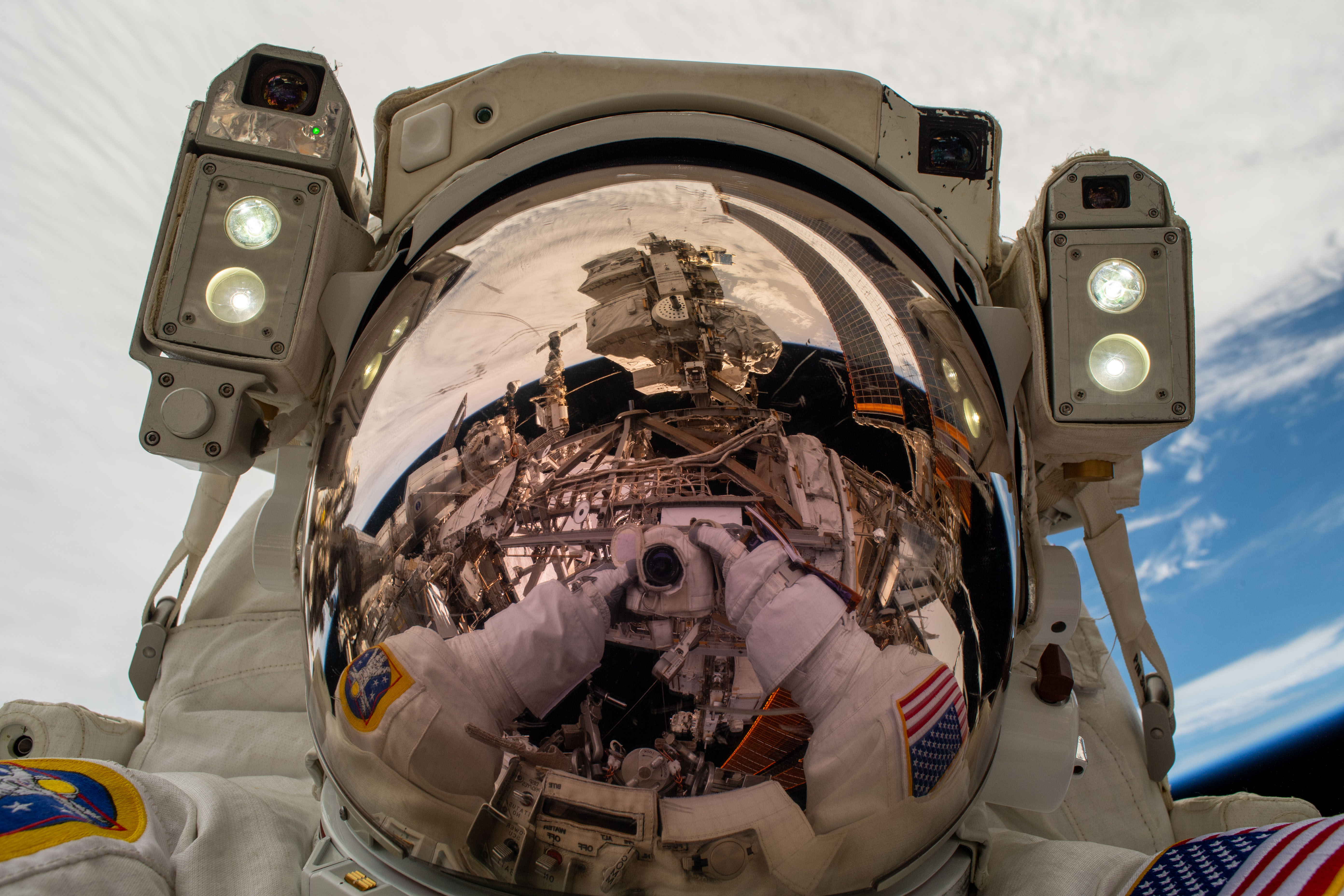
Image: NASA/Anil Menon. Original page
NASA published the image on November 17. Menon took it on October 29, 2026, while he and Canadian Space Agency astronaut Joshua Kutryk installed a new roll-out solar array on the International Space Station.
A photograph inside a longer task
NASA's work log for that day records the spacewalk beginning at 7:57 a.m. EDT and ending at 3:08 p.m. EDT: seven hours and 11 minutes. The selfie preserves one moment within that long sequence of work.
The completion report identifies this as the seventh ISS Roll-Out Solar Array, or iROSA, installed on electrical power channel 2A.
Solar arrays convert light into electricity. A roll-out design lets an array travel in a compact form before spreading into a much larger collecting surface. Installing one means handling structures, securing hardware, and making electrical connections. The extra wing visible from outside becomes electrical power for the laboratory within.
Look again at the reflection and slowly separate the directions: the hands are in front of the visor, the camera is held between them, station hardware appears in the mirror, and Earth lies beyond the astronaut. Working out those relationships gives the photograph more depth than simply recognizing a person in space.
To find the laboratory from the ground, use NASA's Spot the Station to check passes for your location. Under suitable conditions, the station appears as a bright, steadily moving point. When the ground has entered darkness but the station remains in sunlight, reflected light can make it visible. Whether a particular pass works for you depends on the local prediction and the weather.