
NASA's Astronomy Picture of the Day takes us 3,300 light-years away to a stellar nursery in Cepheus. The James Webb Space Telescope used its near-infrared camera to look through dust and reveal many stars still forming in NGC 7129: relatively mature young stars in the golden region on the left, and younger protostars hidden in the red region on the right.
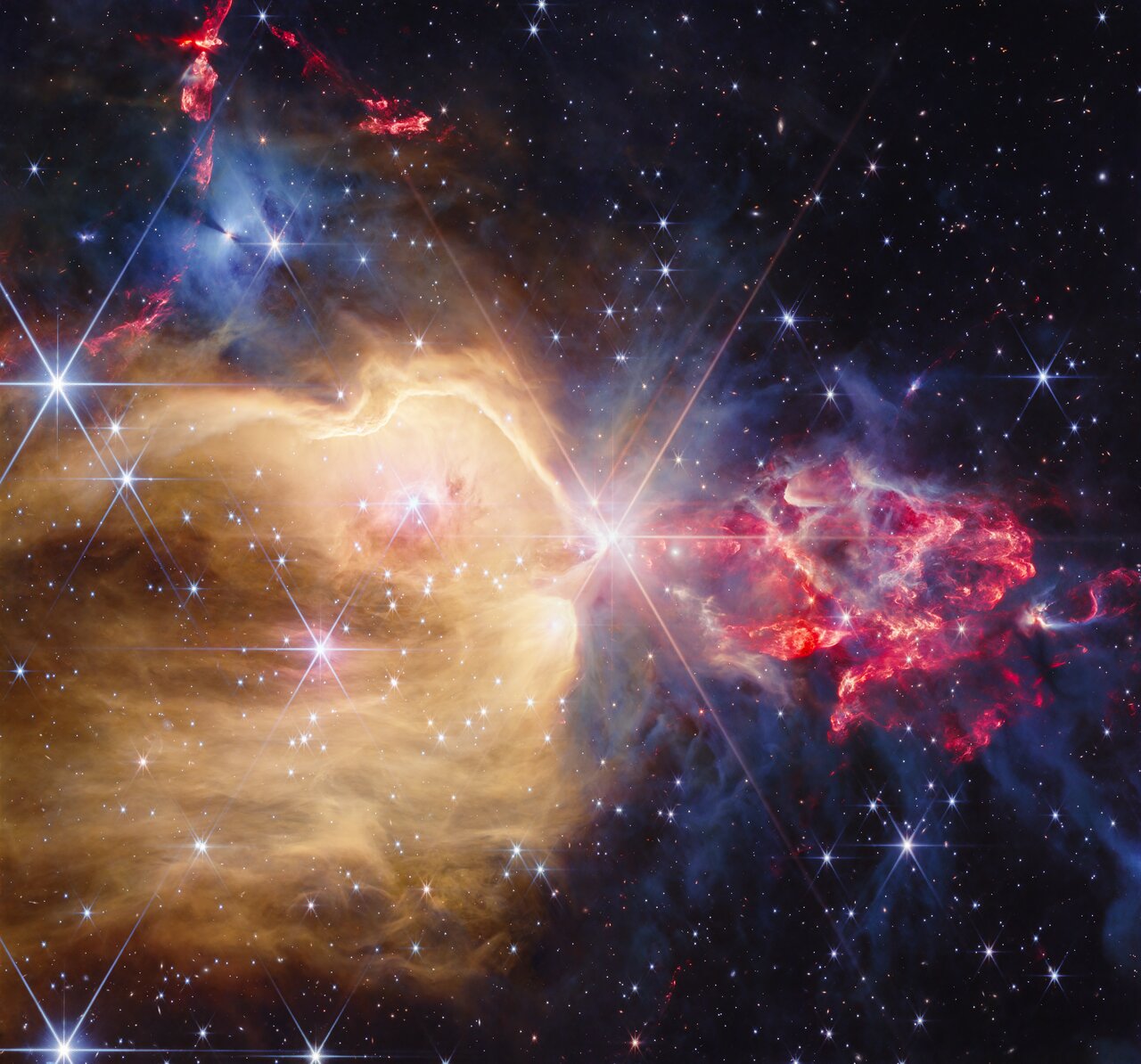
Image: NASA, ESA, CSA, STScI, JWST; processing: A. Pagan (STScI). Original page
Several ages in one cloud
A star does not switch on all at once. Gravity first gathers cold, dense material in a molecular cloud into a dust-wrapped protostar. As it keeps collecting mass, it contracts and heats up before settling into the main sequence. Visible light is easily blocked by that dust; near-infrared light can pass through some of it, allowing Webb to find the hidden stellar infants.
The bright central star is LkHα 234, a pre-main-sequence star with about five to eight times the Sun's mass. The golden cavity to its left spans roughly 3.5 light-years. Earlier outflows and starlight have pushed into the molecular cloud, heating and clearing part of it. Some gas has been blown away, while other gas has been compressed into conditions where another generation of stars might form.
The red region on the right is more like a tangled bundle of yarn. It hides younger protostars wrapped in dust. They launch hot material from their poles; when those outflows hit dense gas, they create shocks and glowing textures. Several stars are launching outflows at once, and their structures overlap along our line of sight, making the region look especially chaotic.
Why do newborn stars blow things out?
As a cloud collapses, its rotation speeds up, just as a skater spins faster after pulling in their arms. If the collapsing material could not get rid of angular momentum, it would resist falling into the center. The material forms a rotating accretion disk, and magnetic fields can guide some of it along the rotation axis into two opposing jets. Those jets carry angular momentum and energy away, helping the remaining material continue inward.
The outflows do not disappear. They slam into the surrounding gas like a pressure washer hitting a wall, heating and compressing it. The red filaments and clumps are shaped by these shocks and by several protostellar outflows crossing the same view.
At the top of the golden cavity, the sharp ridge marks a photodissociation region: intense starlight breaks molecular hydrogen into individual atoms. In the blue area at upper left, a protostar's disk casts a shadow across the surrounding nebula, revealing the relationship between the disk and the light source.
Webb's view brings several stages together in one frame: pre-main-sequence stars that have nearly finished gathering mass, protostars still accreting, and the cloud they are all reshaping. Comparing such different stages helps astronomers work out which physical processes matter most, and when.
NGC 7129 itself is a difficult target for casual viewing. It is faint and small, and its detailed colors come from Webb's infrared observations rather than from what the unaided eye can see. But the idea is easy to carry outdoors: a star is born while it is spinning, feeding, and blowing its surroundings into a new shape.