
Mist drifts between the stones at Avebury. Nearby blocks stand out sharply; farther away, their outlines dissolve into pale gold air. This corner of Wiltshire looks like a field scattered with rocks. Pull back, though, and the monument is large enough to contain roads and a village.
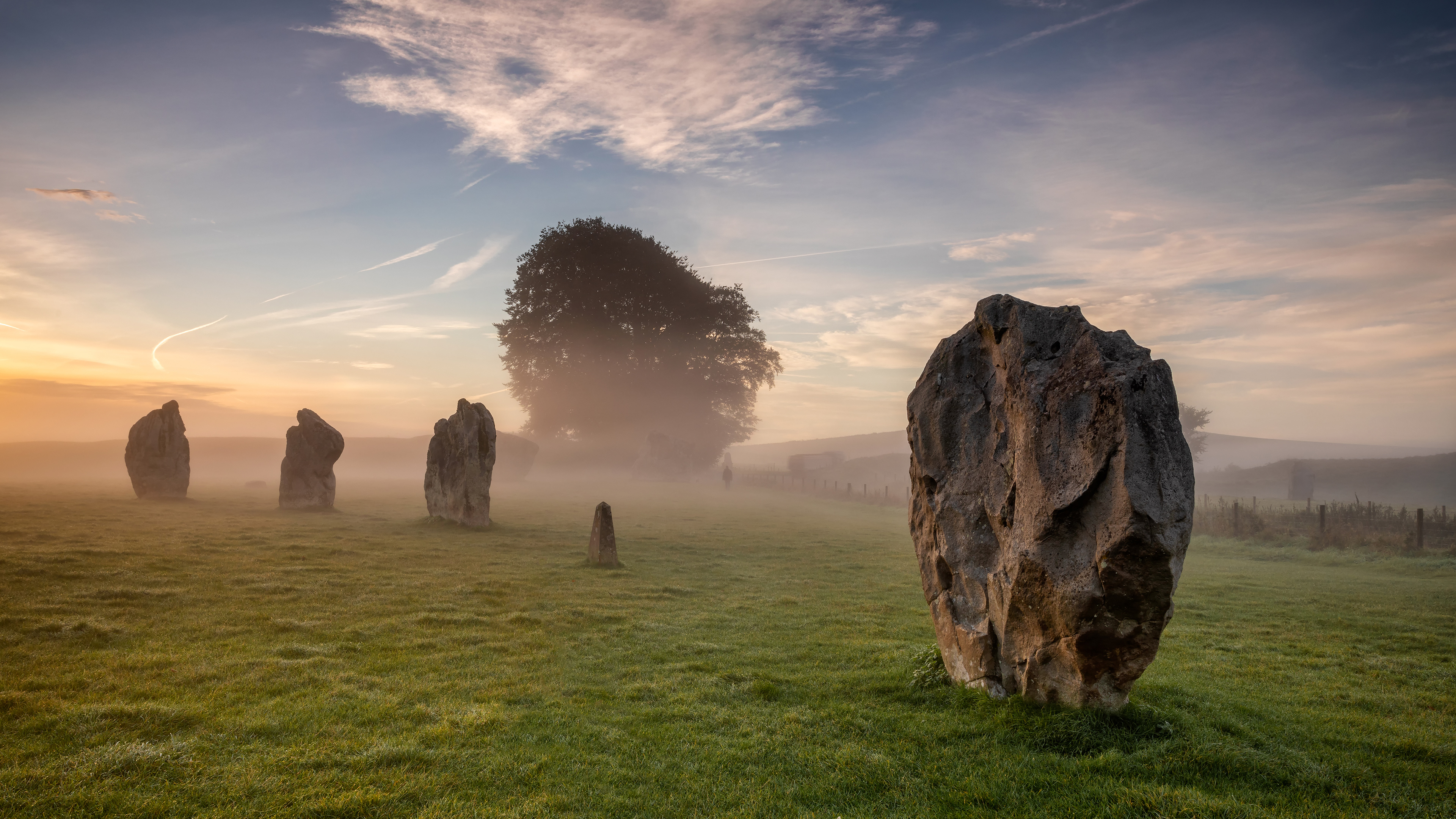
Image: 立石,埃夫伯里,威尔特郡,英格兰 (© George W Johnson/Getty Images) · Original page
Read the earthworks first
English Heritage describes several layers: a circular bank, a ditch inside it, a great stone circle, and two smaller circles within. Four entrances cross the earthworks, while avenues of stones connected Avebury to other ceremonial places.
The arrangement matters. An internal ditch does not fit the most straightforward defensive design. Archaeologists interpret Avebury as a ceremonial space, although its layout cannot supply a complete script for what happened there. Processions, gatherings and boundaries are interpretations of the surviving spaces.
The main period of building and alteration ran from about 2850 to 2200 BC, according to the site's history. Successive generations changed it, and the precise sequence of banks, ditches and circles remains incompletely understood.
Some stones stood up twice
During the Middle Ages, stones were buried or destroyed. Later building and agricultural work removed more. Early antiquarians' drawings and records became clues to the lost arrangement.
In the late 1930s, Alexander Keiller, heir to a marmalade fortune, bought the site, cleared buildings and re-erected many stones. The apparently timeless scene therefore includes modern conservation work. Preserving a monument can mean helping fallen things stand again, while remembering that they once fell.
At Avebury, trace the ditch beside the bank before following a road through the circle. Or sketch the bank, ditch and nested circles on paper. Their positions relative to one another change how the whole place reads.