
A technician in a clean room inspects a towering spacecraft component. This is not the telescope's mirror. It is the sunshade that will help the telescope work, keeping unwanted sunlight out while generating electricity for the spacecraft.
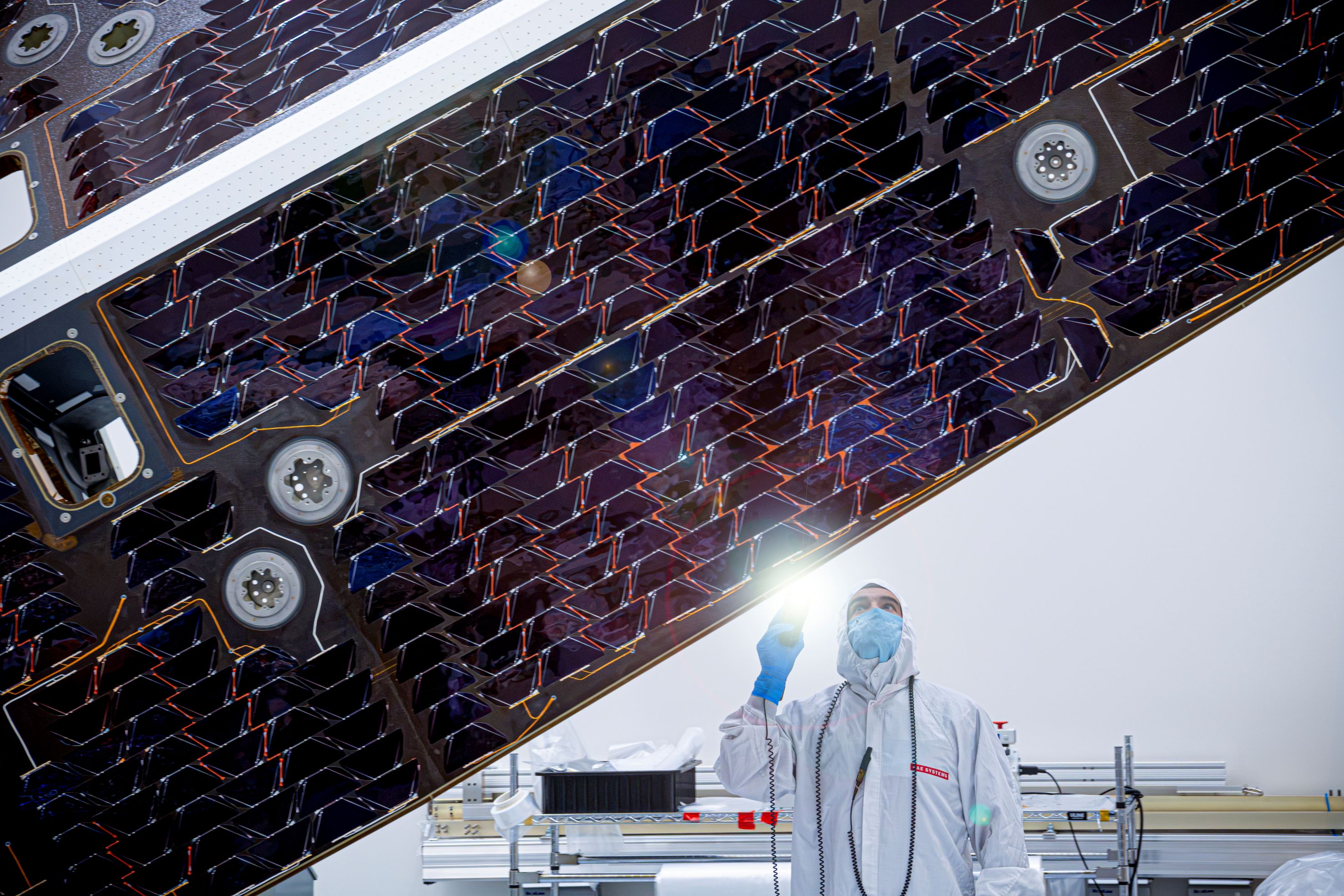
Image credit: BAE Systems Space & Mission Systems. Original page. Photographed in late July 2026; featured as NASA's Image of the Day on October 27.
NEO Surveyor is an infrared space telescope now being developed to search for near-Earth objects. As NASA's mission overview explains, dark asteroids reflect little visible light but still warm up in sunlight and emit infrared radiation. Searching at these wavelengths can reveal objects that optical surveys more easily miss.
The UCLA mission team's explanation describes a familiar ambiguity: a large, dark asteroid and a small, reflective one can send back similar amounts of visible light. That bright point alone does not reveal which you have. Infrared observations constrain size more directly, although temperature and distance still matter. Received infrared brightness is not a direct reading of diameter.
The telescope itself must stay cold. Its sunshade blocks solar glare and helps keep the infrared instrument cool, particularly important when searching toward the Sun's general direction. This does not mean pointing straight at the Sun, nor does finding a near-Earth object mean that it will strike Earth.
NASA's October 26 engineering update gives the sunshade's dimensions: about 6 meters tall and 2.4 meters wide at the base. Two panels meet at a 23.5-degree angle. Their 864 interconnected solar cells can supply up to 2 kilowatts and charge the onboard batteries. Shielding and power generation share one large component.
The telescope will image the same sky in two infrared bands. Those measurements help estimate an object's temperature and then its size. Repeated observations track its changing position. Finding an object, estimating its size and determining its orbit are all part of assessing risk.
NASA currently lists launch as no earlier than September 2027, a future plan rather than a completed milestone. Open the interactive spacecraft model and turn it around: the Sun-facing side collects energy while the protected telescope searches for faint infrared targets.