
Pink filaments curl through a blue-purple cloud, tracing something like a treble clef. The scene resembles a piece of cosmic sheet music, but the telescopes recorded light: this image combines observations made in several different bands.
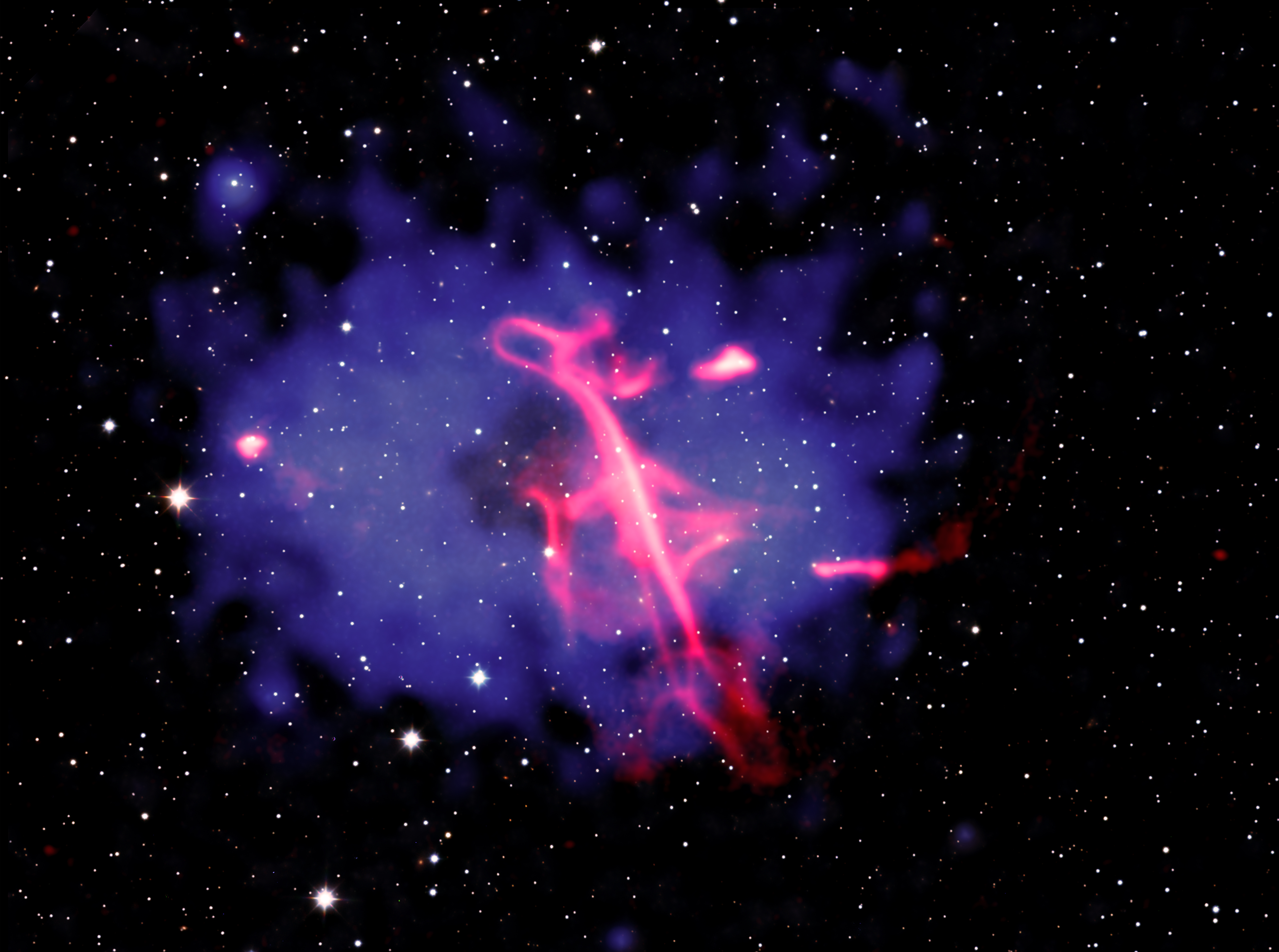
Image: NASA Image of the Day. X-ray: NASA/CXC/INAF-IRA/A. Botteon et al.; Infrared: UKIDSS-GPS; Radio: ASTRON/LOFAR; Image processing: NASA/CXC/SAO/N. Wolk. Original page.
Three kinds of light, three pieces of the puzzle
The Treble Clef lies behind the plane of the Milky Way. Stars, gas and dust in our own galaxy obscure the view. Astronomers needed several observational windows to work out what environment the curling structure inhabits.
NASA's account of the research explains the colors. Blue represents X-ray observations from Chandra and eROSITA, revealing gas at multimillion-degree temperatures. Red represents radio observations from Europe's LOFAR array, tracing the filaments. Mostly white points come from infrared observations by the United Kingdom Infrared Telescope. The colors distinguish datasets; they do not show how these objects would appear to unaided eyes.
The hot gas reveals a merging galaxy-cluster system. Clusters contain much more than their member galaxies: extremely hot, thin gas fills the space between them. A collision stirs and compresses this gas, leaving traces different from those of the galaxies themselves.
Giving old particles another chance to shine
Andrea Botteon and colleagues classify the source as a "radio phoenix." Their research paper describes a possible history in which an active supermassive black hole in a central galaxy once drove jets carrying charged particles and magnetic fields outward. Over time, the particles lost energy, and the radio emission faded.
The cluster merger could then compress or reenergize this old plasma, a thin material made of charged particles, making it easier for radio telescopes to detect again. The phoenix metaphor describes renewed emission.
The detailed shapes remain an open question. The paper's simplified scenario emphasizes mixing and stretching by gas motions during the merger. It does not establish that each curved filament marks a shock front. Shocks may help generate turbulence without having a direct correspondence to every visible strand.
Subtracting an oval glow
Much of the X-ray emission follows a roughly oval, symmetrical distribution. The team subtracted a model of that smooth background to inspect the differences. Brighter residual emission on either side of the center helped them infer the broad direction of the collision. The composite includes both the original X-ray image and the residual data.
It is a little like removing a steady hum from a recording so that changes become easier to hear. Here, the useful information lies in departures from a smooth glow.
NASA published this Image of the Day on October 15, using a composite introduced in its October 14 research release. Open the research page and look first at the extent of the blue gas, then follow the red filaments. Where do they overlap, and where do they go their own ways? Those differences lead closer to the astronomers' questions than recognizing a musical symbol does.