
Today's Astronomy Picture of the Day has no nebula or planet. It is a patch of pale beige.

Image: NASA Astronomy Picture of the Day | Color calculation: Karl Glazebrook and Ivan Baldry, Johns Hopkins University | Original page
The color is #FFF8E7, nicknamed Cosmic Latte. It is not what the night sky looks like. The question behind it is narrower and more playful: if the light emitted by many galaxies were collected and combined, what color would a human observer perceive?
Light from 200,000 Galaxies
Astronomers Karl Glazebrook and Ivan Baldry worked with data from the 2dF Galaxy Redshift Survey. Their study of roughly 200,000 galaxy spectra was aimed at the history of star formation. Once they had assembled a composite "cosmic spectrum," its perceived color became an unexpected side question.
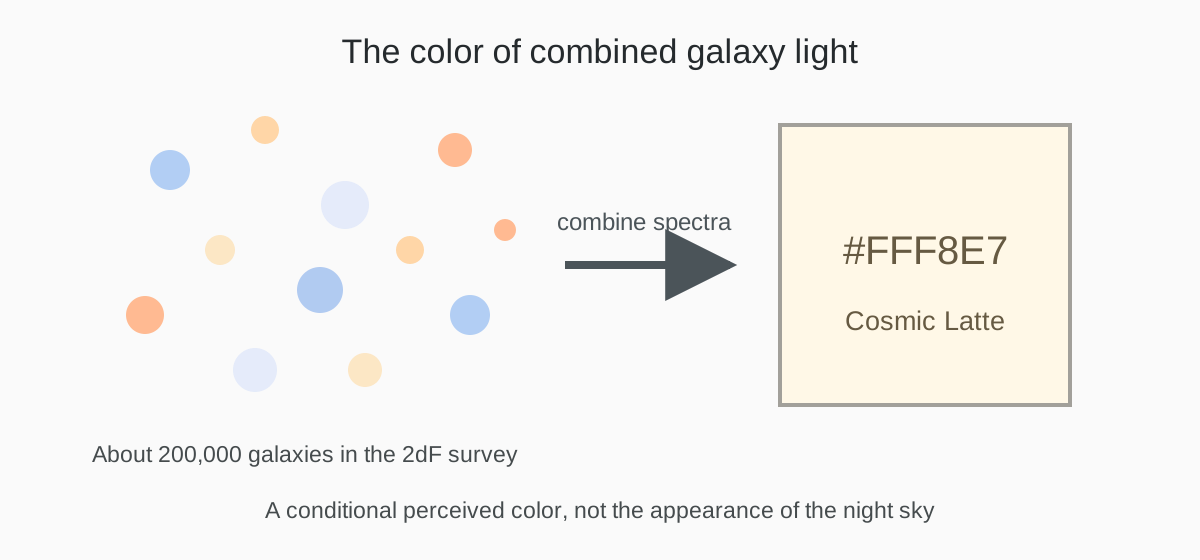
The first answer the team announced was a pale turquoise. After it attracted attention, they found a problem in the conversion from spectrum to perceived color. They publicly corrected the result to beige in 2002. As Johns Hopkins explained at the time, perceived color also depends on viewing conditions. The hex code is therefore a rendering under particular assumptions, not an unchanging color that the universe would show in every setting.
Why the Sky Still Looks Black
Cosmic Latte describes collected and combined galaxy light. It is not the average pixel color of a photograph of the sky. Most directions in the night sky are extremely faint; starlight is spread across vast distances. That is why the sky still looks dark to our eyes. The two observations answer different questions.
NASA's September 28 explanation adds that the composite color has become much less blue over roughly the past 10 billion years. The changing contribution of young, hot blue stars makes color one clue to the history of star formation.
This may be one of astronomy's simplest images: a single field of color. Behind it are the light of some 200,000 galaxies, a public scientific correction, and a way to read the age of stellar populations.
Sources
NASA Astronomy Picture of the Day: Original page; Johns Hopkins University: 2002 color correction; 2dF Galaxy Redshift Survey paper.