
Today's NASA Astronomy Picture of the Day features Omega Centauri, the Milky Way's largest and brightest globular cluster, and the only cluster still bearing a star's name.
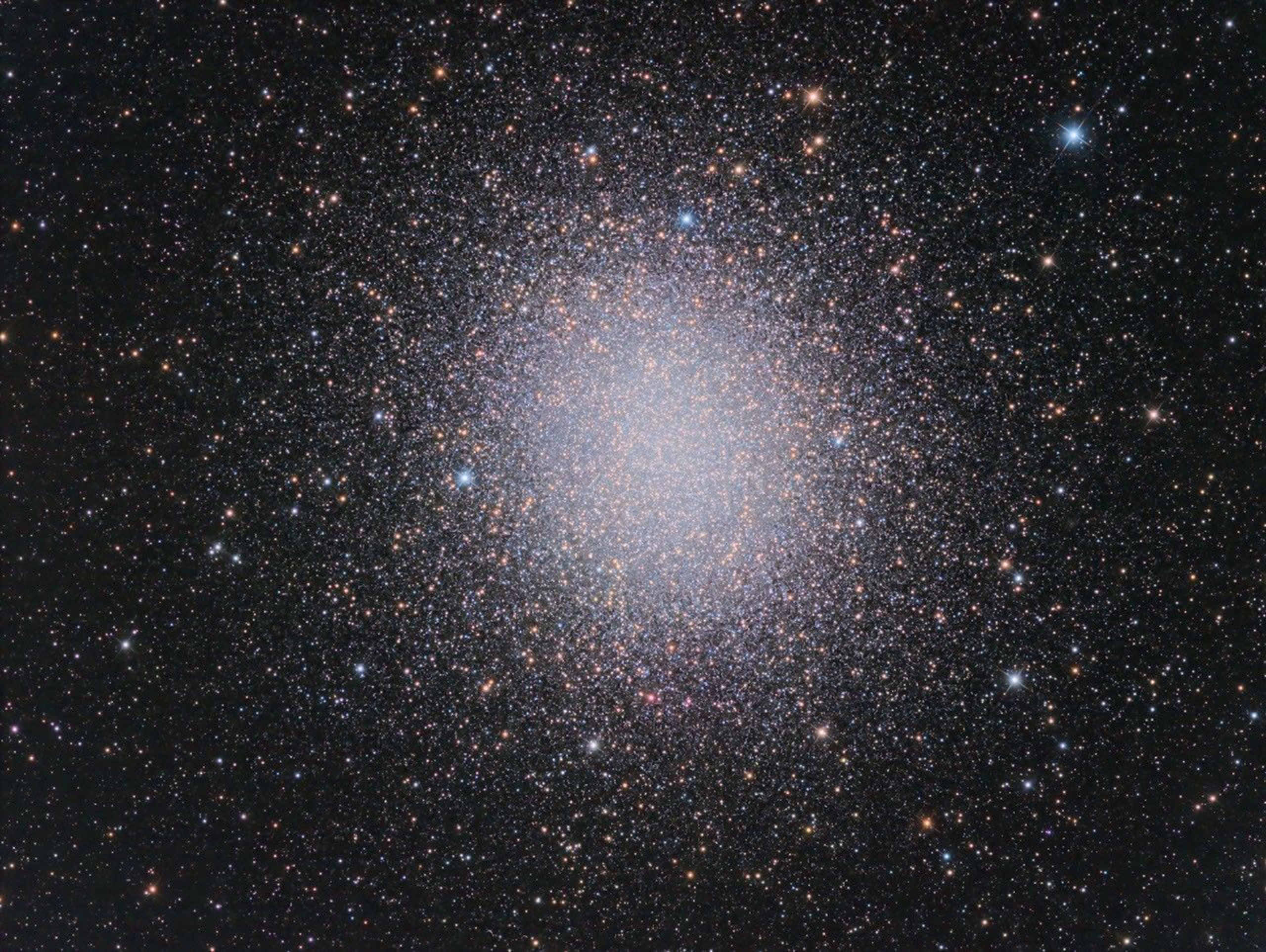
Image: NASA Astronomy Picture of the Day (APOD) | Image Credit & Copyright: Javier O. Cadenas Parra | Original page
There is a great deal inside this photograph.
According to APOD, that ball of light holds about 10 million stars, almost all much older than the Sun. It spans about 150 light-years and lies 15,000 light-years away. Among roughly 200 known globular clusters in the Milky Way's halo, it is the largest and brightest. The conspicuous yellowish points are red giants, stars swollen near the ends of their lives.
Then there is its name: Omega Centauri.
Omega is a Greek letter. Greek letters are used to name stars.
One "Star," Two Independent Mistakes
In 1603, the German astronomer Johann Bayer published Uranometria, assigning Greek letters to stars within their constellations. In Centaurus he saw a fairly faint point of light and gave it omega. That was 423 years ago.
Much earlier, Ptolemy's Almagest had cataloged it as a fifth-magnitude star. According to star-name scholar Ian Ridpath, Ptolemy placed it on the centaur's back, where the human and horse portions meet.
In 1677, the young Edmond Halley went to Saint Helena in the South Atlantic to chart the southern sky, measuring 341 stars in a year. His twenty-first entry for Centaurus described this object as nebulous. Ridpath cautions against the familiar claim that Halley discovered Omega Centauri was not a star: he described its hazy appearance, whereas Ptolemy had simply listed a fifth-magnitude star without mentioning haze. The first clear recognition of it as a globular cluster is generally credited to James Dunlop in 1826, although some accounts trace its identification back to Halley.
Across the world, it had acquired another name.
In Chinese astronomy, it is Kulou Zeng Yi: the first added star of Kulou.
Chinese-Western star concordances place Omega Centauri in Kulou, the Arsenal asterism, within the Horn mansion of the Azure Dragon of the East. It is the asterism's first supplementary star. The Chinese entry adds a crucial detail: it was introduced when the Qing imperial astronomical bureau compiled Yixiang Kaocheng, and only later recognized as a globular cluster rather than a star. A reliable source for the compilation's exact completion year was not established.
Two civilizations, half a world apart, each mistook the same collection of ten million stars for a single star, then gave it an appropriately stellar name. One used a Greek letter, the other an asterism and a number. Both names survive.
Ancient Chinese astronomy was not simply blind to the southern sky. Nanmen, the Southern Gate asterism in the Horn mansion, includes Nanmen Er, or Alpha Centauri, at a declination of -60.8 degrees, 13 degrees farther south than Omega Centauri. Kulou itself is a large asterism spanning Centaurus and Lupus, with a history reaching back to the second century BCE.
The additions that required a translation project lay farther south: the Cross, Sea Rock, Bee, Peacock, Crooked Running Water, and Flying Fish, among 23 asterisms near the south celestial pole. Xu Guangqi and Johann Adam Schall von Bell incorporated them from Western charts into the late-Ming Chongzhen Calendar Compendium. A 2023 study in the history of science identifies their immediate sources as Grienberger's star catalog and Bayer's charts, with the original observations coming from Hipparchus and the Dutch navigator Keyser, rather than Tycho Brahe, as is often assumed.
The Combined Star Map of the Northern and Southern Celestial Hemispheres, drawn in the sixth year of the Chongzhen reign, expanded the traditional 1,461 stars to 1,812. Translation had moved the southern boundary of China's sky.
The Biggest Cluster Does Not Have the Most Crowded Core
Globular clusters look crowded, and Omega Centauri is the biggest and brightest. It is tempting to assume that it must also be the most densely packed.
The standard catalog of globular-cluster parameters says otherwise. Its central luminosity densities, expressed as base-10 logarithms, are 3.15 for Omega Centauri, 3.55 for M13 in Hercules, 3.63 for M22 in Sagittarius, and 4.88 for 47 Tucanae.
On that measure, 47 Tucanae's core is about 54 times as dense as Omega Centauri's. Even M13 and M22 are more crowded. Size and central density describe different things.
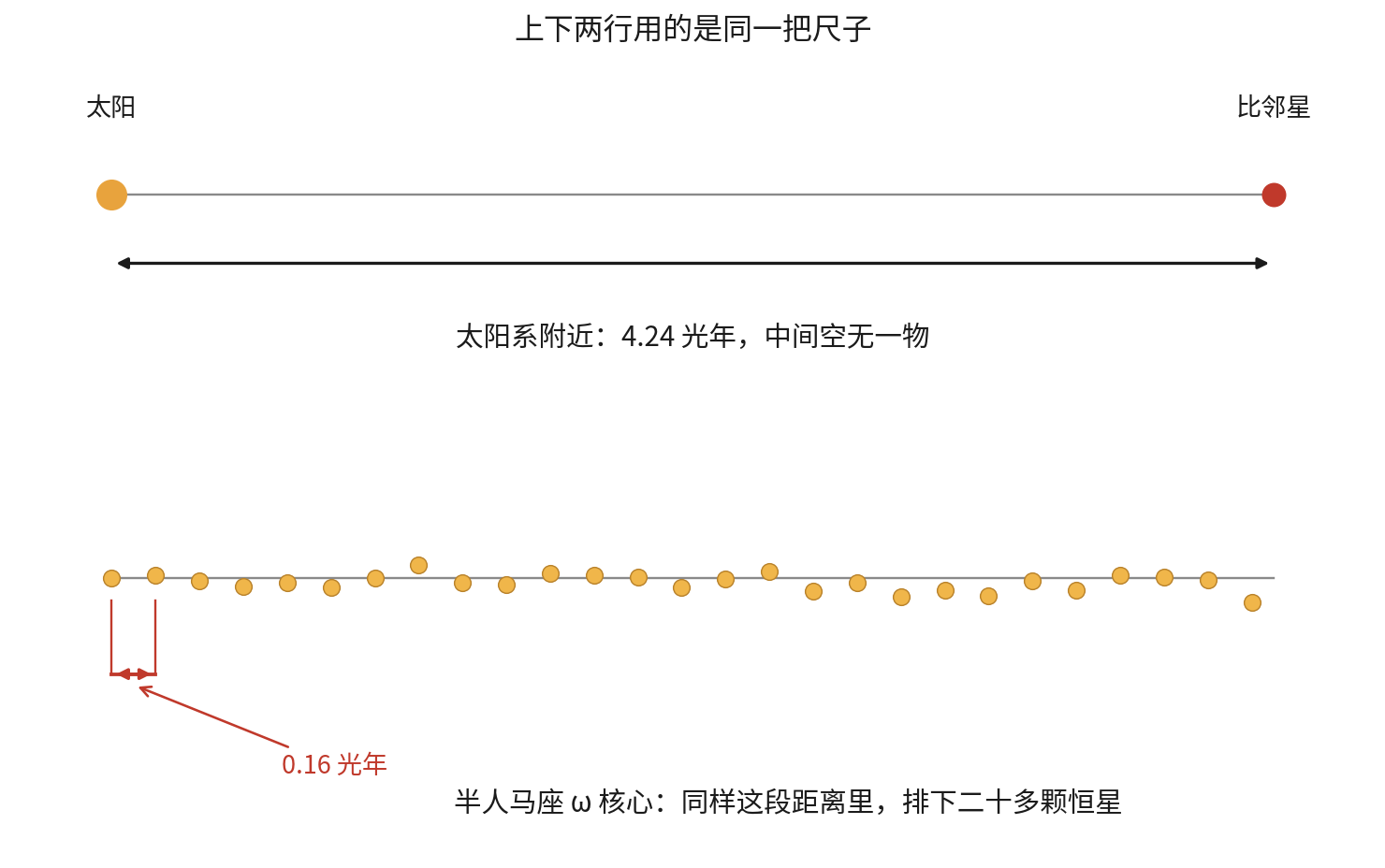
Omega Centauri is still extraordinarily crowded by our standards. A 2018 study in The Astrophysical Journal put the average separation between stars in its core at about 0.16 light-years. The Sun's nearest neighbor, Proxima Centauri, is 4.24 light-years away, more than 20 times farther. The study estimated that a core star experiences a close encounter with a neighbor about once every million years, frequent enough to disrupt planetary orbits in the habitable zone. The researchers therefore considered the core an unlikely place for stable homes for life.
A claim circulating online imagines an Earth inside a globular cluster beneath a night sky 20 times brighter than a full-moon night, with more than a thousand stars brighter than Sirius. Those figures actually come from simulations of 47 Tucanae, rather than Omega Centauri. Other estimates suggest that even a globular cluster's core would have a night sky dimmer than a full-moon night. With the estimates differing by more than a factor of a hundred, such descriptions cannot simply be transferred to Omega Centauri.
The Heart of a Swallowed Galaxy
APOD makes a quiet but consequential observation: unlike most clusters, Omega Centauri contains multiple stellar populations with different ages and chemical compositions. It may be the remnant nucleus of a small galaxy being incorporated into the Milky Way.
Several lines of evidence support that possibility.
The simple picture of a globular cluster begins with a cloud of gas collapsing and producing stars together, giving them the same age and composition. Omega Centauri does not fit. The European Southern Observatory describes several generations of stars within it, an anomaly in that standard picture. Its mass is about 4.05 million Suns. NASA describes it as roughly ten times as massive as other large globular clusters, approaching the scale of a small galaxy. Its orbit is retrograde.
A 2019 paper in Nature Astronomy, linked directly from APOD's explanation, identified the Fimbulthul tidal stream as belonging to Omega Centauri. It extends 28 degrees from the cluster, tracing outer stars pulled away by the Milky Way's tidal forces.
The picture is of a galaxy torn apart: its outer stars stripped away, its densest central part left behind.
A 2026 study adds another possibility. Omega Centauri and halo streams called Thamnos and Sequoia may be different layers stripped from the same disrupted dwarf galaxy. Outer layers would have been removed first, inner layers later, leaving apparently separate fragments with a shared origin. Whether this system was related to the better-known Gaia-Sausage/Gaia-Enceladus merger remains uncertain, as the paper carefully states.
A Black Hole Still Under Debate
APOD's final sentence notes that two decades of Hubble observations have revealed evidence for a massive black hole near the cluster's center.
The evidence has prompted an argument that is still unresolved.
In July 2024, an international team published a result in Nature after examining more than 500 Hubble images spanning 20 years. Within 0.08 parsecs of the cluster's center, they found seven unusually fast-moving stars. The lead author explained that the stars were moving so fast they should have escaped the cluster altogether. Something near the center must be holding them. The inferred black hole would have a mass of at least 8,200 Suns. That is a lower limit, rather than a measured mass.
The figure falls in a conspicuous gap. Familiar black holes range from remnants of dead stars, with tens of solar masses, to galactic-center giants containing hundreds of thousands to billions of solar masses. The territory between is sparsely populated by known examples. Astronomers describe intermediate-mass black holes as a rare missing link in black-hole evolution.
In January 2025, another team combined stellar motions with pulsar timing and obtained a 3-sigma upper limit of 6,000 solar masses. They favored a concentration of 10,000 to 20,000 stellar-mass black holes as the source of the central gravitational pull. Their result did not exclude an intermediate-mass black hole; it constrained how massive one could be.
That July, a different paper approached the problem through dynamical modeling. A seed black hole of 500 to 5,000 solar masses, repeatedly merging with stellar-mass black holes of 30 to 40 solar masses, could grow to about 50,000 solar masses over 12 billion years.
A paper appearing in late 2025 and early 2026 used the Webb telescope to search for an accretion signal and detected none. Its authors included members of the original 2024 Nature team. They concluded that the non-detection need not contradict the mass range inferred from the fast-moving stars.
A result featured on Nature's cover in 2024 remains unsettled after two years of scrutiny. The competing measurements and models are the work of science in progress.
The Photographer Is Not an Observatory
APOD credits the photograph and its copyright to Javier O. Cadenas Parra.
He is an amateur astrophotographer, rather than a professional astronomer. Chilean astrophotography community records describe him as a stargazing tourism guide from Quirihue, in central Chile's Ñuble region. They also record his belief that good photographs are possible with entry-level equipment, often no more than ordinary DSLR lenses.
Public records do not specify when or where this Omega Centauri photograph was taken, or what equipment was used.
The image on NASA's site today comes from someone whose everyday work includes guiding other people beneath the stars.
Sources
NASA Astronomy Picture of the Day, September 25, 2026; the Harris catalog of Milky Way globular-cluster parameters, McMaster University; Kane and Deveny, The Astrophysical Journal (2018), on stellar spacing and encounter rates in Omega Centauri's core; a University of California, Riverside news release; official releases from the European Southern Observatory and ESA/Hubble; Ibata et al., Nature Astronomy (2019), on the Fimbulthul tidal stream; Häberle et al., Nature (2024), on fast-moving stars and an intermediate-mass black hole; Bañares-Hernández et al., Astronomy & Astrophysics (2025); 2025 papers on intermediate-mass black-hole growth in Omega Centauri and Webb observations; the 2026 oMEGACat X study; Ian Ridpath's Star Tales, on Ptolemy's and Halley's records; Chinese-Western asterism concordances, on Kulou Zeng Yi; the Hong Kong Space Museum's table of asterisms near the south celestial pole; Ji Xiang, a study tracing the southern polar stars added in the Chongzhen Calendar Compendium, The Chinese Journal for the History of Science and Technology, issue 3 (2023); and AstroFotografiaChile's photographer profile.