
The peaks around Misurina in Italy's Dolomites
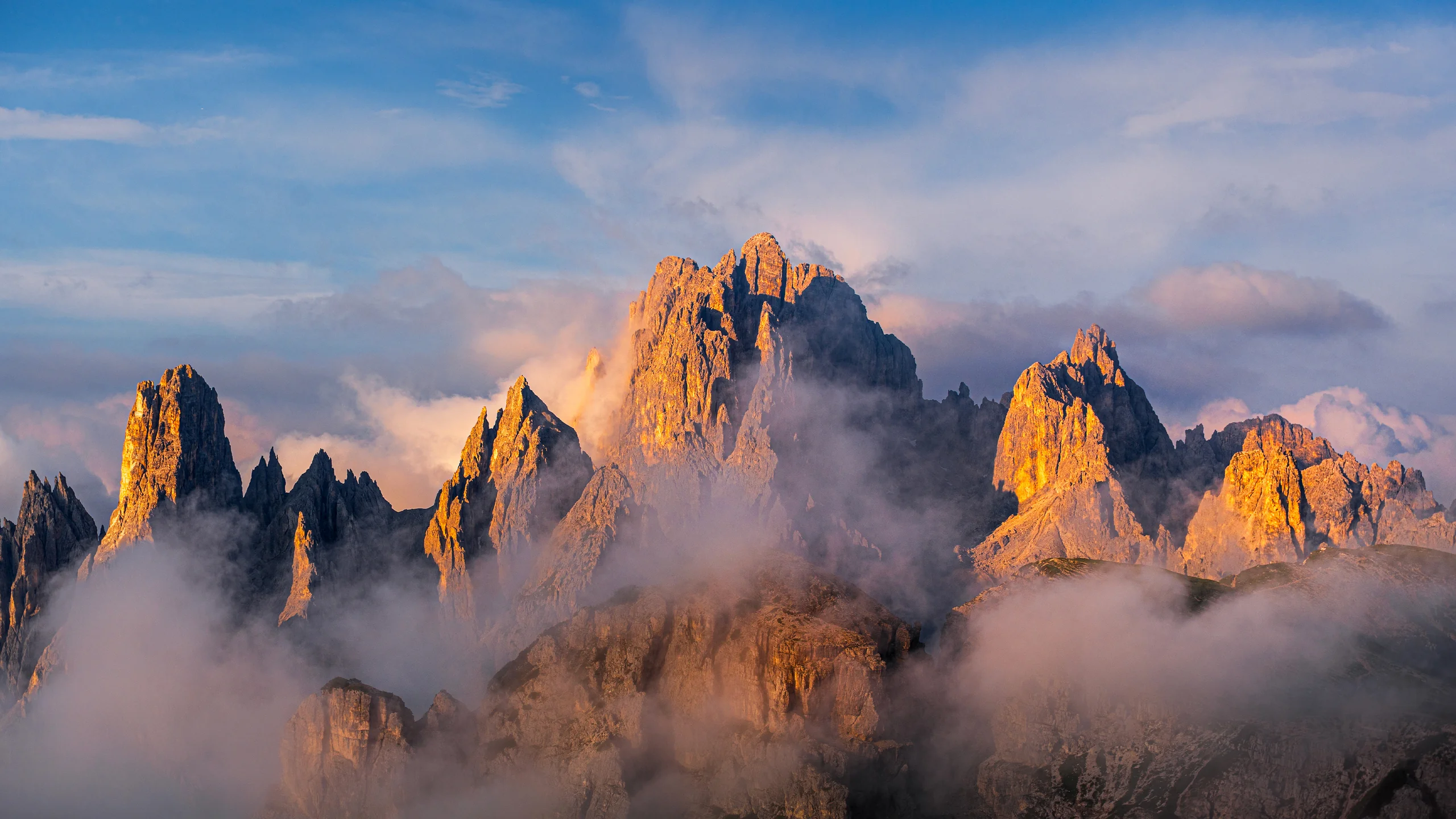
Image: Bing Daily Wallpaper | Peaks around Misurina, the Dolomites, Veneto, Italy (© Vithun Khamsong/Getty Images)
Open Bing today and a row of stone towers rises across the homepage. They are almost vertical, with uneven tops, as if someone split a city skyline down the middle and left only its narrowest buildings standing. Bing gives the photograph a curious title: "Coral reefs at high altitude."
A reef? These rocks approach 3,000 meters above sea level and stand more than 100 kilometers from the nearest coast.
Yet the title is more than half right. Long ago, the mountains in the photograph were submerged in a warm, shallow sea, and reefs did grow there. Bing leaves out the most interesting part: coral did not do most of the building.
The Towers in the Photograph
This group is the Cadini di Misurina, in Belluno Province in Italy's Veneto region, beside Lake Misurina. Its highest peak is Cima Cadin di San Lucano, at 2,839 meters. The group belongs to the Northern Dolomites and lies near the more famous Tre Cime di Lavaredo.
The shape is no accident. It is the signature of the Dolomites: not rounded ridges, but ranks of nearly vertical towers, pinnacles and columns. When UNESCO placed the Dolomites on the World Heritage List in 2009, its first justification was not scientific value but beauty, arising from "a variety of spectacular vertical forms such as pinnacles, spires and towers." That combination is unusual among natural heritage sites: the Dolomites qualified under criteria for both beauty and scientific importance.
How a Sea Became a Mountain
Begin with the sea.
About 240 million years ago, what is now northern Italy lay beneath a shallow tropical part of the Tethys Ocean. UNESCO's official description uses a lovely phrase for what remains: "fossilized atolls." The Dolomites UNESCO Foundation is more direct. Organisms that needed sunlight began building reefs, atolls and small islands, leaving behind "a unique fossil archipelago."
An archipelago, not a single reef. The distinction matters. Reefs occupied the shallow sea, lagoons lay between them, and deeper basins opened beyond. Different rocks settled in each environment.
Then the reefs stopped growing. The sea had not retreated; volcanoes intervened. Around 236 million years ago, enormous eruptions struck the region, and lava and volcanic rocks buried and altered the existing reefs. Only after the volcanism ended did reef growth resume.
Layer upon layer of sediment eventually accumulated to more than 3,000 meters thick, recording events from 270 million to 25 million years ago. Compare that with the 2,839-meter peak in the photograph: the pile of rock itself is thicker than the mountain it built.
How did it travel from the seabed to the sky? Late in the Cretaceous, the African plate collided with Europe. The Dolomites UNESCO Foundation says the collision caused the sediments to emerge from the sea and form mountains. Further compression, thrusting and faulting followed in the Eocene and Neogene.
The simplest way to hold the story in mind is this: every stone pinnacle in the photograph is a piece of seabed turned upright.
Then Who Built It?
Now for the part Bing leaves out.
Read UNESCO's official justification for the Dolomites and one omission stands out: it never uses the word "coral." Instead, it chooses the more careful term bio-constructors, saying the site's importance lies partly in showing how reef-building organisms evolved after the Permian-Triassic boundary.
That caution is not stylistic. It is scientifically necessary.
A 1993 paper on Anisian bioherms in the northern Dolomites, the region shown here, was emphatic: low-diversity corals played no significant part in building the organic framework. Calcareous sponges, bryozoans and several calcareous algae did the work.
By the later Ladinian to Carnian stages, the cast had changed. A 2019 study of reef boulders around Misurina found a startling proportion: microbialites make up an average of 75% of the reef framework and as much as 90%, while large fossils visible to the naked eye account for only about 20%.
Microbialite is rock made when films of bacteria and algae trap and bind calcium carbonate layer by layer until it hardens. It has no skeleton or clear shape; its layers appear only under a microscope.
The real reef, then, looked like this: it was built not mainly by crowds of brightly colored coral polyps, but by sponges, calcareous algae and layer upon invisible layer of microbes, piling their remains into a mountain over millions of years. The uniform gray-white mass visible today is honest. There was never much obvious structure to see.
One qualification is essential: the two periods cannot be collapsed into one sentence. The 1993 paper specifically found microbial crusts rare or entirely absent from the Anisian reefs it studied. Microbialites became overwhelmingly dominant later. Over 30 million years, the reef-building crew changed.
Another caution is worth adding. In its descriptions of the famous vertical walls at Tre Cime and Monte Paterno, the Dolomites UNESCO Foundation identifies the formation as Dolomia Principale, or Main Dolomite. This formed in shallow lagoons and tidal flats during the Norian. It is not a reef; it is the floor of the shallow water beside one. No primary geological source was found that establishes the precise formation of the Cadini di Misurina, so the claim must stop here: the Dolomites as a whole are a fossil archipelago, but not every peak is a reef. Some peaks are reefs; others are the lagoon floors the reefs enclosed.
That may be more memorable than "coral reefs at high altitude."
The Rock Itself Is a 200-Year-Old Unsolved Problem
The Dolomites are named for a person.
Déodat de Dolomieu, born in France in 1750, was a mineralogist. In 1791, he found a rock in Tyrol that resembled limestone but behaved differently: dilute hydrochloric acid did not make it fizz. Limestone reacts with acid and releases bubbles of carbon dioxide. This rock did not. He published the observation in the French Journal de Physique. The following year, another scholar, Saussure, named the material dolomie after him: dolomite, CaMg(CO3)2.
The test is simple enough for a child to understand: limestone fizzes; dolomite does not. In dolomite's crystal lattice, magnesium replaces half the calcium.
Dolomieu's own story ended badly. He became a prisoner of war at Taranto in 1799 and was transferred to Messina in Sicily, where he spent 21 months in solitary confinement under appalling conditions. In prison, he completed his principal work on mineralogy in the margins of a Bible.
The rock he discovered later left geology with a puzzle that has remained open for two centuries: the dolomite problem. Thick deposits of dolomite, sometimes kilometers deep, occur across Earth's surface. Yet under ordinary temperatures and pressures, researchers have found it extraordinarily difficult to grow dolomite crystals in the laboratory. If we cannot reproduce the process, we cannot fully explain how the ancient rock formed.
A paper published in Science in November 2023, led by Joonsoo Kim with Wenhao Sun of the University of Michigan as corresponding author, proposed a mechanism. Dolomite accumulates structural defects as it grows and eventually blocks its own growth. Repeatedly washing those defects away, perhaps through cycles of rain or tides, lets growth continue. The Chinese Academy of Sciences highlighted the same key point in its report: removing defects from the mineral structure during growth.
It is an elegant breakthrough. But mind the scale. The laboratory-grown dolomite was about 100 nanometers thick, roughly 300 layers. Before this work, researchers had never grown more than five.
The distance from five layers to 300 is still far smaller than the distance from 300 layers to a mountain more than 3,000 meters thick. The result should not be presented as "the dolomite problem has been solved." A 2024 commentary in Nature Geoscience said the problem may now be closer to a solution, not that it was solved. The State Key Laboratory of Biogeology and Environmental Geology at China University of Geosciences (Wuhan) is more direct: the dolomite problem remains a focus of international scientific controversy.
Humanity has known one of the world's most common rocks for more than 200 years and still does not fully understand how it formed. That is closer to the everyday reality of science than any tidy answer.
The Same Rock in China
This story is not distant from China. It has two connections, and then a third.
The first is the rock itself. One Chinese natural World Heritage property was listed specifically because it is dolomite: Shibing in Guizhou. UNESCO's official evaluation of the South China Karst says Shibing offers a spectacular fengcong landscape and is also special because it developed in relatively insoluble dolomite.
"Insoluble" is the important word. Karst usually develops in limestone because limestone dissolves quickly. Dolomite is harder to dissolve, so erosion produces different forms. Shibing joined the World Heritage List on June 23, 2014, as part of the second phase of the South China Karst property. Its dolomite karst covers 282.95 square kilometers.
In China, then, there is a vast expanse of the same rock as the Dolomites, worked by a different process. In Italy, compression, uplift and freeze-thaw action split it into towers. In China, rain slowly dissolved it into clusters of peaks.
The second connection is time. The China Geological Survey records the discovery and naming of the Luoping Biota in Yunnan in 2007. Its age was later narrowed to the Pelsonian substage of the Anisian in the Middle Triassic, with zircon in a sedimentary tuff layer dated to 244.2 Ma.
The 1993 paper mentioned above dated the northern Dolomite reefs to the middle to late Pelsonian.
The same substage, the same ancient Tethys Ocean, the same recovery. Marine ecosystems were rebuilding after the end-Permian mass extinction. To the west, sponges and microbes in the Dolomites were building reefs. To the east, ichthyosaurs and horseshoe crabs swam in the sea at Luoping. Qujing's municipal government says the Luoping Biota has yielded 113 species in 40 genera across eight phyla. Its horseshoe crab, isopod and millipede fossils were the first found in China.
Two hundred forty-four million years ago is roughly 3.7 times as distant as the extinction of the dinosaurs 66 million years ago.
The third connection concerns the unresolved problem. In a 2021 paper in Geology, Professor Song Haijun's team at China University of Geosciences (Wuhan) proposed that Phanerozoic dolomite may have consisted mainly of primary dolomite induced by anaerobic microorganisms, with variation in its abundance perhaps controlled by the ocean's redox conditions. Chinese researchers have a place in this 200-year debate.
What Makes the Mountains Turn Pink?
The Dolomites are famous for turning rose-colored at sunrise and sunset. Local speakers of Romance languages have a word for the phenomenon: enrosadira, roughly "turning pink." A local legend credits King Laurin, whose rose garden was said to cover the mountains.
The most common online explanation is that calcium and magnesium in dolomite reflect pink when sunlight hits the rock.
No authoritative support was found for that claim.
The Dolomites' own tourism website is notably restrained in its page about enrosadira. It first gives the physical explanation: when the Sun is near the horizon at sunrise or sunset, its light travels a longer path through the atmosphere and takes on warmer tones. It then adds a careful qualification: dolomite in the rock contributes to the phenomenon's distinctive appearance, but the colors we see mainly result from the interaction of sunlight, atmosphere, weather conditions and the characteristics of the rock face.
In plain language: the rock does not change color on its own. It is a white screen under a red light. At sunrise and sunset, sunlight cuts obliquely through the atmosphere. Blue light scatters away, leaving red and orange light. The Dolomites' enormous, near-vertical walls are pale, almost neutral gray-white, and reflect that light efficiently toward your eyes. A darker rock would absorb the same red light.
No scientific paper devoted specifically to enrosadira was found. The most accurate description is therefore ordinary atmospheric optics combined with an unusually suitable screen.
Why Today?
There is no reason.
I checked September 13 against the Dolomites, Dolomieu, dolomite, the UNESCO inscription and Italian geology, and found no connection. Dolomieu was born on June 23 and died in November. The Dolomites entered the World Heritage List in June 2009. Shibing was listed on June 23. The Science paper appeared in November.
The only honest answer is that Bing placed the photograph on its homepage today.
Sometimes that is enough. A good photograph needs no anniversary to deserve attention.
Sources: UNESCO World Heritage Centre pages for the Dolomites and the South China Karst, with their IUCN evaluations; official geological material from the Dolomites UNESCO Foundation and its Bletterbach Gorge pages; the official dolomiti.it page on enrosadira; Senowbari-Daryan et al., 1993, Facies; Sánchez-Beristain and Reitner, 2019, TIP; Bosellini et al., 2003, Episodes; Kim et al., 2023, Science, DOI 10.1126/science.adi3690, with official releases from the University of Michigan and Hokkaido University; the Chinese Academy of Sciences; Roberts, 2024, Nature Geoscience; the State Key Laboratory of Biogeology and Environmental Geology at China University of Geosciences (Wuhan); the China Geological Survey's Luoping Biota page; the Qujing municipal government portal; the official MUSE Dolomites geological museum; the Britannica and Mindat entries for Dolomieu and dolomite; and the Bing Daily Wallpaper official feed.