
A rock can decide which trees grow, which flowers bloom and when the rivers run - if that rock was once a sea.
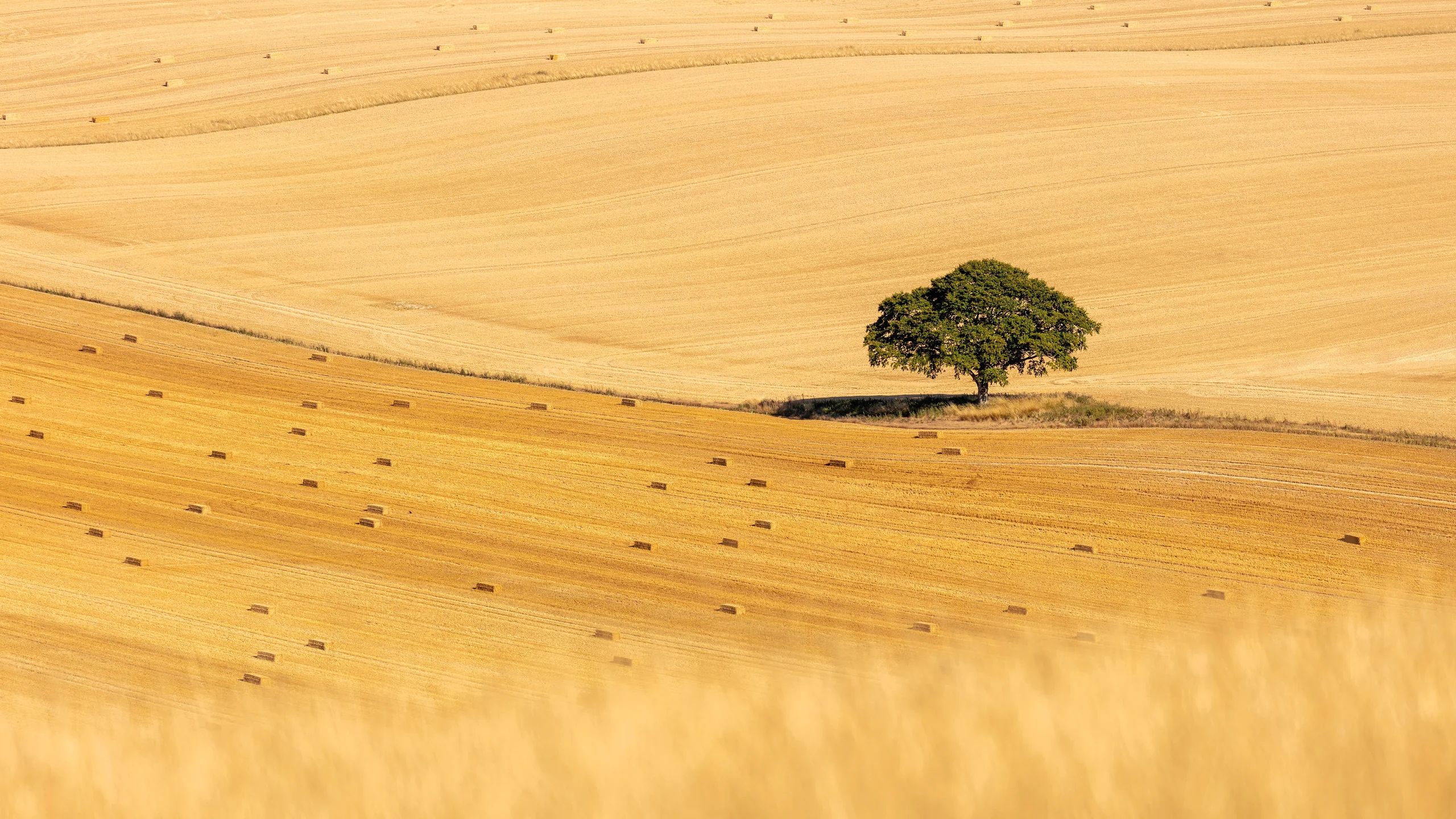
Image: Bing Daily Wallpaper | Beech trees in a grain field in South Downs National Park near East Meon, Hampshire, England (© Guy Edwardes/Minden Pictures) | Bing homepage
Open Bing today and the homepage shows a ripe grain field. The crop is a gold so warm it seems to radiate heat. A few beech trees stand within it, their heavy crowns so dark they are almost blue. Bing gives the image a simple title: Golden Fields.
The location is precise: near the village of East Meon in South Downs National Park, Hampshire, England.
One fact may be surprising. The photograph is on the homepage today, but the standing grain in it is no longer there. The August 28 harvest report from the Agriculture and Horticulture Development Board, Britain's statutory levy board, said that 94% of wheat, 99.5% of winter barley and 100% of winter oilseed rape had been harvested nationwide. It stated that the harvest was finishing across Wales and most of England. A standing field this golden belongs to July or early August. In East Meon today, it would be sharp stubble.
That makes the field itself, rather than its crop, the real subject. Grain changes every year and the trees return each year, but what supports them has been there for 100 million years.
Thirty Thousand Shell Plates on a Pinhead
The South Downs are chalk hills. Chalk is calcium carbonate, the same material once used for blackboard chalk.
That description barely begins to explain it.
Volume 23 of the Joint Nature Conservation Committee's official Geological Conservation Review, in its chapter on Britain's Upper Cretaceous rocks, gives a more revealing scale. In the portion of chalk made of grains smaller than 10 micrometers, a pinhead-sized sample one millimeter across contains about 30,000 coccoliths.
Coccolithophores are single-celled marine algae. A living cell is about 4 micrometers wide - roughly half the size of a red blood cell, according to educational material from the Howard Hughes Medical Institute. It builds a suit of tiny calcite plates around itself. Those plates are coccoliths. When the organism dies and decays, they settle to the bottom.
One hundred million years ago, this place was a warm, shallow sea. The British Geological Survey says chalk accumulated in warm water about 50 to 300 meters deep. There were no people and no wheat, only layer after layer of calcite plates falling through the water year after year and slowly raising the seabed.
The BGS rock-unit lexicon dates the Chalk Group from the Cenomanian to the Maastrichtian ages, the Late Cretaceous. South Downs National Park Authority's own landscape assessment offers the easier phrase: "about 100 million years ago." How thick is it? Different BGS reports give different figures for different things: about 560 meters onshore in Hampshire and Sussex, "nearly 500 meters" in the South Downs, and about 400 meters in the folded core of the Hampshire Basin. These are not contradictions, but measurements of different areas and structures. The honest range is 400 to 560 meters, from BGS.
Four hundred meters. Press a pin lightly into the hill and beneath its point are 30,000 pieces of something once alive. Continue downward for 400 meters, and the hill is made of them.
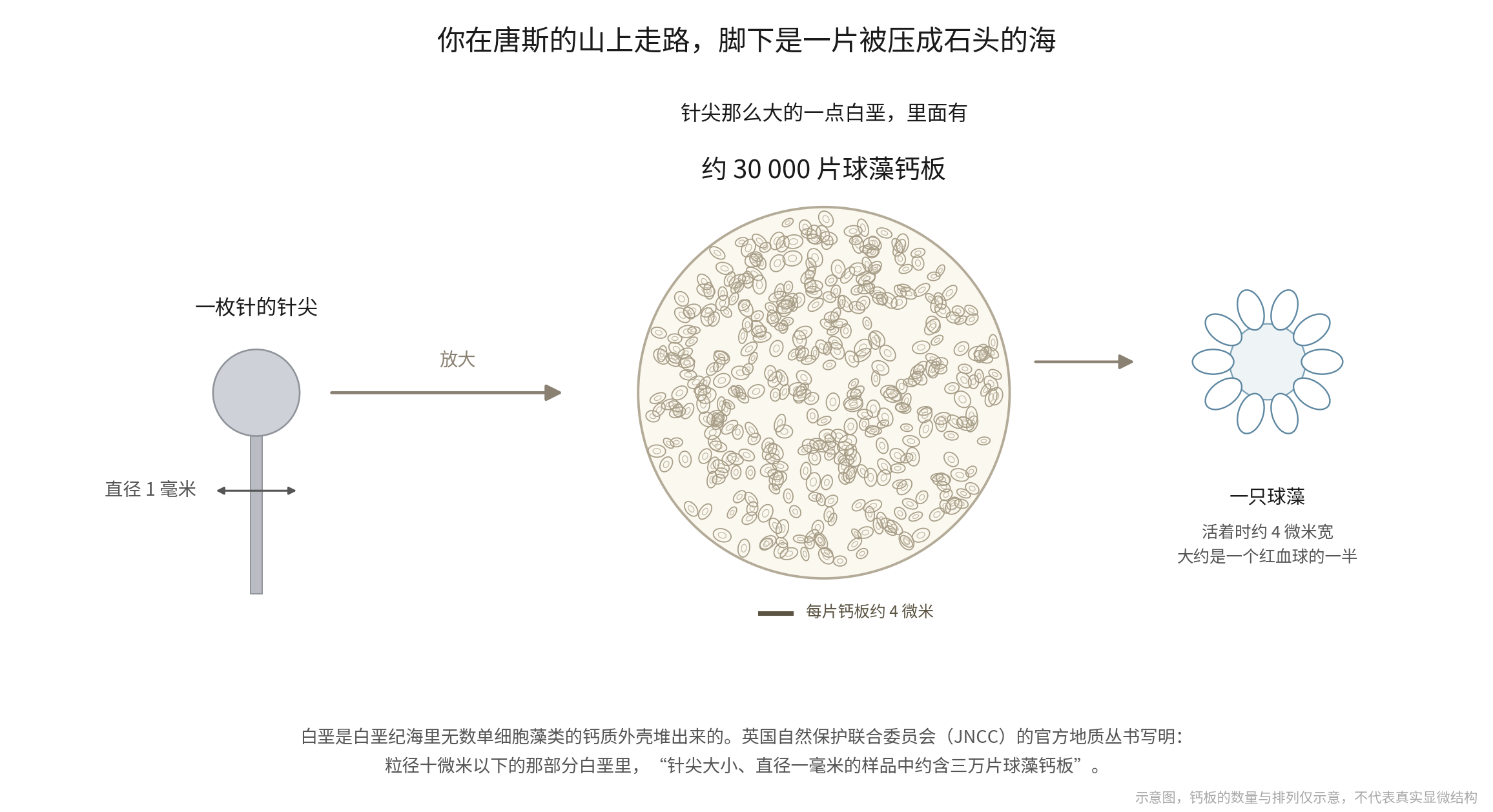
Stand on a windy ridge of the Downs with grass beneath your feet, and geologically you are standing on a sea surface - a sea compressed into rock and then lifted into hills.
That is not metaphor. It is stratigraphy.
Which Is Why Beech Grows Here
The rock is white, and it leaks.
Chalk drains very quickly, so rain barely lingers at the surface. The topsoil is also remarkably thin. Together they create dry, poor ground. South Downs National Park Authority's learning material on chalk grassland puts it directly: these soils are well drained and low in plant nutrients.
That is bad news for most trees, but not for European beech, Fagus sylvatica. The Woodland Trust says it needs humid air and well-drained soil and specifically lists drier, free-draining soils such as chalk, limestone and light loam. The European Commission's Joint Research Centre is more technical: beech tolerates a pH from 3.5 to 8.5, prefers moderately fertile calcareous or slightly acidic ground, requires good drainage and cannot survive waterlogged or compacted soil.
The trees in the photograph are not there by accident. The chalk filtered out many alternatives and left them standing.
Three counterintuitive facts about beech are worth pursuing.
First: it is the most shade-tolerant broadleaf tree in its range, which is why so little grows beneath it. That sounds like a virtue, but a tree that tolerates deep shade can germinate under others and eventually become an enormous umbrella that shuts out the ground below. The Woodland Trust says beech woods are very dark and their floors are covered by thick layers of leaves and husks, preventing most woodland plants from growing. The Wildlife Trusts add a second mechanism: beech leaves are thick and slow to decay, making a blanket on the ground that suppresses plants as well as shading them.
About 10 kilometers north of East Meon is a famous kind of beech woodland locally called a hanger. South Downs National Park Authority describes these steep wooded hills as hangers because ancient beech, lime, yew and ash woods appear to hang from the high slopes. The East Hampshire Hangers are designated an EU Special Area of Conservation, UK0012723, covering 561.69 hectares.
East Meon itself is not in the Hangers. The national park's conservation-area assessment describes it as a chalk valley system surrounded by a mosaic of hills and does not discuss hanger woodland. The Hangers lie 10 kilometers away in the same national park. They show what the same tree can become when allowed to occupy an entire slope of the same chalk.
Second: even authoritative institutions do not agree on how often beech produces a heavy seed crop. Beech has "mast years," when it suddenly produces enormous quantities of nuts, with sparse crops in between. A Woodland Trust blog from July 2026 says every 5 to 10 years. A blog from its own Nature's Calendar project says usually every 3 to 5 years. The JRC's European atlas says seed crops usually come every 5 to 8 years, with irregular mast years following hot summers. Even two pages from one organization give different numbers. Roughly once every five years is a fair shorthand, but the timing is highly irregular.
Why do it this way? The Woodland Trust's explanation is admirably clean. Several lean years keep seed-eating animal populations low; then, in a mast year, the trees produce more food than the animals can possibly consume. What remains ensures that some seeds survive to become trees.
The strategy is called predator satiation. A tree cannot run or hide, so it fights with time: keep the predators hungry, then feed them more than they can eat.
That pattern is now changing. A 2021 paper by researchers in Poland, Britain and elsewhere, published in Global Change Biology by Bogdziewicz and colleagues (DOI 10.1111/gcb.15560), analyzed 139 European beech trees across 39 years. As summers warmed, the frequency of reproductive cues changed fivefold, flowering lost synchrony, pollination efficiency fell and seed maturation became less synchronized. The abstract's judgment is stark: climate change is causing the mast-seeding mechanism to break down.
An algorithm evolved over millions of years is being disrupted within decades.
Third: scholars have not agreed on whether beech is native to Britain. This is an honest dispute. A peer-reviewed Biological Flora of the British Isles monograph by Packham and colleagues in the Journal of Ecology in 2012 says it is undoubtedly native to Britain, though not to Scotland or Ireland. The Woodland Trust says European beech is considered truly native in Britain only in southeastern England and southeastern Wales. Oxford University's Plant 400 page says the question has long been debated, with evidence suggesting beech arrived only after the English Channel formed, about 6,000 years ago.
Its arrival sits exactly on the boundary between Britain being joined to continental Europe and Britain becoming an island. Whether the tree walked in or people carried it remains unresolved.
A tree that can stand 40 meters tall, appears everywhere and is familiar to every British child still has no settled answer to the question: does it belong here?
The Most Crowded Garden on Thin Soil
What chalk's poverty denies trees, it offers flowers.
Natural England's official leaflet for Old Winchester Hill National Nature Reserve explains the mechanism best: flower-rich grassland develops on thin, nutrient-poor chalk soil, preventing dominant species from overwhelming more delicate herbs.
In plain language, the ground is too lean for aggressive grasses to take over, so gentler flowers get room to live.
The result is some of Europe's most crowded grassland. A range is necessary here. Different South Downs National Park Authority pages say as many as 40 plant species per square meter and 30 to 40 species in a single square meter; the Wildlife Trusts say a square meter of turf can hold more than 40. The defensible figure is 30 to 40 species per square meter, attributed to the national park authority.
One square meter, about the patch of ground enclosed by outstretched arms, can hold 30 or 40 kinds of plant.
The late naturalist David Bellamy called this grassland "Europe's rainforest." It is his phrase, not a scientific classification, but it does not exaggerate the density.
The cost also appears in official figures. South Downs National Park Authority's key-facts page says Britain has lost more than 80% of its chalk grassland since World War II, and only about 4% of the national park is now chalk grassland.
Chalk Is Both Rock and Sponge
Chalk's most elegant trick begins with the same quality that makes it drain so quickly: it is porous.
Porous rock does not merely leak water. It stores it.
Rain falling on the Downs does not immediately rush downhill as it would over granite. It seeps into innumerable small pores in the chalk and waits. Later, where the groundwater table intersects the valley floor, it emerges again as a spring.
South Downs National Park Authority says chalk streams are fed by springs rather than rain, because of the porous nature of the chalk landscape.
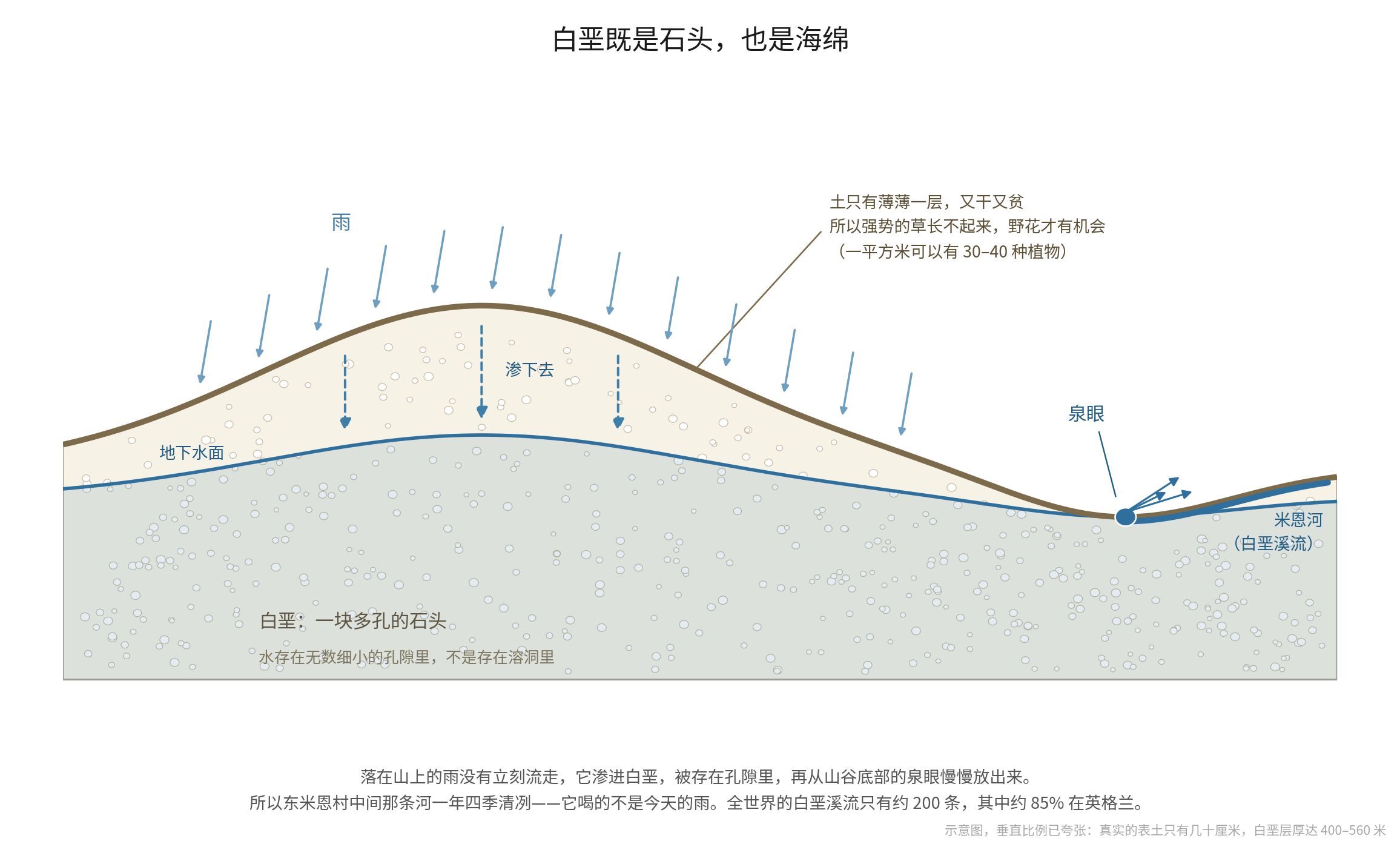
One common misconception needs preventing. Chalk stores water in pores, not caverns. It is more like a sponge than an underground palace. Water moves slowly through countless tiny spaces, emerging remarkably clean and at a remarkably stable temperature.
Chalk streams are rare worldwide. Two official figures are worth preserving without multiplying them into an unsupported third. South Downs National Park Authority says there are only 200 chalk streams in the world, most of them in southern England. A British government release from October 2021 says an estimated 85% of the world's chalk streams are in England and calls them "England's rainforests."
East Meon sits at the source of one of them.
The River Meon rises from Hampshire's chalk aquifer near the village, according to a 2010 technical advisory report from the Wild Trout Trust. It flows about 37 kilometers south to the sea and falls roughly 120 meters from source to mouth, a steep gradient for a chalk river. The report describes clear water, low, soft banks and abundant aquatic vegetation dominated by water crowfoot, starwort and water moss.
The national park authority's conservation assessment offers a detail with the rhythm of village life: the River Meon runs through the village center, follows the High Street for much of its length, then turns at The Cross.
A clear river with a nearly constant temperature runs beside the main street all year. It can do so because 100 million years ago, four-micrometer algae died here in vast numbers.
East Meon's All Saints Church is a Grade I listed building, Historic England entry 1351116, with origins in the early 12th century. The national park's assessment calls its black Tournai marble font, dating to about 1130, "a magnificent feature" and part of a notable Hampshire group. No official source was found describing what is carved on it, so that detail is not supplied. The font has nevertheless stood there for nearly 900 years.
The Trees in the Field Belong to a Shrinking Population
Return to the few trees in the photograph.
Britain has a special category for trees that stand outside woods: hedgerow trees and isolated field trees. Because they are not in forests, they often fall through gaps in statistics and subsidies.
Hedgelink, the partnership recognized by Britain's Department for Environment, Food and Rural Affairs to coordinate hedgerow work, compiles two particularly sharp official figures.
From 1997 to 2007 alone, the number of isolated hedgerow trees fell by as much as 3.9%.
And 15,000 to 20,000 new hedgerow trees must be established every year merely to keep the population stable.
Fifteen to twenty thousand trees each year across England buys no growth. It only prevents decline.
The trees in the photograph are not landscape decoration. They belong to a population that is slowly disappearing. Every old tree lost needs a new one, and replacement is not keeping pace.
Official British planning guidance gives these trees substantial weight. An ancient tree is exceptionally valuable because of its age, size and condition, the biodiversity value created by significant decay and the habitat produced by aging. Planning permission that would destroy or degrade ancient or veteran trees should be refused unless wholly exceptional reasons exist, and even then compensation can only be partial.
The definition of a veteran tree is counterintuitive: it need not be especially old. Under the same guidance, a younger tree can qualify if it already has important signs of decline, such as dead branches or a hollow trunk. The holes are part of what makes the tree valuable.
This year brought a policy reversal.
England once offered an agricultural payment specifically for these trees. Scheme code CHRW3, "Maintain or establish hedgerow trees," paid £10 per 100 meters of hedgerow per year, counting both sides, provided the included hedges averaged at least one hedgerow tree per 100 meters.
On February 26, 2026, Hedgelink reported that CHRW3 had been removed from the 2026 Sustainable Farming Incentive. It quoted the official explanation: uptake was high but value for money was low, and the government would no longer pay specifically to maintain existing hedgerow trees because most farmers would maintain them anyway, producing little additional environmental benefit.
Whether that reasoning holds is a matter for debate; Hedgelink offered no comment in its report, and neither does this article. The juxtaposition is factual. The same country can set a legal target - regulation 3(2) of The Environmental Targets (Woodland and Trees Outside Woodland) (England) Regulations 2023 says that at least 16.5% of England must be covered by woodland and trees outside woodland by December 31, 2050 - and in the same year remove the payment dedicated to trees outside woodland.
England's own Trees Action Plan 2021-2024 reads almost like a prediction: trees outside woodland are among those of greatest value to society, yet often fall between funding mechanisms, worsening their long-term neglect and decline.
The beeches in the field stand precisely in that gap.
Why Today?
The honest answer is that there is no anniversary.
South Downs National Park's birthday is March 31; the authority's key-facts page says it was officially established on March 31, 2010. The same authority elsewhere gives 2009 for designation and April 2011 for the authority becoming fully operational, three official dates that are not reconciled here. All Saints Church entered the statutory list on March 16, 1985. The harvest, as noted above, was mostly over by the end of August. Bing's copyright link offers only the dry search phrase "Hampshire, England."
Some photographs are simply beautiful without a calendar reason. There is no need to invent one.
Yet two events on today's calendar happen to meet this image.
One is in China. Xinhua reported on September 6 that White Dew, the solar term known as Bailu, would arrive at 10:41 p.m. Beijing time on September 7. Strictly speaking, that was yesterday. But a solar term is a span of time: the China Agricultural Museum defines White Dew as the moment between September 7 and 9 when the Sun reaches celestial longitude 165 degrees, and the term continues until the autumn equinox. Today lies within White Dew.
Xinhua gives the traditional reasoning behind the name: ancient Chinese thought associated the four seasons with the five elements; autumn belonged to metal, whose color was white, so autumn dew was described as white.
The other event is both British and Chinese. The three traditional stages of White Dew are the arrival of geese, the departure of swallows and birds beginning to store food. On South Downs National Park's official calendar this month is a guided walk called Pagham's Migration Magic.
Two hemispheres and two calendars are describing the same birds preparing to move.
September itself is an event.
China's Beeches
The genus behind the European beech has its center of origin in China.
The English tree and the beeches of Sichuan belong to the same genus, Fagus.
An official research report from Sun Yat-sen University's School of Earth Sciences and Engineering gives a revealing contrast: China has four species in the beech genus, while only one species occurs on the western side of Eurasia, where it is a dominant tree of temperate deciduous forest.
In Europe, one species spreads across the temperate deciduous forest. In China, four species occupy a much smaller zone of subtropical evergreen and deciduous broadleaf mixed forest in the humid monsoon region.
A genus is often richest where it is least conspicuous.
An article titled "The Red Leaves of Beech" in the overseas edition of People's Daily on December 19, 2024, is more specific. Wangcang County in Sichuan has more than 1,700 hectares of primeval beech forest and is described as the center of origin and modern distribution of the genus worldwide. The article lists four species: Fagus pashanica, F. engleriana, F. lucida and F. longipetiolata. It says F. pashanica dominates local forest communities at elevations of about 1,100 to 2,000 meters, can reach 30 meters in height and 50 centimeters in trunk diameter, with the largest exceeding 100 centimeters. The claim about the center of origin and distribution is substantial and is recorded here as People's Daily states it.
There is a real disagreement to note. Sun Yat-sen University says China has four species; a 2008 review by Li Tengfei and Li Junqing in Chinese Agricultural Science Bulletin lists five. The difference is whether F. pashanica should be merged into F. engleriana, a genuine taxonomic dispute. Oxford University's Plant 400 says the genus has about 12 species worldwide, all in the northern temperate zone.
Taiwan beech, Fagus hayatae, is a Class II nationally protected plant in China. The National Key Protected Wild Plants database maintained by the Plant Science Data Center of the Chinese Academy of Sciences records it in Shaanxi, Zhejiang, Hunan, Hubei, Sichuan, Taiwan and Chongqing, growing in open mountain forest from 1,300 to 2,300 meters above sea level.
There is one final seasonal contrast. Southern England's wheat fields have already been harvested. On the China Agricultural Museum's White Dew farming calendar, the entry for northwestern and northeastern China is the sowing of winter wheat.
The same crop, in the same week: harvested on one side of the planet and sown on the other.
The Photographer
Guy Edwardes writes on his website that he lives with his wife, Cat, in Dorset, England, and has worked as a professional landscape, nature and travel photographer for more than 25 years. He first studied nature conservation, then earned a photography degree at Salisbury College. His office houses a library of more than 250,000 images, and he leads about 40 photography workshops each year. He lists his equipment precisely: Canon EOS R5 and R7 bodies with EF lenses from 8 to 600 millimeters.
Dorset is not the South Downs, and his biography does not claim that it is. One of his standing workshops is called "Landscape Photography in Dorset and on the Jurassic Coast." His regular work is, in other words, to stand before the exposed ancient strata of southern England and make photographs.
The image is represented by Minden Pictures, which describes itself as representing leading wildlife and nature photographers since 1989, specializing in natural history, biodiversity and endangered species from every continent.
Bing calls this picture Golden Fields and places the emphasis on gold. But the golden part was cut down in August and will grow again next year. What stays is something else: trees able to survive on poor chalk, and beneath them 400 meters of rock built from calcite plates, 30,000 to a pinhead-sized sample.
The wheat is the field's harvest for one year. The chalk is its harvest from 100 million years.
Sources: Bing Daily Wallpaper (zh-CN); the Joint Nature Conservation Committee's Geological Conservation Review, volume 23; the British Geological Survey rock-unit lexicon, Earthwise material and South Downs chalk-aquifer report; South Downs National Park Authority material on key facts, chalk grassland, chalk streams, the East Hampshire Hangers, the East Meon conservation area, River Meon restoration and its events calendar; Natural England's Old Winchester Hill National Nature Reserve leaflet; Historic England listing 1351116; National Trails on the South Downs Way; the Woodland Trust on European beech, mast years, Nature's Calendar and the Ancient Tree Inventory; the European Commission Joint Research Centre's European Atlas of Forest Tree Species; Packham et al., Journal of Ecology (2012); Oxford University's Plant 400; Bogdziewicz et al., Global Change Biology (2021); Sercu et al., Ecology and Evolution (2017); Nolan et al. (2020); Hedgelink on the importance of hedgerows and its February 2026 SFI policy report; British government guidance on ancient and veteran trees, CHRW3, chalk-stream strategy and the England Trees Action Plan 2021-2024; The Environmental Targets (Woodland and Trees Outside Woodland) (England) Regulations 2023; Agriculture and Horticulture Development Board harvest reports; the Wild Trout Trust's River Meon report; the Natural History Museum; the Palaeontological Association; the Wildlife Trusts and Sussex Wildlife Trust; Xinhua; the China Meteorological Administration; the China Agricultural Museum; the overseas edition of People's Daily; Sun Yat-sen University's School of Earth Sciences and Engineering; Chinese Agricultural Science Bulletin; the Chinese Academy of Sciences Plant Science Data Center's National Key Protected Wild Plants database; Guy Edwardes's official website; and Minden Pictures.