
The white is not an aesthetic choice. It is free air conditioning.
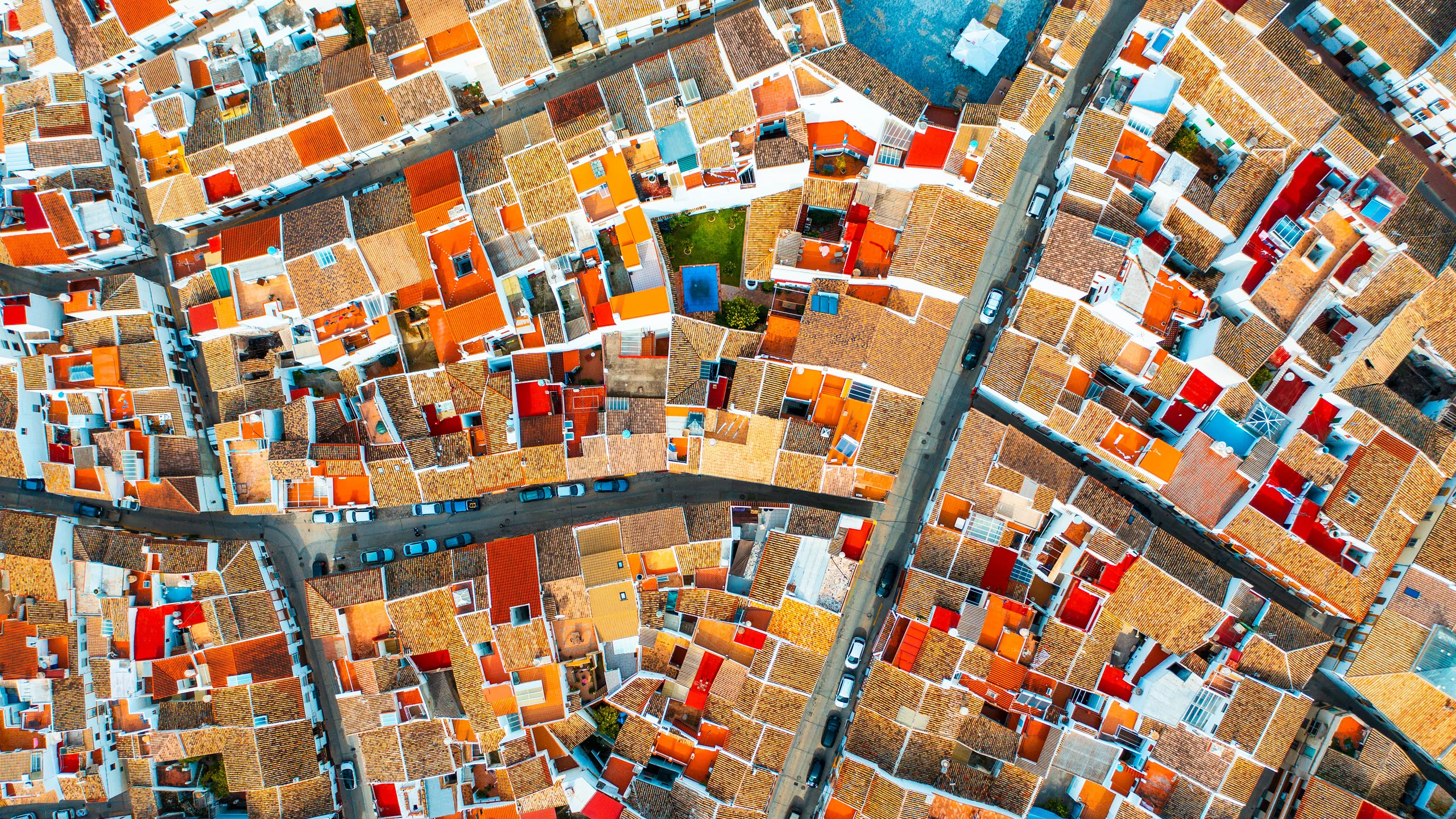
Image: Bing Daily Wallpaper | Aerial view of Olvera, Andalusia, Spain (© Marco Bottigelli/Getty Images) | Bing homepage
Open Bing in China today and you will see a sweep of white from above.
Hundreds of houses crowd a hillside, so bright they almost glare, like a spoonful of sugar scattered over dark green velvet. Two structures stand at the top: a stone castle and a church. Beyond them, orderly olive groves in shifting shades stretch to the edges of the frame. Bing calls the image "A Puzzle on the Land."
This is Olvera, in Cádiz Province in southern Spain. Official figures from the Institute of Statistics and Cartography of Andalusia give it just 7,838 residents in 2025 and a reference elevation of 603 meters. It lies on an official tourism route called the Ruta de los Pueblos Blancos, the Route of the White Villages, which includes 19 towns in Cádiz Province.
Why Are the Houses White?
Cádiz Province's official tourism portal explains the name plainly: "The name comes from the ancient custom of the inhabitants whitewashing the facades of their houses."
Whitewash. That is all.
But why white, rather than any other color?
The answer lies in something you already know but may never have applied here: dark colors absorb heat; light colors reflect it. Stand in the summer sun in a black T-shirt and then a white one, and the difference is obvious. Andalusians turned the entire house into that white shirt.
Today we can put numbers to the effect. The Heat Island Group at Lawrence Berkeley National Laboratory gives a solar reflectance range of 0.60 to 0.90 for white roofs. In other words, they send 60% to 90% of incoming sunlight back where it came from. The California Air Resources Board puts it more directly: during the hottest part of a summer day, a white roof can be 28 to 33 degrees Celsius cooler at the surface than a conventional roof.
The figure closest to life in Olvera comes from the U.S. Environmental Protection Agency's heat-island pages. Measurements in buildings without air conditioning found that highly reflective "cool roofs" could reduce peak indoor temperatures by 1.2 to 3.3 degrees Celsius.
Put that number beside the houses on this hillside.
When those walls were first painted white, air conditioners did not exist. Neither did electric fans, thermometers or laboratories. An Andalusian farm woman climbing a ladder with a bucket of lime was achieving the same one, two or three degrees that the EPA now measures with instruments. She did not know the phrase "solar reflectance of 0.85." She knew the room felt cooler afterward.
Lime was inexpensive, among the cheapest materials available locally. In the end, that coat of white says something practical: people who could not afford cool air painted a layer of it onto their homes.
A Beautiful Legend, and an Honest Qualification
Another explanation circulates about these white walls: people used limewash to prevent epidemics because lime is a disinfectant.
The story is still alive locally. Spanish-language media interviewed María Luna, a resident of Zahara, who said epidemics were common and livestock were kept inside the home. A local painter, David Barranco, was more definite: people did it "because it disinfects."
Limewater is strongly alkaline and does kill microbes. That is not in dispute.
But the surviving historical record is not enough to prove that disease prevention motivated the original whitewashing. There is no verifiable municipal ordinance, named epidemic year or firsthand account, only an oral tradition passed between generations.
The careful reading is this: it is a legend, and it may well be true, but for now it remains a legend. White surfaces reflecting sunlight and keeping interiors cooler is evidence: measured, repeatable, and easy to test for yourself.
Knowing the difference matters more than remembering either claim.
Two Buildings on the Summit, and the Year 1327
The castle at the town's highest point dates to the late 12th century, under Muslim rule. It was later incorporated into the chain of fortresses guarding the frontier of the Kingdom of Granada. From its walls, that boundary between Muslim and Christian Spain was visible at a glance.
In 1327, Castilian forces captured it. The castle changed hands and became a fortress for the other side.
(Bing's text and many other descriptions call it a "Nasrid castle." There is a problem with that wording: the Nasrid dynasty was founded in 1232, while the castle dates to the late 12th century. A building cannot have been erected by a dynasty that appeared more than a century later. More precisely, it was built under an earlier Muslim power and later incorporated into the Nasrid frontier defenses.)
The large white building beside the castle is often called a cathedral in Chinese accounts. It is not one. It is a neoclassical parish church, funded by the ducal house of Osuna in the late 18th century to replace an older Gothic church. Remains of that earlier church survive in the baptistery.
The Dark Green Belongs to Trees That Can Live 1,700 Years
The dark expanse surrounding the white houses is olive groves.
Olvera is one of eight municipalities in the Sierra de Cádiz protected designation of origin for olive oil. Spain's Official State Gazette recorded that fact in a 2011 resolution, down to the permitted olive varieties.
What do olives mean to Spain? Official figures from the Ministry of Agriculture, Fisheries and Food count 2.75 million hectares of olive groves nationwide, 93% of them used for oil. Andalusia alone produces 80% of Spain's total. Spain, in turn, accounts for 45% of world production and 70% of European Union production, involving more than 350,000 farms. (For the single 2024/25 season, the International Olive Council put Spain at about 40% of global output. The figures use different bases: one is a long-term average, the other that year's measured result. Both are valid.)
One misconception needs correcting. If you imagine the groves bustling with a September harvest, the same official resolution says otherwise: in the Sierra de Cádiz, picking begins "around November and ends in February or March of the following year." For now the trees are growing quietly. The activity is still two months away.
The most astonishing thing about an olive tree is how long it can live.
Spain has a Route of the Thousand-Year-Old Olive Trees. A consortium of local municipalities and the forestry department of the Technical University of Madrid conducted an inventory using one threshold: a trunk circumference greater than 3.5 meters, measured 1.3 meters above the ground. So far, 5,767 trees have been cataloged. Tree number 1878, the Farga de l'Arion, was planted in AD 314.
AD 314. The Roman Empire had only just legalized Christianity. China was in the Eastern Jin dynasty, and the Battle of Fei River was still 69 years away. That tree has stood in the same place ever since. (It grows in Ulldecona, at the other end of Spain, not in Andalusia, but it is the same kind of tree.)
A Railway With 30 Tunnels and Not One Train
Now for the part of this story I most wanted to tell you.
Below Olvera runs a 36.5-kilometer trail called the Vía Verde de la Sierra, the Sierra Greenway. It passes through 30 tunnels and over four viaducts. Walk it and the route plainly feels like a railway.
That is exactly what it was meant to be. In 1926, precisely a century ago, Spain approved a railway from Jerez to Almargen. Workers bored through 30 mountains, raised four bridges and prepared the trackbed.
Then the dictatorship fell, the economy collapsed and construction stopped. The foundation's official history is blunt: "Work was interrupted and never completed."
Thirty tunnels, four viaducts, one hundred years, and not a single train ever passed through.
Eighty years later, the railway that never opened became a walking and cycling route. It now crosses the Peñón de Zaframagón nature reserve, a sheer rock face that holds western Andalusia's largest breeding colony of griffon vultures. (Andalusia's 2018 census counted 3,399 breeding pairs across the region, with Cádiz Province alone holding nearly two-thirds of them. Officials have not published a count specifically for Zaframagón, so neither will we.)
The reserve has a bird observatory equipped with a high-sensitivity camera that can rotate 360 degrees and see in infrared at night. Fiber-optic cable carries the feed to a control room. Visitors can take the joystick, aim at any nest on the cliff and watch the vultures feed their young. Recordings appear on the foundation's YouTube channel.
A failed project became, a century later, a road from which people can see vultures. That fact deserves to be told to any child discouraged because something they tried did not work.
China Has a Puzzle With 295 Million Pieces
Bing calls today's picture "A Puzzle on the Land." China has a more rigorous version of the same idea.
The main-data bulletin from China's Third National Land Survey gives the numbers. Using December 31, 2019 as the reference date, 219,000 surveyors combined satellite remote-sensing imagery at better than one-meter resolution with mobile internet, cloud computing and drones. They divided China's territory into 295 million mapped parcels and checked them one by one. The final count found 127.8619 million hectares of cultivated land, about 1.918 billion mu.
The Chinese term tuban, or mapped parcel, is not a metaphor. It means the shape that one discrete patch of ground makes on a map.
This aerial view of Spain contains a few hundred puzzle pieces. China has a puzzle with 295 million pieces, and people really did assemble it one piece at a time.
China has olive country of its own. Xinhua reported in June 2026 that Wudu District in Longnan, Gansu, had 641,300 mu of olive groves by 2025, with a total industrial output value of 4 billion yuan. Officials said its scale, production and economic returns all ranked first in China, and that the industry had produced more than 80 products in ten categories. Andalusia begins picking olives in November; Longnan's harvest arrives at roughly the same time.
Today Is Not an Anniversary
One final clarification: September 10, 2026 has no commemorative connection to Olvera, Spain or olives. The town's major celebration, the San Agustín fair, ended in late August. The olive harvest does not begin until November. Bing probably selected this image today because it is beautiful.
But "Why today?" can be reframed as "Why this season?"
September brings Andalusia its last summer heat. The white is still working every day. In another two months, people on these same slopes will shoulder their poles and go out to beat the olives from the trees. The white walls can rest for a while.
Lawrence Berkeley National Laboratory has also modeled the effect at a much larger scale. Raising the reflectance of every wall in Los Angeles County by 0.4 would lower the city's average daily temperature in July by only about 0.2 degrees Celsius. The benefit to one building can be substantial; the cooling effect across a whole city is small. White walls reduce heat absorption, but they cannot solve global warming on their own.
Sources: the Institute of Statistics and Cartography of Andalusia (IECA) SIMA database; the official Cádiz Province tourism portal; the Olvera municipal tourism office; the official Andalusia tourism portal, andalucia.org; Spain's Official State Gazette, BOE-A-2011-9398; Spain's Ministry of Agriculture, Fisheries and Food (MAPA); the International Olive Council (IOC); the Route of the Thousand-Year-Old Olive Trees (Taula del Sénia/Technical University of Madrid); the Sierra Greenway Foundation; the Andalusian government's 2018 griffon vulture census; the U.S. Environmental Protection Agency heat-island pages; the Lawrence Berkeley National Laboratory Heat Island Group; the California Air Resources Board's CoolCalifornia; the main-data bulletin of China's Third National Land Survey; and Xinhua.