
How can thousands of tons of steel obey the touch of a few hands?
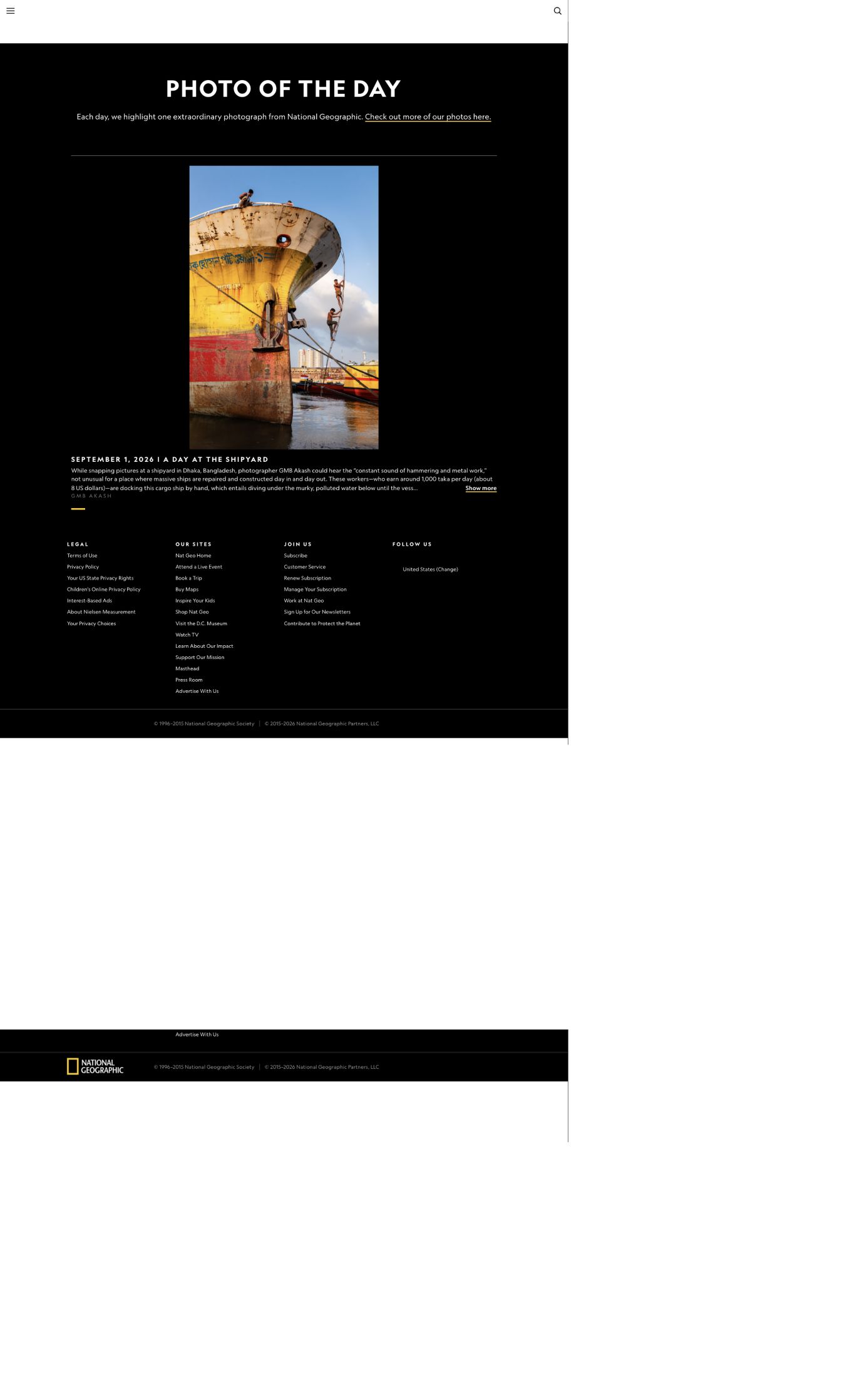
Screenshot: National Geographic Photo of the Day | Original page
Listen first.
When photographer GMB Akash pressed the shutter at a shipyard in Dhaka, Bangladesh, what stayed with him was not the scene but "the sound of hammers and iron, all the time." It continued from morning to night without a second of quiet.
Imagine how many people that requires. How many hands must be striking at once to keep an entire riverbank from falling silent?
Then there are the only two bodies in the image that the description supports: two shirtless men climbing a ladder toward the top of a rust-whitened ship streaked with yellow and red.
National Geographic's copyright rules prevent the photograph itself from being reproduced here. Each Photo of the Day page says that unauthorized use is prohibited. See the Original page. Every description of the scene in this article relies only on National Geographic's published caption and image description; no detail has been added.
Now lower the viewpoint beneath the waterline.
The caption adds that workers position cargo ships by hand, a job that requires diving into the murky, polluted water below until the vessel is properly aligned and can be winched ashore.
How can thousands of tons of steel obey the touch of a few hands?
The answer is not that the workers can endure anything. The answer is physics.
In Water, It Almost Weighs Nothing
The US Occupational Safety and Health Administration's official guidance for shipbuilding and ship repair captures the problem in one sentence:
"The most dangerous moment in dry docking is when the vessel's support transfers from the buoyancy of the water to the blocks beneath it. If the blocks are not strong enough, they may crush and the ship may roll over."
Read that twice.
A 1,500-ton ship afloat is supported by buoyancy equal to its full weight. Its apparent net weight approaches zero. Push it and it moves, not because it is light but because the water is carrying its weight.
Once out of the water, the same ship can crush the timbers beneath it.
The weight never disappeared. Water had simply taken responsibility for it. The danger lies not in the weight but in the handoff.
That is why workers must dive below and realign the vessel repeatedly. Alignment must happen while the ship is still "weightless." Once the water hands the load over, it is too late.
A Number You Can Calculate Yourself
That idea can become an arithmetic problem, and the arithmetic requires little more than division.
A ship displacing 1,500 tons pushes aside 1,500 cubic meters of water, or 1.5 million kilograms. The water's upward force exactly balances the ship's weight. In the horizontal direction, the workers are not overcoming 1,500 tons, only water resistance and friction.
Suppose ten people push together and each exerts 400 newtons, roughly 40 kilograms-force. Their combined 4,000 newtons acts on 1.5 million kilograms:
Acceleration = 4,000 ÷ 1,500,000 = 0.0027 meters per second squared.
After pushing for one minute, the speed reaches 0.16 meters per second, less than 0.6 kilometers per hour.
Slow, but moving.
That is the complete physical reason human beings can position thousands of tons of ship. It needs no myth and no wonder, only a division problem a primary-school student can solve.
These numbers are an estimate based on the class of ship described in the caption, not the actual specifications of this vessel. Their purpose is to establish the scale: motion so slow that it can be almost invisible, but motion nonetheless.
Dhaka's Shipyards Build Ships; They Do Not Break Them
One common error must be stopped here, because it would distort the entire story.
These Dhaka yards build and repair ships. They are not ship-breaking yards.
They cluster around Keraniganj on the south bank of the Buriganga River. According to a Bangladeshi industry investigation, the area has about 27 shipyards and more than 70,000 workers across more than a dozen trades. Each year it builds about 80 vessels and repairs 400 to 500. Most range from 700 to 3,000 tons, with 1,500 tons the most common order. Building a 1,500-ton ship costs at least 50 million taka. A vessel comes ashore for repairs once every two years, at a cost of 2.5 million taka. This is what the National Geographic caption means when it says that immense vessels are repaired and built there day after day.
Ship breaking happens somewhere else: on Sitakunda Beach north of Chittagong, beside the Bay of Bengal, along roughly 25 kilometers of tidal flats from Fauzdarhat to Kumira. There, end-of-life oceangoing ships are driven onto the beach and dismantled in one of the world's largest ship-breaking centers.
The two places lie about 250 kilometers apart. One is inland, the other on the coast; one builds, the other dismantles. Calling this Dhaka scene "the world's largest ship-breaking yard" is the most common mistake made about the subject.
There is, however, a strong link between them. We will reach it shortly.
The River Is Called the Old Ganges
The river into which these workers dive is the Buriganga.
Its name means "Old Ganges," and the name preserves a real geological history. Long ago, a channel of the Ganges flowed through this area toward the Bay of Bengal. After it lost its connection to the main river, it became known as the Old Ganges.
Today it is only 27 kilometers long, averaging about 400 meters wide and 10 meters deep. Most of its water now comes from the Turag River. It is not the Ganges' main channel. It is a memory of the Ganges.
It is also a tidal river, although Dhaka stands more than 200 kilometers from the sea. The Bay of Bengal has a mainly semidiurnal tide with a period of 12 hours and 25 minutes. The mean tidal range is about three meters at the coast and declines to about 0.5 meters 275 kilometers inland. The sea's breathing travels two or three hundred kilometers upstream, lifting Dhaka's river by tens of centimeters every half day. No number better illustrates how flat this country is.
Because Dhaka's tidal range is only a few decimeters, the familiar coastal-shipyard image of a high tide lifting a ship onto a slipway does not apply here. Dhaka relies on winches, ramps and buoyancy itself.
There are measurements behind the caption's phrase "murky, polluted water." A 2024 survey along the river, from Sadarghat launch terminal to Shyampur terminal, recorded dissolved oxygen of 0.14 to 0.72 milligrams per liter. Aquatic animals need at least 4 milligrams per liter to survive.
0.14 is one twenty-ninth of 4.
The workers dive into a river with barely one-thirtieth the oxygen aquatic life requires. That sentence needs no adjective.
The survey came from two civic organizations, not an official ruling by Bangladesh's Department of Environment. The country's official encyclopedia says that in the dry season the river's dissolved oxygen becomes "extremely low or nonexistent" and the water turns toxic.
A Country That Depends on Ships
Why do 70,000 people build ships beside a river in Bangladesh? Because here a ship is not romance. It is infrastructure.
The country sits on the world's largest delta, the shared outlet of the Ganges, Brahmaputra and Meghna. The delta covers roughly 100,000 square kilometers, spans more than 350 kilometers and supports more than 100 million people. The rivers carry about one billion tons of sediment into it each year, although published estimates vary widely, from 500 million to more than 11 million tons. This delta is not a finished piece of land. It is something the water is still assembling.
Part of it disappears under water every year. Bangladesh's official encyclopedia says that about 26,000 square kilometers, or 18 percent of the country, floods in an ordinary year. In extreme years, the figure can exceed 55 percent; in 1988 it was about 60 percent. From May through October, 844 billion cubic meters of upstream water enters the country.
A widely repeated statement says that 70 percent of Bangladesh floods every year. That does not match the official figures. The normal share is 18 percent, and only an exceptional flood year may cover more than half.
The country therefore has about 700 rivers. More than 8,400 kilometers of waterways can carry large vessels in the rainy season and about 4,800 kilometers can in the dry season. Water transport carries about 35 percent of freight and about 14 percent of passenger traffic, or more than 80 million passenger journeys a year. The official encyclopedia's shipbuilding entry gives an even sharper figure: inland and coastal vessels carry 70 percent of the country's goods and more than 90 percent of its petroleum products.
A 1,500-ton river vessel here serves the role a railway line serves elsewhere.
Steel's Second Life
Now return to the line connecting Dhaka with Chittagong.
Bangladesh has almost no iron ore. Where, then, do Keraniganj's 27 shipyards get their steel plate?
The country's official encyclopedia answers in the sentence this article most wants readers to remember after the physics:
"More than 60 percent of the materials and machinery used in domestic shipbuilding come from the country's ship-breaking and ship-recycling industry."
In other words, more than 60 percent of the steel in Dhaka's new ships comes from old ships dismantled in Chittagong.
The path runs like this. An oceangoing vessel works for 30 years, grows old and is sold to Sitakunda, where it is run onto the beach and taken apart. Plate and structural steel go to roughly 130 rerolling mills and become rebar. Some becomes buildings; some returns to the river as the hull of a new inland vessel. Industry reporting says ship breaking supplies about half the raw material for the country's steel industry. In the 2023-24 fiscal year, 166 scrap ships were imported, containing about 975,000 tons of iron.
In a country without iron ore, someone else's old ship is the mine.
The interface between these two lives is the central fact of this article. The same piece of steel is carried by water twice: first as part of an ocean ship, then as part of a new river vessel. The time between them, ashore, is the only time it must bear all of its own weight.
One Thousand Taka
The caption gives a number: the workers earn about 1,000 taka a day, equivalent to roughly eight US dollars.
At 2025 retail prices in Bangladesh, coarse rice cost about 55 taka a kilogram:
1,000 ÷ 55 ≈ 18 kilograms of rice.
One day's wages, 18 kilograms of rice.
For comparison, Bangladesh has no single minimum wage covering every industry. A wage board sets rates by sector, usually revising them about every five years. The best-known current rate is for garment workers: 12,500 taka a month since 2023, about 113 dollars, up from 8,000 taka in 2018. At 26 workdays a month, 1,000 taka a day is roughly twice the garment industry's legal minimum. That calculation does not account for the realities of day labor, missing contracts or work stoppages during the rainy season.
Another figure must be placed beside it. A field investigation by a different Bangladeshi news organization found daily pay in the same shipyard belt beginning at 300 taka for helpers and reaching 700 taka for a fitter with 12 years of experience, for a workday from 7 a.m. to 6 p.m. That differs from National Geographic's figure of 1,000 taka, perhaps because of the year, trade or specific job. Both figures are presented here; the article does not choose one for the reader.
No official occupational-safety statistics for Bangladesh's ship building and repair industry were found. On the ship-breaking side, however, a positive change can be documented.
The Hong Kong International Convention for the Safe and Environmentally Sound Recycling of Ships was adopted in 2009. Bangladesh acceded on June 26, 2023, and the convention entered into force on June 26, 2025. A 2025 report by an international organization that has long monitored the industry said that 17 Bangladeshi yards had been certified under the convention, while India still had none authorized under it. The same report counted 321 ships dismantled worldwide in 2025, a clear decline from each of the previous three years, when annual totals exceeded 400.
Conditions are changing after the rules took effect. This is not a subject that permits only despair.
The Photographer
GMB Akash was born in Bangladesh in 1977.
In 2002, he became the first Bangladeshi selected for World Press Photo's Joop Swart Masterclass. He won a World Press Photo award in 2006, has since received more than one hundred international awards, and has published two books. One of them, Survivors, grew from a ten-year project.
His camera repeatedly turns toward the people in his country most easily overlooked: child laborers, garment workers, tannery workers, railway communities, villages damaged by riverbank erosion and settlements after cyclones. His website sorts his work under only four words: trains, ships, light, slums.
Ships are one of his sustained subjects. Today's photograph was not a chance encounter.
The National Geographic caption also says the image belongs to a photo feature in the magazine's September 2026 issue. The contents and theme of that feature could not be confirmed. No reason is invented for why it appeared today. The verifiable fact is simply that, on the first day of the month in which a print issue went on sale, one of its images became Photo of the Day.
The China Connection: An Airbag and a Giraffe
First, the airbag.
At riverbank yards around the world that lack a dry dock or cannot afford a slipway, a new vessel can be launched on rows of enormous rubber airbags. Inflated bags lift the hull and roll it into the water. Adjusting the pressure adjusts the ship's direction and height.
The method was invented in China.
On Tuesday, January 20, 1981, Xiaoqing River Shipyard in Jinan, Shandong, launched a 60-deadweight-ton oil barge on airbags. It is recorded as the first use of the method: a 60-ton barge and a beginning that fits in one sentence.
Forty-five years later, the same method can launch vessels of 55,000 deadweight tons, and the launching surface can be flat. Its greatest advantage remains the reason it was invented: it requires no traditional slipway, saving time, money and land.
It did not remain merely a local Chinese technique. The International Organization for Standardization issued two standards. ISO 14409:2011, Ships and Marine Technology - Ship Launching Air Bags, covers the bags themselves, including terminology, classification, materials, dimensions and test methods. ISO 17682:2013, Ships and Marine Technology - Methodology for Ship Launching Utilizing Air Bags, governs the launch process. Its continued validity was confirmed in a 2024 review.
A practical method from a county-level shipyard became two worldwide standards.
No evidence was found that Keraniganj's yards actually use airbags, nor was any formal International Maritime Organization document on airbag launching located. This is a parallel global fact. It cannot be turned into a claim that Chinese airbags are carrying the ship in the photograph.
Then, the scale. Figures released by China's Ministry of Industry and Information Technology in February 2026 show that Chinese yards completed 53.69 million deadweight tons of ships in 2025, 56.1 percent of the global total. China held 69 percent of new orders and 66.8 percent of orderbooks, leading the world on all three measures for a sixteenth consecutive year.
More than one of every two new ships in the world is therefore launched in China. In Dhaka, 70,000 people in a belt of manual riverbank yards build 80 inland vessels of around 1,500 tons each year. Both ends of the same industry stand beside rivers.
Finally, the giraffe.
Ming China called the Bengal region Bangala. In 1414, the twelfth year of the Yongle emperor, Bangala's new king sent an official named Baqishi to China with a giraffe as tribute. To Chinese eyes at the time, it was a qilin, a mythical auspicious creature. This was the Ming dynasty's first giraffe tribute. Roughly seven more maritime giraffe tributes followed in connection with Zheng He's voyages. Bangala's last came in 1438, also the Ming dynasty's last.
Six hundred and twelve years ago, a ship leaving this delta carried to Beijing a giraffe taken for a qilin. Today, people along the delta's riverbanks still build ships by hand.
Sources
National Geographic Photo of the Day; US Occupational Safety and Health Administration official shipbuilding and ship-repair materials; The Business Standard investigation of the Keraniganj shipyard belt; Banglapedia entries on shipbuilding, ship breaking, the Buriganga River, water transport, flooding and tidal waterways; European Space Agency and NASA Earthdata materials on the Ganges delta; 2023 Nature Communications research on delta sediment loads; Prothom Alo and The Business Standard reporting on dissolved oxygen and wages; Cornell University School of Industrial and Labor Relations, February 2025 Bangladesh policy brief; International Maritime Organization materials and news on the Hong Kong International Convention for the Safe and Environmentally Sound Recycling of Ships; NGO Shipbreaking Platform 2025 report; GMB Akash's website and Panos Pictures profile; gCaptain and Maritime Professional on the history of airbag launching; ISO 14409:2011 and ISO 17682:2013; China's Ministry of Industry and Information Technology 2025 shipbuilding figures; Zou Zhenhuan, "Zheng He's Voyages and the Ming Dynasty's 'Qilin Diplomacy,'" Journal of East China Normal University, issue 2, 2018; TeachEngineering, "Clay Boats" lesson; University of Akron K-12 outreach module; China Three Gorges Corporation on the dual-line five-step ship locks; and VesselFinder.