
One stripe on a national flag belongs to a country that left.

Image: Google Doodle, Hari Merdeka 2026 (Malaysia National Day) | Official page
Open Google in Malaysia today and the logo on the homepage has changed. This Doodle marks Hari Merdeka, Malaysia's Independence Day.
Only a few facts about the Doodle itself are available. Its official page says it went live on August 31, 2026, and nothing more. There is no description of the work, no artist credit and no list of countries where it appears. Last year's page included a description; this year's field is blank. So this article will not invent an interpretation of the image. It will tell the story of the day.
Something That Has Already Happened Today
Malaysia and Beijing share the same time zone, UTC+8, so no conversion is needed. When it was 7 a.m. in Beijing, the National Day parade in Putrajaya's Independence Square was beginning. The National Security Council described the event as "moderate in scale," as announced by Communications Minister Fahmi Fadzil. By 8:55 a.m. local time, the national broadcaster RTM was already publishing its report. The air-pollution index at 7 a.m. was 79, in the "moderate" range, and visibility was good, so the ground formations and aerial display proceeded as planned.
By publication time, that event was already over. Another national commemoration was still to come.
That Morning 69 Years Ago, at 9:30
August 31, 1957, was a Saturday.
At midnight the night before, on the Padang of the Selangor Club in Kuala Lumpur, Tunku Abdul Rahman arrived at 11:58 p.m. Then every light went out for two minutes of darkness. At midnight, the lights came back on and "God Save the Queen" began. The British flag came down. Then the flag of the Federation of Malaya rose, and "Negaraku" was played for the first time. The crowd shouted "Merdeka," or independence, seven times. The ceremony ended at around 1 a.m.
One nearly universal mistake needs correcting.
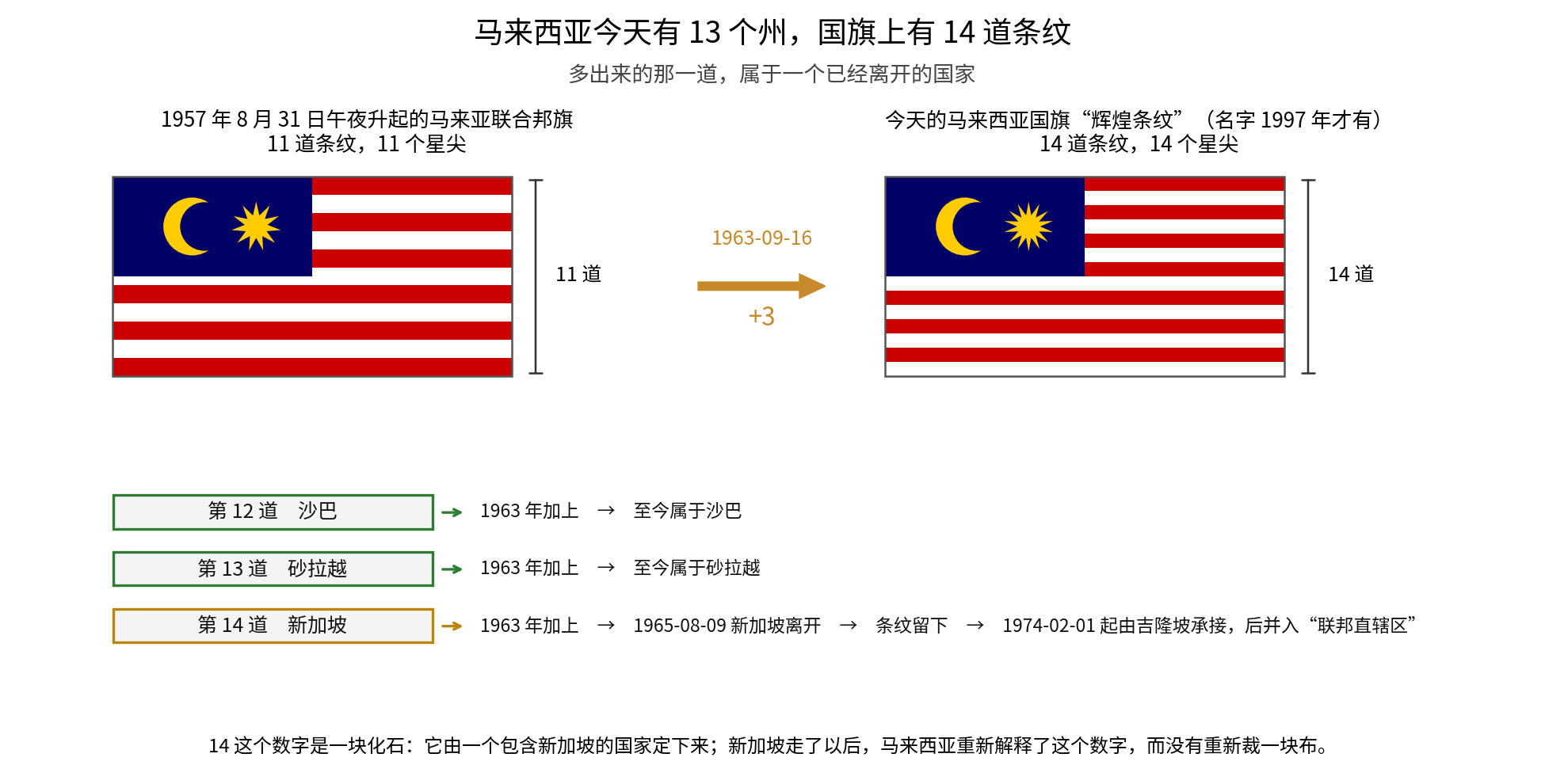
The flag raised at midnight was not today's Malaysian flag, and it cannot be called the "Stripes of Glory," or Jalur Gemilang. There are two reasons. The name Jalur Gemilang was officially announced by then prime minister Mahathir Mohamad in Independence Square on August 31, 1997, the 40th anniversary of independence. It did not exist in 1957. More importantly, the flag raised that night had 11 stripes, not 14. Its proper name is the flag of the Federation of Malaya.
The flag raised at the country's birth is not the flag flying there today. That is a literal fact, not a figure of speech, and it leads to the central point of this story.
After daybreak, at exactly 9:30 a.m., more than 20,000 people gathered in Stadium Merdeka: the Malay rulers, foreign dignitaries, the federal cabinet and members of the public. The Duke of Gloucester, representing the British queen, handed the instrument of independence to Tunku. Tunku then cried "Merdeka" seven times, and the crowd answered. The flag was raised, a military band played, a 21-gun salute sounded, and the call to prayer and a prayer followed.
(The seven cries occurred both on the Padang at midnight and in the stadium that morning. At midnight the crowd shouted them; in the morning Tunku did. The two events should not be collapsed into one.)
One detail is especially vivid. Stadium Merdeka had been completed only nine days before it was used. Construction began on September 25, 1956, and ended on August 21, 1957. It opened on August 30; on August 31, a country's birth was proclaimed inside it. Its designer was Stanley Jewkes, an American architect who directed the Public Works Department. The stadium in which a British representative surrendered power was drawn by an American.
Count the Stripes on Today's Flag
The Malaysian flag now has 14 stripes, and the star in its canton has 14 points.
Malaysia has 13 states.
Where did the extra one come from?
On September 16, 1963, the Federation of Malaya joined North Borneo, now Sabah, Sarawak and Singapore to form Malaysia. The number of stripes increased from 11 to 14, as did the number of points on the star. The three additions represented Sabah, Sarawak and Singapore.
On August 9, 1965, Singapore left Malaysia.
The stripe did not leave with it.
The number did not return to 13. Instead, the flag's meaning was quietly reassigned. On February 1, 1974, Kuala Lumpur took over one stripe and one point. When Labuan in 1984 and Putrajaya in 2001 also became federal territories, the remaining stripe and point came to represent the federal territories collectively. The National Security Council's current official wording is "the unity of the 13 states and the federal territories."
The number 14 is a fossil. It was fixed by a country that included Singapore. After Singapore left, Malaysia chose to reinterpret the number rather than cut a new piece of cloth.
A child counting the stripes on today's flag is counting a decision made in 1963. That is why the number is worth noticing.
Even Official Sources Disagree About the Flag Designer's Job
In 1949, one year after the Federation of Malaya was established, the Federal Legislative Council held an open competition for a new flag and received 373 entries. A committee selected three finalists, and The Malay Mail conducted a public poll.
Two finalist designs featured the kris, the Malay dagger. One placed 11 white stars in a circle and two crossed red kris on a blue field. The other used the same idea but arranged the stars in two circles of five and six. The third design had 11 blue-and-white stripes, a red canton, and a white crescent and five-pointed star.
The poll gave the third design 42 percent of the vote and one of the kris designs 27 percent.
Remarkably, both were submitted by the same person. Mohamed Hamzah entered four designs in all, reportedly completing them in three days; one reached the final round and took first place. A native of Johor, he drew inspiration from the Johor state flag and added five white stripes to its blue field.
His profession reveals an inconsistency in Malaysia's own official record. The Johor state government's page calls him a Public Works Department pelukis pelan, or draftsman. His biography likewise says he entered the Johor Bahru Public Works Department as a tracer in 1937 and was later promoted to technical assistant. But the federal National Security Council calls him an arkitek, or architect. He was born in 1918, which would make him about 31 in 1949, while the most common account says he was 29. The numbers do not match.
This account therefore gives neither the disputed age nor the title "architect." He was a government draftsman in Johor's Public Works Department. The larger point is revealing: even the country's official websites have not settled what the designer of its flag did for a living. National stories become smoother in the telling.
There is another twist. He won, but his submitted design did not become the flag unchanged. Before adoption, the Federal Legislative Council reversed the red and blue, changed the crescent and star from white to yellow, and increased the star from five points to 11. King George VI approved it on May 19, 1950, and it was first raised on May 26 outside the Sultan of Selangor's palace.
Malaysia's government assigns the colors these official meanings: red is courage and readiness to face all obstacles; white is purity, sincerity and earnestness; dark blue is the unity of Malaysia's diverse peoples; and yellow is the sovereignty of the constitutional monarchy, as well as the royal color of the Malay rulers. The crescent represents Islam as the religion of the Federation.
Two National Days and a Difficult Question
Malaysia has two national days. They are often confused in Chinese-language accounts, and the distinction reflects a real debate that continues today.
Independence Day is August 31, 1957, when the Federation of Malaya gained independence from Britain with 11 states, all on the peninsula.
Malaysia Day is September 16, 1963, when Malaysia was formed from Malaya, Sabah, Sarawak and Singapore.
The central fact is that Sabah and Sarawak were still under British rule on August 31, 1957. They were not present. Many people in East Malaysia therefore regard September 16 as the true national day. Yet September 16 did not become a nationwide public holiday until 2010. Then prime minister Najib Razak announced the change during a parliamentary answer on October 19, 2009, with effect the following year. For 47 years, the day had not been commemorated nationally, a history that forms part of East Malaysia's case. Debate over the Malaysia Agreement 1963 centers on the argument that Sabah and Sarawak should be treated as equal partners, not ordinary constituent states.
Another detail shows how concrete the issue is. Malaysia was originally due to be formed on August 31, 1963, deliberately coinciding with the anniversary of independence. Objections from Indonesia and the Philippines, followed by a United Nations assessment of public opinion in Borneo, delayed the date until September 16.
The locations of this year's events tell the story. Today's National Day parade was held in Putrajaya on the peninsula. The national Malaysia Day celebration on September 16 will be held in Kuching, Sarawak, on Borneo. The country places one national day on the peninsula and the other on Borneo.
A Signature Many Chinese Readers Will Not Know
Independence was negotiated not by one man but by a multiracial alliance. That can sound like a slogan until it is reduced to names on paper.
On January 1, 1956, two delegations sailed from Singapore. Negotiations took place at Lancaster House in London from January 16 to 18. On February 8, 1956, Tunku and British Colonial Secretary Alan Lennox-Boyd signed the London Agreement of 1956, setting independence for August 1957.
February 8, 1956, was Tunku's 53rd birthday. On his birthday, he signed the date of his country's independence.
The Malayan Chinese Association's representative in London was H. S. Lee, also known as Lee Hau-shik. He was:
the only ethnic Chinese signatory to the independence agreement reached in London in 1956.
The signature of a Chinese Malaysian appears on the document that fixed August 31, 1957. For Chinese readers, that may be the most important sentence in this article.
(Two common Chinese-language claims need correction. The role of Tan Cheng Lock, the MCA's first president, was real and important, but it was chiefly strategic and domestic; he did not join the London delegation. The Malaysian Indian Congress leader V. T. Sambanthan went to London for the constitutional talks in May 1957, not in 1956. One charming detail survives: before the 1957 trip, Tunku took Sambanthan shopping for a Western suit.)
The MCA's own history records another achievement. After independence, it launched a citizenship application campaign through which "more than one million Chinese residents obtained citizenship within one year." That is the party's account of its own record and should be read as such, but the scale of the number still conveys the magnitude of the moment.
An Unbroken Ladder
Chinese-language education in Malaysia is often called "the most complete Chinese education system outside Greater China." The claim can stand, but it needs more precise wording.
The ISEAS - Yusof Ishak Institute in Singapore wrote in 2025 that this is "the most complete Chinese education system outside mainland China, Taiwan, Hong Kong and Macao, with every level represented from kindergarten to university."
The key word is complete. The claim concerns whether any rung is missing, not the system's size or quality.
The ladder has this shape: about 1,302 to 1,303 Chinese primary schools (SJKC), with 463,988 pupils, according to a January 2026 report by the United Chinese School Teachers' Association; 81 national-type secondary schools (SMJK); and a little more than 60 independent Chinese secondary schools. The familiar figure of 63 is conventional because branch campuses are counted differently. In 2020, the United Chinese School Committees' Association used the formula "60 + 2 + 1."
Why do these schools exist? The answer lies in a split in 1961. The Education Act 1961 gave Chinese secondary schools a choice: convert into the national system, teach in Malay and receive government funding, or remain independent and receive none. Of the Federation's 71 Chinese secondary schools, about 54 converted and 17 refused. Every independent Chinese secondary school today descends from those 17.
The issue is still moving. In mid-May 2026, the cabinet agreed to open a pathway into public universities for graduates holding the Unified Examination Certificate, or UEC, as well as graduates of religious and private schools. Many Chinese-language outlets described this as "recognition of the UEC," but that is inaccurate. Higher Education director-general Azlinda Azman was explicit that the issue was not recognition of the UEC syllabus but the existence of a route. Prime Minister Anwar Ibrahim added that all students would still have to pass the Malay language and history papers in the SPM examination. A former MCA leader called the move "nothing earth-shattering." This issue, more than 60 years old, was not resolved in 2026.
The most surprising figure may be this one: Chinese primary schools now enroll 41,133 Malay pupils, 9.01 percent of their students, according to the education minister's written parliamentary reply using May 31, 2026, data. The share was 6.84 percent in 2022. Counting all non-Chinese pupils, the proportion rose from between three and six percent in the 1990s to around 20 percent by 2020.
Over roughly the same period, total Chinese-primary enrollment fell from 563,781 in 1995 to 408,578 in 2020, a decline of 28 percent, while 47 percent of Chinese primary schools enrolled fewer than 150 pupils.
ISEAS summarized the situation in four words: "revived, yet under threat." More Malay parents are sending their children to Chinese primary schools while the schools themselves are shrinking. It is not a story that fits into one sentence, but it is the reality now.
Malaysia Rejected Two Great British Composers
As independence approached, Tunku's committee held a worldwide competition for a national anthem. It received 514 entries and accepted none of them.
The committee then commissioned new pieces directly from Benjamin Britten, William Walton and Gian Carlo Menotti.
Their submissions were rejected too.
On August 5, 1957, the committee decided instead to use the melody of the Perak state anthem because it had a "traditional flavor." A group led by Tunku wrote new words. The result was today's "Negaraku."
Consider the scale of the choice. Britten wrote the War Requiem. Walton composed music for Elizabeth II's coronation. A country on the verge of independence invited them to write its anthem, then replied: no, we will use an old local tune.
(Many stories circulate about the tune's origin, including a supposed French chanson, but none has a reliable source and they are not repeated here. One better-supported anecdote says that at Edward VII's coronation in 1901, an official accompanying the Sultan of Perak realized the state had no anthem and, in the emergency, hummed a melody he knew. That melody later became the state anthem. It should still be treated as an anecdote.)
The Commemoration Still to Come
Malaysia's national Malaysia Day celebration will take place on September 16 at the Borneo Convention Centre Kuching (BCCK) in Sarawak, 17 days from today. The official calendar has not yet published a time, so none is guessed here.
RTM's Ai FM 89.3 is Malaysia's national Chinese-language radio service, and its Facebook page carries live coverage of events of this kind. The official merdeka360.my portal is operated by Malaysia's Department of Information.
Malaysia and Beijing use the same time, UTC+8.
Sources: the official Google Doodles page; Malaysia's National Security Council (MKN); the Ministry of Communications; the Department of Information's merdeka360.my; national broadcaster RTM Berita; the Malaysian government portal malaysia.gov.my on the national principles; Johor state government digital media; the official Muzium Negara website; Museum Volunteers JMM; the Malayan Chinese Association's official party history; Department of Statistics Malaysia first-quarter 2026 population statistics; ISEAS - Yusof Ishak Institute / FULCRUM (May 30, 2025); Free Malaysia Today (May 15, 2026); Malay Mail (May 14 and 16, 2026; June 28, 2025; August 29, 2026); The Star (May 18, 2026); Bernama; Berita Harian; Oriental Daily News (August 31, 2026); and colonialfilm.org.uk, Imperial War Museums MGH 2245.