
A space repair delayed for an entire week by a few bolts that would not turn.
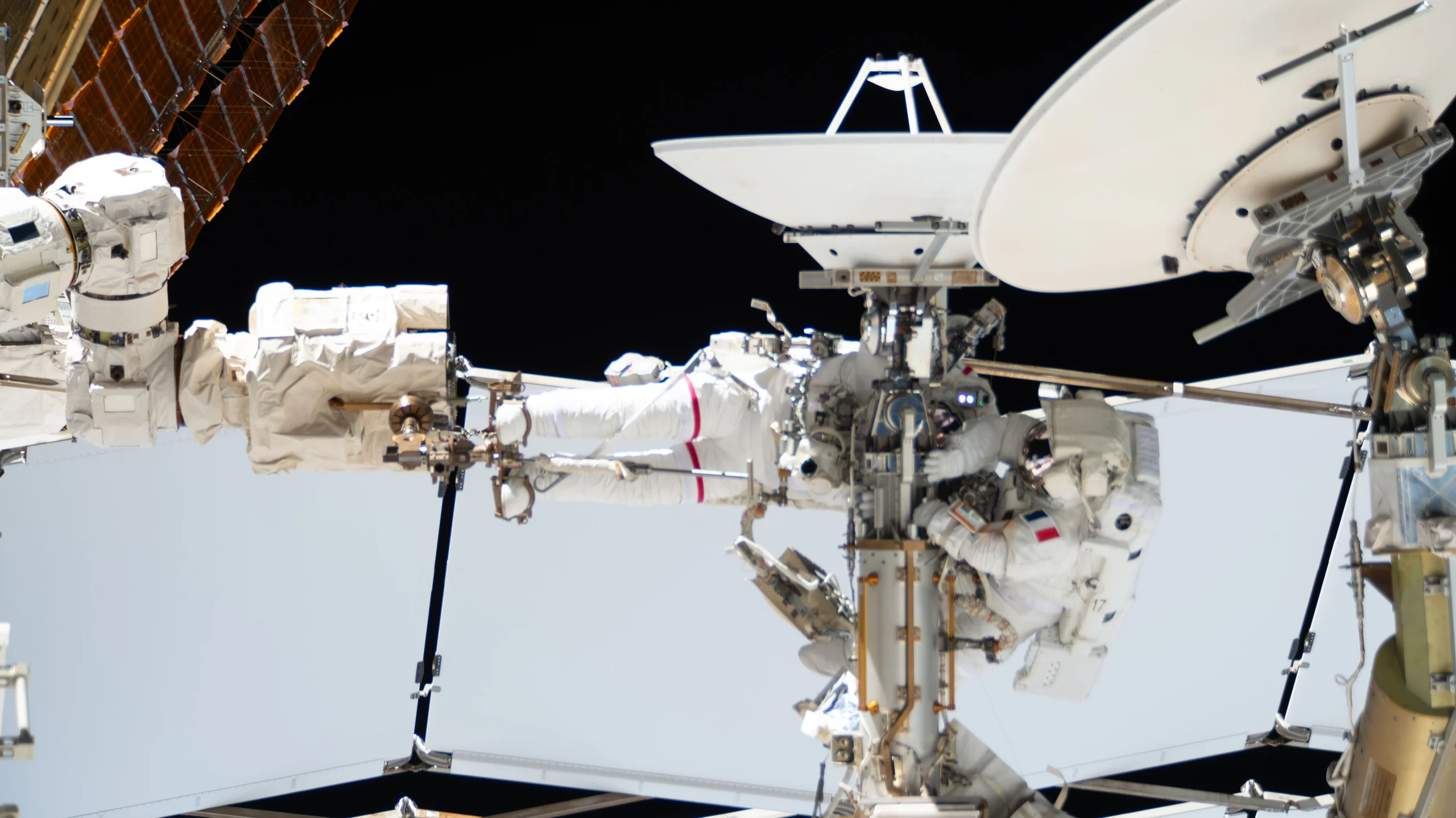
Image: NASA Image of the Day | Image credit: NASA | Image page
There are two people in the photograph NASA posted today.
The astronaut on the left is partly hidden; all you can see are the red stripes on the legs of his spacesuit. The astronaut on the right wears unmarked white. They are suspended outside the International Space Station with Earth below.
The red-striped astronaut is NASA's Anil Menon. The other is the European Space Agency's Sophie Adenot. Both are Expedition 75 flight engineers, and this spacewalk lasted 6 hours and 23 minutes.
But the photograph was not taken today.
An Antenna That Took a Week to Repair
NASA's full caption includes a detail often omitted: this was the spacewalk on Tuesday, August 18; "the duo will finish installing a high-speed communications antenna on August 25."
In other words, this job took two attempts.
The story begins earlier. In August 2026, the station conducted three US spacewalks in succession, numbered 96, 97 and 98.
On Thursday, August 6, during US spacewalk 96, Jessica Meir and Menon installed modification hardware on the station's 3B power channel in preparation for a future rollout solar array. It was Menon's first spacewalk.
On Tuesday, August 18, spacewalk 97 took place, the one shown here. Its purpose was to replace a failed space-to-ground communications antenna. It was also the 282nd spacewalk in the history of the station's assembly, maintenance and upgrades. It was Adenot's first. NASA's blog chose its words carefully: she became the first French woman to conduct a spacewalk. ESA used the same wording; neither organization tried to rank her among all French spacewalkers.
Then the work stalled.
The antenna being removed was SGANT-2, which had been unable to track the relay satellite constellation since November 2025. ESA gave a more specific explanation than NASA's blog: seized bolts and connectors on the failed antenna delayed the astronauts and prevented them from installing the spare as planned.
In more than six hours outside, they managed only to remove the failed antenna and temporarily secure it to the truss. They also inspected and replaced an articulating portable foot restraint near the airlock. The spare remained where it was for a full week.
On Tuesday, August 25, the day this photograph was published, the pair went outside again. The spacewalk began at 8:27 a.m. Eastern time, or 8:27 p.m. in Beijing, and ended at 2:57 p.m. Eastern, lasting 6 hours and 30 minutes. NASA's blog headline was blunt: astronauts complete high-speed antenna installation. This was the station's 283rd spacewalk. They installed and connected the spare space-to-ground antenna, then secured the failed antenna from the previous week on a spare-parts platform.
What does the antenna do? NASA calls it "a key component enabling high-rate data transmission between Mission Control in Houston and the orbital complex."
A space station worth tens of billions of dollars was held up for seven days by a few seized bolts.
The Hard Part Comes Before the Hatch Opens
Now for the central point of this story.
The most dangerous part of a spacewalk is not turning bolts. It is changing atmospheres.
The station's cabin is kept at sea-level pressure: 14.7 psi, or 101.35 kilopascals, with air like that on the ground, mostly nitrogen. The American Extravehicular Mobility Unit, or EMU, contains pure oxygen at only 4.3 psi, about 29.65 kilopascals.
What happens if someone moves directly from nitrogen-rich air at 101 kilopascals into pure oxygen at 29.6 kilopascals? Nitrogen dissolved in the tissues and blood cannot leave quickly enough through breathing. It comes out of solution as bubbles in the joints and blood vessels, causing what divers call the bends and physicians call decompression sickness.
Astronauts therefore have to purge nitrogen before going outside. NASA's current In-Suit Light Exercise protocol, or ISLE, works like this: first, the astronaut breathes pure oxygen through a mask for 60 minutes while preparing for the spacewalk. The cabin pressure then drops to 10.2 psi, about 70.3 kilopascals, while the astronaut breathes oxygen-enriched air and performs light exercise for 40 minutes. Donning the suit at that pressure takes 30 minutes. Once suited, the astronaut performs 50 minutes of light activity inside the suit, then rests for 50 minutes while breathing pure oxygen.
The total is 230 minutes: three hours and fifty minutes.
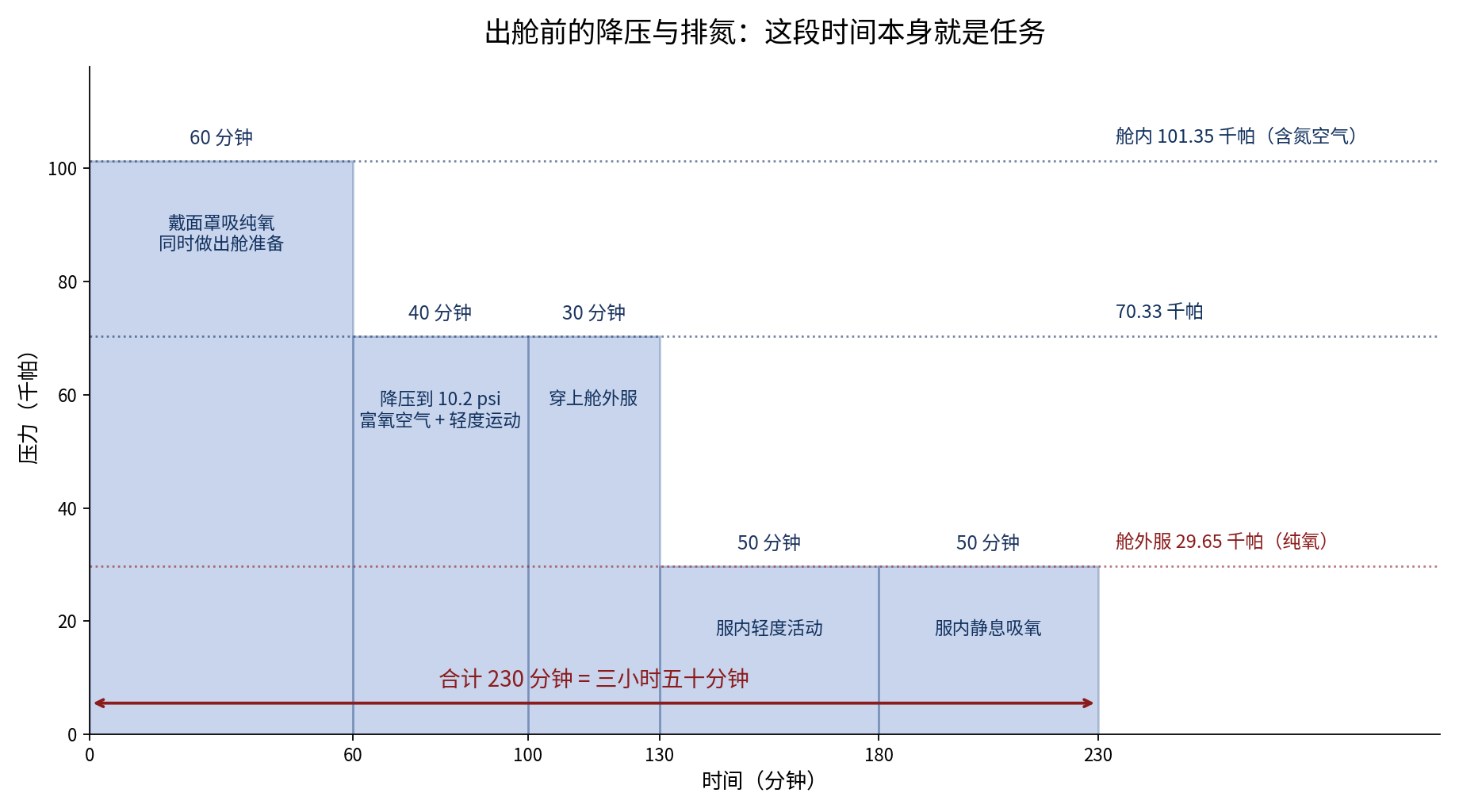
Those three hours and fifty minutes are not merely preparation. They are part of the mission. A six-and-a-half-hour spacewalk rests on nearly four hours of prebreathe; the time outside accounts for only about 60 percent of the entire operation.
Why Not Simply Raise the Suit Pressure?
It is a good question, and it has a quantitative answer.
A study published in npj Microgravity compared the options. After 240 minutes of denitrogenation for a suit at 4.3 psi, the relative risk index for decompression sickness was 0.8. Raise the suit pressure to 8.3 psi, and just 40 minutes of pure-oxygen prebreathe brought the risk index down to 0.6.
Higher pressure looks better. Why not use it?
Because a spacesuit is fundamentally an inflated balloon. The higher its pressure, the stiffer it becomes. The same study states that reducing spacesuit gas pressure is an effective way to improve mobility, but it requires a tradeoff against greater risks of hypoxia and decompression sickness. The cost reaches all the way to the fingertips: the study also notes that the likelihood of spacesuit-induced fingernail injury is related to hand circumference. Every grip outside pits an astronaut's hand against roughly 30 kilopascals of internal pressure. Over time, fingernails can detach.
NASA's choice of 4.3 psi is a compromise between losing fingernails and forming bubbles in blood vessels.
The rest of the suit is also a set of engineering compromises. Its flexible sections contain as many as 16 layers of material. Heat removal relies on a porous-plate sublimator: the vacuum of space makes water change directly from solid to vapor at the plate, carrying heat away. It can handle up to 2,000 British thermal units per hour, about 586 watts, of an astronaut's metabolic heat, in addition to the system's own heat and heat absorbed from the environment. The liquid-cooling garment worn next to the skin contains about 300 feet of water tubing. NASA gives the temperature outside as ranging from minus 250 degrees Fahrenheit to 250 degrees Fahrenheit in sunlight, about -157 to 121 degrees Celsius.
(NASA's own description of the gold-coated visor is simply that it acts like the astronaut's sunglasses, protecting the eyes from intense sunlight. Saying that it blocks ultraviolet and infrared radiation is optically sound, but it is not NASA's official phrasing, so the agency's wording is retained here.)
The Red Stripe Was Invented by Public Affairs
The photograph's most visible identifying mark has a surprising origin.
In the early Apollo missions, people on the ground could not tell which astronaut was which in photographs because both wore identical white suits. Brian Duff, head of public affairs at Johnson Space Center, pushed to add identifying stripes to the commander's suit on later missions. They first appeared on Apollo 13; there had not been enough time to modify the Apollo 12 suits. Red stripes were placed on the commander's arms, legs and helmet.
Their original name was Public Affairs Stripes. Only later did they become known as commander stripes.
They solved a communications problem, not an engineering one. More than half a century later, that red stripe still moves beside an antenna, though it now identifies the lead spacewalker rather than an Apollo commander.
This Suit Is Older Than the People Wearing It
Here is a fact tied firmly to 2026.
On April 20, 2026, NASA's Office of Inspector General released report IG-26-006, an assessment of the agency's acquisition of next-generation spacesuits. Its verdict on the current EMU was unsparing:
The Extravehicular Mobility Unit spacesuits used by astronauts aboard the International Space Station were designed more than 50 years ago. They were first used in 1983 on the sixth Space Shuttle flight. The suit has seen no major redesign in the past 20 years.
The report says NASA intends to keep using the EMU until the station is retired in 2030, or until an upgraded replacement becomes available. The risk is that if contractors cannot meet contract requirements promptly and affordably, NASA "may be forced to continue using the problematic EMUs for the remainder of the Station's operational life."
"Problematic" is not rhetoric. On July 16, 2013, between one and one and a half liters of water entered an astronaut's helmet during a spacewalk, forcing an emergency termination. NASA's mishap investigation found that inorganic material had clogged drum holes in the water separator, sending water into the ventilation loop. But the report's five organizational root causes deserve just as much attention: an overemphasis on maximizing crew time; a mistaken belief about the drink bag's reliability; reluctance to initiate the anomaly-reporting process; inadequate understanding of water behavior inside the suit in microgravity; and, most seriously, the normalization of small amounts of water leakage.
The report's essential conclusion was that if the small amount of water found in the same helmet after the previous spacewalk had been fully investigated, the accident would not have happened.
(The official report refers throughout only to EV1 and EV2 and names neither astronaut.)
In March 2022, another incident left a thin layer of moisture inside a helmet, and spacewalks were temporarily suspended. This investigation found no hardware failure. The cause was "system integrated performance": several variables, including crew exertion and cooling settings, combined to produce much more condensation than normal. NASA revised procedures, developed new mitigation hardware and cleared spacewalks to resume through a flight readiness review in October 2022.
As for the replacements, the lunar AxEMU had originally been promised for demonstration in November 2025. The 2026 inspector general report says the contractor is now working toward having "two suits ready to demonstrate by the end of 2027," at least a year and a half late. Another company responsible for a low-Earth-orbit suit negotiated a reduction in its task order with NASA in June 2024, after concluding that development could not meet the station demonstration schedule. The inspector general's assessment of the original schedule was clear: overly optimistic and unrealistic.
The technological ancestor of the suit used for this antenna repair first flew before either astronaut wearing it was born.
China: 40 Kilopascals and "Four Years, Twenty Uses"
The comparison is instructive.
On September 27, 2008, Zhai Zhigang left the Shenzhou 7 spacecraft. The China Manned Space program's official site records the exact sequence: the hatch opened at 16:43:24, he "took his first step in space" at 16:45:17, and the extravehicular activity ended with his return to the orbital module at 16:59. The China National Space Administration described the achievement as making China the third country in the world to independently master the key technology of extravehicular activity.
The official specifications for the first-generation Feitian spacesuit were published at the time: a 40-kilopascal pure-oxygen pressure regime; four hours of independent operation in vacuum; a service life of at least five uses; a mass of no more than 120 kilograms; at least 30 minutes of emergency oxygen; average heat dissipation of 300 watts; and accommodation for astronauts 165 to 175 centimeters tall.
Set the two figures side by side: the American EMU uses pure oxygen at 29.6 kilopascals; China's Feitian uses pure oxygen at 40 kilopascals. Higher pressure means a lighter denitrogenation burden, at the cost of stiffer gloves. Neither answer is inherently right or wrong. They are different solutions to the same tradeoff.
The newer Feitian used in China's space-station era can operate independently for eight hours. Its gloves can grip objects as small as 5 millimeters in diameter, and its upper limbs have three bearings aligned with the body's joints. At the elbow, for example, the required flexion range is at least 60 degrees. A trained astronaut can don or remove it in five minutes.
The most consequential Chinese figure concerns service life.
The design requirement was "three years of in-orbit storage and no fewer than 15 spacewalk uses during that period." By March 2025, officials reported that the suits had supported 19 station spacewalks, with one suit used as many as 17 times, exceeding the "three years, 15 uses" specification. In August 2025, the Astronaut Center of China announced that spacesuit B had achieved its life-extension goal of "four years, twenty uses." It had supported 20 spacewalks, worn in succession by 11 astronauts across eight crewed missions.
Eleven people, eight missions, one suit passed from astronaut to astronaut for twenty trips through the hatch.
The duration record must be stated precisely. On December 17, 2024, Shenzhou 19 astronauts Cai Xuzhe and Song Lingdong completed a spacewalk lasting about nine hours. The official China Manned Space Agency wording was that it "once again set a new record for the duration of a spacewalk by Chinese astronauts"; Xinhua's headline likewise called it the record for a single Chinese spacewalk. The previous record, set by the Shenzhou 18 crew, was about 8.5 hours. No Chinese official source called it a world record. That embellishment appeared in commercial-media headlines, so the official wording is used here. (On April 17, 2026, Shenzhou 21 astronauts Zhang Lu and Wu Fei completed a roughly 5.5-hour spacewalk. Zhang's career total of seven spacewalks set a new individual record for a Chinese astronaut.)
There is another shared feature. On August 18, Menon rode on the end of Canadarm2 to reach the work site while Meir operated the arm from inside. The large robotic arm on China's space station extends 10.2 meters, has seven degrees of freedom, can handle 25 metric tons and can walk between adapters on the station. Its official spacewalk role is likewise to support astronaut transfers and reduce physical exertion.
Astronauts from both countries are carried where they need to go by a robotic arm.
Smaller Details That Are Hard to Forget
How do astronauts drink and use the toilet inside the suit? NASA's official documentation is direct. The suit contains a water bag holding 21 ounces, about 621 milliliters, and "a maximum absorbency garment, which is a modified adult incontinence diaper." Those are NASA's own terms.
What does space smell like? NASA Ames Research Center has an official page for that question. Astronaut Greg Chamitoff described "a very, very strong metallic smell, and I don't know exactly what it is." Don Pettit said it was metallic, a rather pleasant sweet metallic sensation that reminded him of "pleasant-smelling welding fumes." ESA astronaut Alexander Gerst supplied the most vivid comparison: "a mixture between walnuts and the brake pads of my motorbike."
There are two explanations for the odor. Louis Allamandola of the Ames Astrochemistry Laboratory points to polycyclic aromatic hydrocarbons, unusually sturdy, chicken-wire-shaped molecules found throughout the universe and also in soot and burnt toast on Earth. Another scientist, Scott Sandford, argues that oxidation is the main cause: as the station races through the remnants of the atmosphere, it creates a halo of excited oxygen that oxidizes materials on the surfaces of spacesuits.
The best detail is that the smell clings to the suits, helmets, gloves and tools. Astronauts cannot smell it outside, where the suit interior smells only of plastic. They encounter it only after returning to the airlock and repressurizing.
So when Menon and Adenot climbed back inside at nearly 3 a.m. Beijing time on August 26 and removed their helmets, what they smelled was the scent of the sun-baked universe brought in by the antenna outside.
Things also get lost. During a spacewalk in November 2023, "one tool bag was inadvertently lost." NASA's blog recorded what happened next. Flight controllers spotted it with the station's external cameras. Its tools were not needed for the rest of the spacewalk. Mission Control analyzed the bag's trajectory, found that the risk of it striking the station again was low and concluded that the crew and station were safe, with no action required.
When the tool bag drifted away, the first thing the ground team did was calculate whether it would come back and hit the station.
One last detail: the station circles Earth roughly every 90 minutes, making 16 orbits and crossing 16 sunrises and sunsets in 24 hours. During Menon and Adenot's 6-hour, 23-minute spacewalk, they experienced about four sunrises and four sunsets. Between lunch and afternoon tea on Earth, they watched the Sun set four times.
Sources: NASA Image of the Day, "Astronauts Anil Menon and Sophie Adenot on Spacewalk"; NASA, "NASA to Cover Three US Spacewalks"; NASA Space Station blog posts from August 17, 18, 19 and 25, 2026; European Space Agency reports on the two Epsilon mission spacewalks; NASA's official Anil Menon biography and "Expedition 75" page; NASA, "In-Suit Light Exercise (ISLE) Prebreathe Protocol Peer Review Assessment"; the npj Microgravity study of spacesuit pressure and decompression-sickness risk; NASA's EMU manual, "Spacewalk Spacesuit Basics" and "Management of the Post-Shuttle EMU Water Circuits"; NASA Office of Inspector General report IG-26-006, April 20, 2026; NASA's 2013 "Suit Water Intrusion Mishap Investigation Report" and its 2022 return-to-flight announcement; the Apollo Lunar Surface Journal page on commander stripes; the China Manned Space program on the Shenzhou 7 spacewalk timeline, Feitian spacesuit specifications, robotic-arm parameters and the Shenzhou 19 and Shenzhou 21 spacewalks; the China National Space Administration's Shenzhou 7 page; Xinhua's report on the Shenzhou 19 spacewalk; the International Science and Technology Innovation Center's republication of the Astronaut Center of China's spacesuit life-extension report; NASA's Spot the Station and FAQ pages; NASA Ames, "What does space smell like?"; ARISS; and NASA's station facts and figures.