
The green cloud on the left will be gone in a few days; the starlight on the right has been sitting in the same spot for about thirteen billion years.
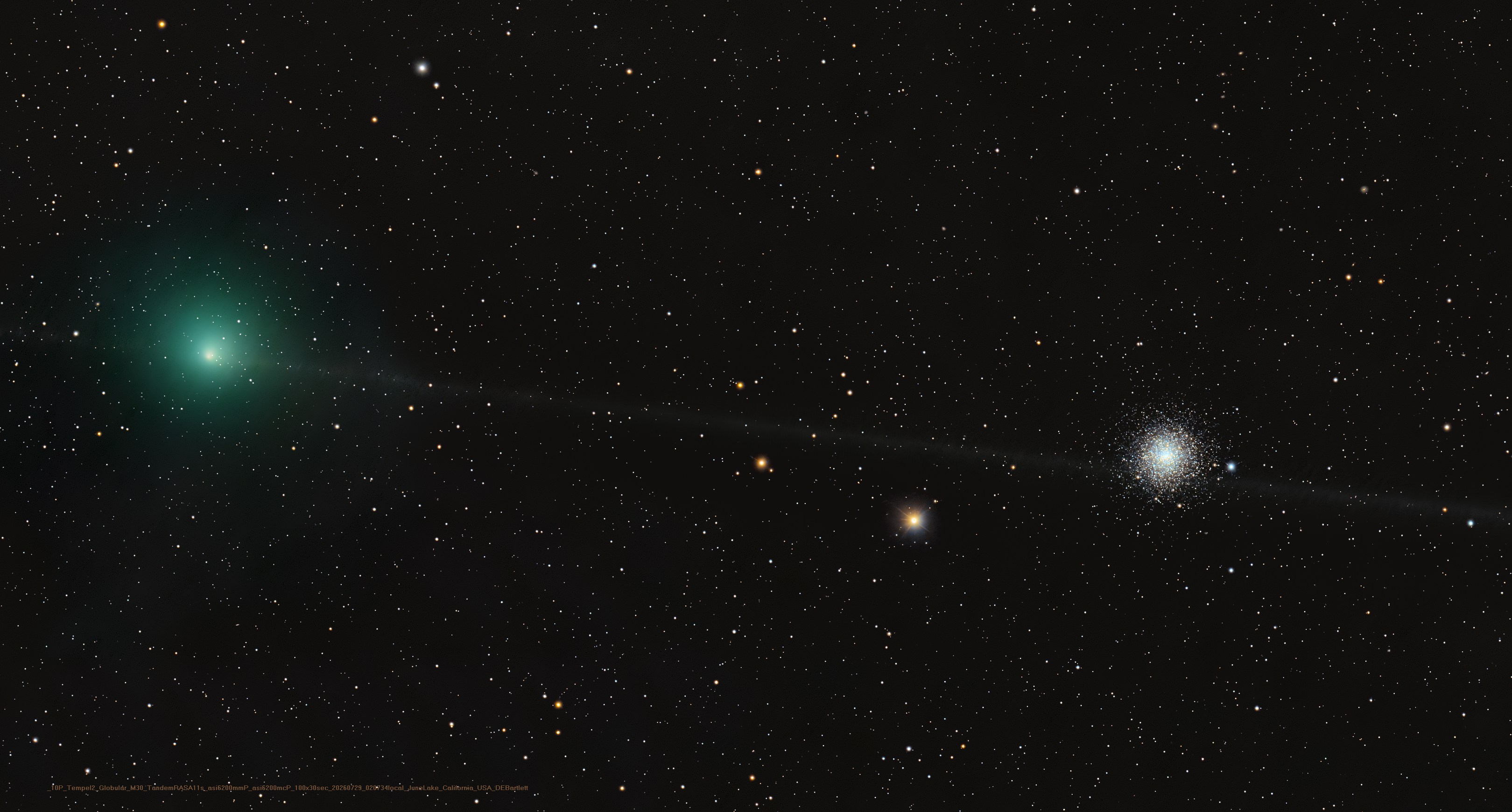
Image: NASA Astronomy Picture of the Day (APOD) · Image Credit & Copyright: Dan Bartlett · Today's page
Today's APOD opens with a quiz: there are two fuzzy blobs of light in the picture—which one is not a comet?
Don't rush to answer. The person who set this question wrote the answer key 262 years ago—and in doing so, produced one of the most beloved catalogues in the history of astronomy.
First, the picture
The blob on the left, wrapped in a green haze, is a comet—designated 10P, named Tempel 2. The tightly packed blob on the right is globular cluster M30—a ball made of several hundred thousand stars. There's also a thin, straight line cutting diagonally across the frame, like a needle piercing the cluster. It's not a scratch; we'll come back to it.
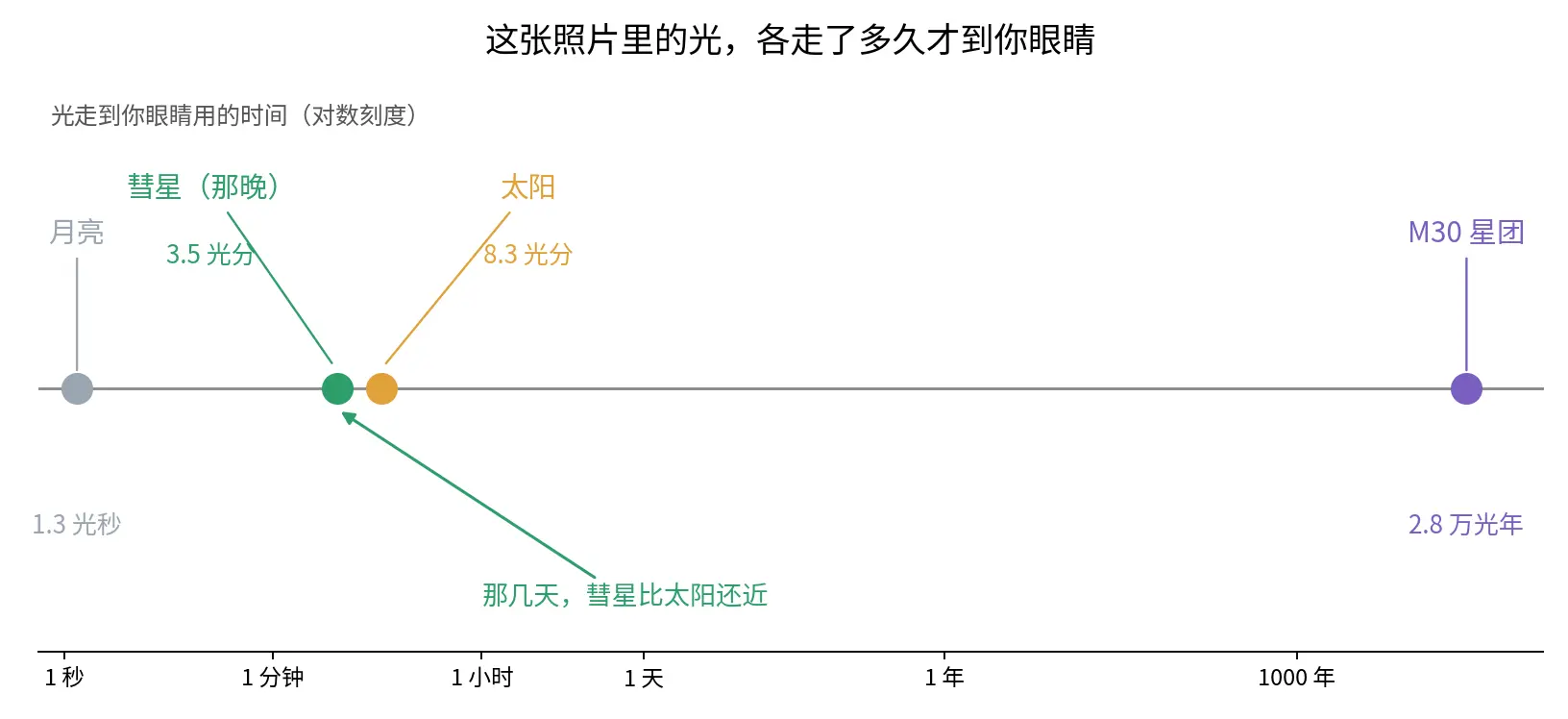
The photograph was taken by astrophotographer Dan Bartlett on July 29. A note: these two blobs only happen to line up along our line of sight. According to APOD, the comet was only about 3.5 light-minutes from Earth at the time of the shot—roughly 63 million kilometres, closer to us than the Sun—while M30 lies 28,000 light-years away. To put it in perspective: place the comet one step away from you, and at the same scale, M30 would have to be more than five times farther than the Moon.
The light from M30 set out when Earth was still in an ice age and humans had not yet invented agriculture.
A "don't look" list
The question-setter was Charles Messier, born in France in 1730. He lost his father at eleven, dropped out of school, and at thirteen or fourteen witnessed the Great Comet of 1744—according to NASA's biographical sketch, at peak brightness it was the brightest thing in the sky after the Sun and Moon. The boy was transfixed, and spent the rest of his life chasing comets.
At twenty-one he joined the French Navy as a draughtsman and, thanks to a sharp pair of eyes, eventually rose to chief astronomer at the Naval Observatory in Paris, discovering more than a dozen comets along the way. King Louis XV gave him a nickname: "the comet ferret"—a ferret being a small animal that dives into burrows to flush out prey, a compliment to his keen nose.
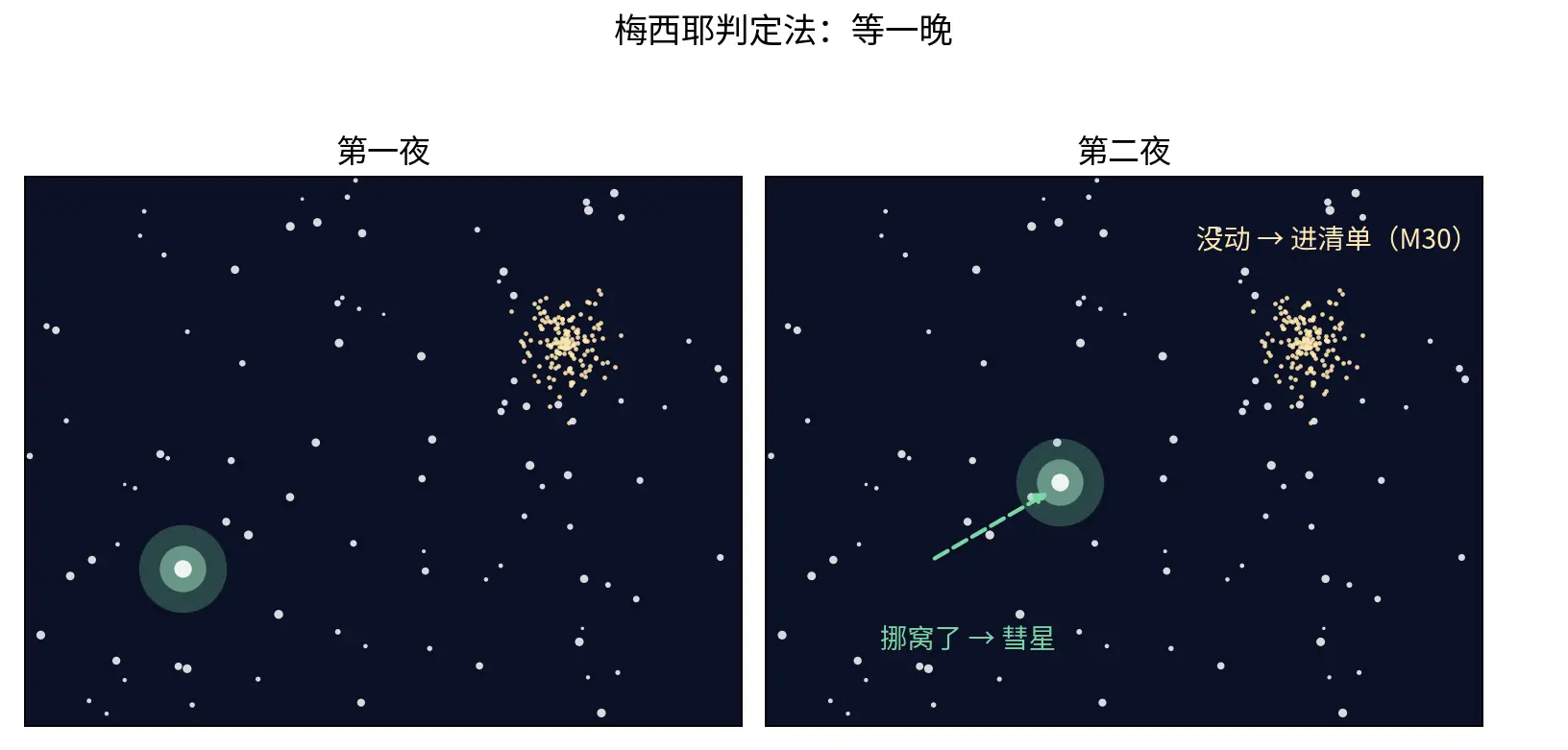
The turning point came in 1758. Messier was tracking a comet when a cloudy smudge in Taurus blocked his view. He watched it for several nights and realised something was wrong: it didn't move. A comet shifts against the background stars night after night; this thing refused to budge—so it wasn't a comet, just a "fake" that would fool people every time.
He did something of incalculable service: he wrote it down, and began deliberately collecting these "things that impersonate comets," so his colleagues wouldn't waste their nights on them. That smudge became entry No. 1, M1—what we now call the Crab Nebula. By the time he died in 1817, the catalogue held 103 objects; twentieth-century historians of astronomy later rounded it out to 110.
That is the origin of the Messier Catalogue: the most widely circulated deep-sky object list in history, originally a guide to things to avoid. He spent a lifetime recording objects marked "do not look," and yet amateur astronomers the world over still use that very list today, ticking them off one by one.
The test: wait one night
In a small telescope, a comet and a star cluster look identical—both are fuzzy blobs. APOD makes a point of joking that even if you placed today's two blobs in Messier's own telescope, he would have seen two nearly indistinguishable smudges—and still got the right answer.
Because there is only one test, and it is reliably simple: wait one night. The one that has moved by the following evening is a comet; the one still sitting in the same place goes on the list.
That is how M30 made the list, as entry No. 30. On the night of August 3, 1764—a Friday—Messier recorded it, writing words to the effect of: round, no individual star visible. He never knew it was several hundred thousand stars: his telescope couldn't resolve the glow. It took about twenty more years before Herschel, using a larger instrument, split it into individual stars for the first time.
Today we know far more about entry No. 30 than its cataloguer could have imagined: it is roughly 90 light-years across, approximately 13 billion years old—nearly as old as the universe itself. The Hubble Space Telescope even found a batch of "faking youth" blue stragglers at its core—a handful of impossibly blue, bright stars lurking among what should be a uniformly ancient population. Some formed when two old stars collided head-on and merged; others siphoned hydrogen from a companion star to "rejuvenate" themselves.
262 years, to the day
Now for the one on the left.
On July 4, 1873, German astronomer Wilhelm Tempel discovered this comet from Milan—he also discovered Tempel 1, the one NASA's Deep Impact probe blasted a crater into in 2005. Tempel 2 is a short-period, Jupiter-family comet that orbits the Sun roughly every 5.4 years, with a nucleus about 10 kilometres long.
It returns every five-odd years, but on most passes Earth isn't in a favourable position and no one gets a good look. This year is an exceptional exception: it passed perihelion on August 2 and reached its closest point to Earth on August 3—0.414 AU, about 62 million kilometres. According to TheSkyLive's calculations based on JPL ephemerides, this is its closest approach to Earth in the entire 21st century; the last encounter better than this was in 1967. It has never become a naked-eye comet—even at its historically closest recorded approach in 1925 it reached only magnitude 6.5—always remaining a binocular-level target.
Now put the two dates together: the comet's closest approach to Earth on August 3 falls on the exact same day of the year that M30 was entered into the catalogue—the night of August 3, 1764. Exactly 262 years. This photograph from July 29 is, in effect, a group portrait taken a few days early for an anniversary nobody planned.
And to answer a question children will inevitably ask: where does the green come from? Large molecules escaping the nucleus are broken apart by sunlight, producing a molecule that barely exists on Earth—C₂, two carbon atoms holding hands. When solar ultraviolet light strikes it, it glows green. But sunlight both illuminates and destroys it: near Earth's orbit, a C₂ molecule survives less than two days. That is why the green only ever clings to the comet's head and never enters the tail—physicist Gerhard Herzberg guessed this explanation in the 1930s, but it wasn't truly confirmed in the laboratory until 2021.
That line isn't a comet tail
Finally, the "needle" in the frame.
It looks as though it pierces the cluster, but it has nothing to do with M30—it is the comet's dust trail, and it is not a tail. A comet tail is freshly ejected fine dust, light enough to be pushed away by sunlight, always pointing away from the Sun, fluffy in shape. This line is the opposite: it consists of millimetre-scale and larger coarse particles shed by the comet over decades or centuries, too heavy for sunlight to push, left behind in place, slowly spreading along the comet's own orbit—like a contrail laid down on a flight path.
The human eye cannot see such structures. In 1983 the Infrared Astronomical Satellite (IRAS) scanned the entire sky and for the first time "saw" the infrared glow of these warm dust grains. JPL's press release that year reported observing a "long, thin, invisible trail of debris" behind Tempel 2—one of the first such trails discovered and, at the time, the most conspicuous. That same year, IRAS also incidentally identified the long-sought parent body of the Geminid meteor shower—a debt a century overdue.
These two facts are really the same fact: when Earth ploughs headlong into the dust trail a comet has laid down, the result is a meteor shower.
Next Wednesday, go catch a comet's dust
Tempel 2's trail doesn't reach Earth's orbit; its grains can't fall on us. But another comet's trail is one Earth barrels through every August—Comet Swift-Tuttle. The trail it laid down is the Perseid meteor shower.
According to NASA, this year's peak falls on the night of August 12 into the early morning of August 13, with the nights on either side also worth watching. Better still, it coincides with a new moon—the same moon that will block out the Sun during a total solar eclipse over the Atlantic on the 12th—leaving the sky moonless all night. NASA's live-stream page states: under good conditions, the peak rate can reach 50 to 100 meteors per hour.
How to watch
- Peak: the night of August 12 (Wednesday) through the early hours of August 13 (Thursday); visible from all parts of China. After midnight the radiant climbs higher, producing more meteors.
- No equipment needed: find a spot far from city lights with an open sky, lie down, and give your eyes 20 minutes to adapt to the dark.
- This year's peak night falls on a new moon—no moonlight interference all night.
- Cloudy backup: NASA Marshall Space Flight Center Meteoroid Environment Office's official livestream Up All Night, at youtube.com/watch?v=kVRkkrB4eS0 (the stream runs during U.S. nighttime hours; check the channel page for start times and adjust for your time zone).
Every streak you see will be a single grain of sand a comet dropped onto its orbit years ago, now slamming into the atmosphere and burning itself into one second of light—just for you.
Messier spent his life cataloguing "things that don't move" so others could confidently chase the things that do. More than two hundred years later, it's the list that the world remembers. In today's photograph, his No. 30 shares the frame with a comet he never lived to see—if he could look at it, he'd probably squint for a moment, then say: check again tomorrow night and you'll know.
Sources: APOD, August 8, 2026 · NASA: Charles Messier biography · NASA Hubble Messier Catalog: M30 · SEDS: Messier's original observation of M30 · Wikipedia: 10P/Tempel · In-The-Sky.org: Tempel 2 at perihelion · TheSkyLive: 10P/Tempel data page · Universe Today: Catch Comet 10P Tempel While You Can · Forbes: How to see Comet 10P/Tempel 2 · NASA JPL 1983 press release: IRAS discoveries · Astronomy magazine: Tempel 2's dust trail · Chemistry World: Comet's green colour from dicarbon dissociation · NASA Night Sky Network: Prepare for Perseids