
The Sombrero Galaxy is famous for its hat. Today's photograph asks us to look beyond the brim.
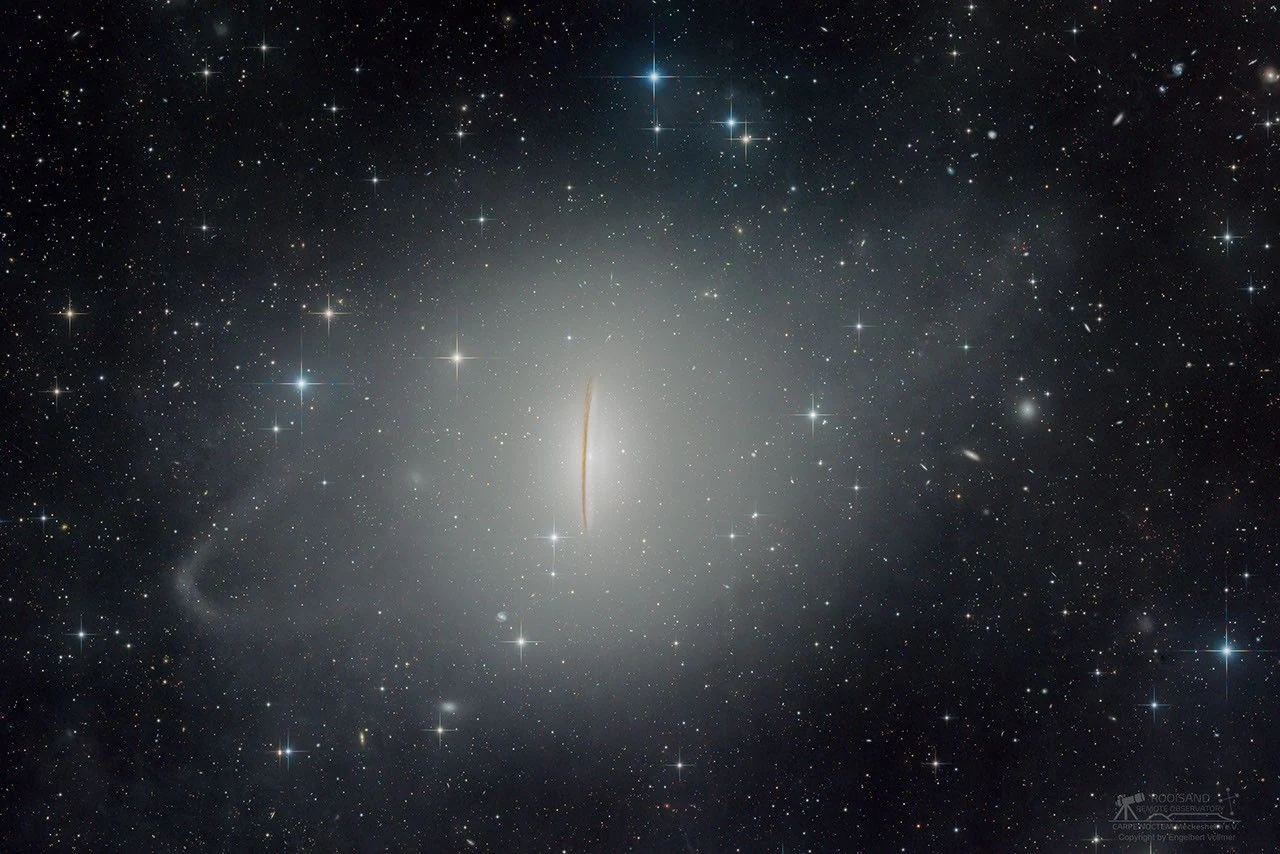
Image: NASA Astronomy Picture of the Day | Credit & Copyright: Engelbert Vollmer | Original page
NASA says Vollmer acquired this image over seven days in Namibia in mid-2026. That describes the imaging period. It does not establish seven uninterrupted days of exposure, or a total of 168 hours with the shutter open.
The distinction matters because deep astronomical photographs are commonly built by calibrating, aligning and combining individual exposures. The final image can contain structures too faint to pick out in a shorter observation.
Collecting a Faint Signal
In familiar pictures of M104, a dark dust lane encircles the bright central region and gives the galaxy its hatlike appearance. This deeper view reveals a hazy stellar halo extending well beyond the disk. NASA points to structure within it, including a diagonal ring.
Longer effective exposure gathers more signal. Imagine very light rain collecting in a bowl: a brief wait leaves almost nothing to notice, while a longer one allows the water to accumulate. The analogy explains the principle, not a measured photon count for this photograph.
Real detectors also collect noise, and the sky contributes background light. Calibration and careful combination help improve the signal-to-noise ratio. Exposure time does not determine magnification; it helps determine which faint features can be distinguished.
The light reaching the camera has traveled roughly thirty million years. NASA gives the galaxy's full span as about 150,000 light-years. A photograph assembled over days can therefore reveal evidence of events that unfolded over billions of years.
Stars Stretched into a Stream
A galaxy's gravitational pull varies across a smaller companion. Tidal forces can strip stars from it, and differences in the stars' orbits spread the debris into extended streams.
These structures offer clues to earlier interactions. They are not permanent records immune to change: orbital mixing can blur and disperse them.
In 2020, Roger Cohen, Paul Goudfrooij and colleagues reported an unusually metal-rich halo around the Sombrero. In astronomy, metals are elements heavier than helium. The observed abundance reflects earlier generations of stellar enrichment.
The researchers found very few of the metal-poor stars usually expected in a massive galaxy's halo. A past merger involving similarly massive, mature galaxies is one possible explanation. The smooth appearance of today's Sombrero makes that proposed turbulent history particularly intriguing.
A separate study, published in 2021 under the title A Feather on the Hat, traced the full path of a ringlike stream on both sides of the disk. Its best-fitting model suggested that the stream formed within the past three billion years, independently of an older major merger.
That is a model-based interpretation, not a direct recording of the encounter. Together, the chemical composition and the faint structure support a history more complicated than the tidy brim first suggests.
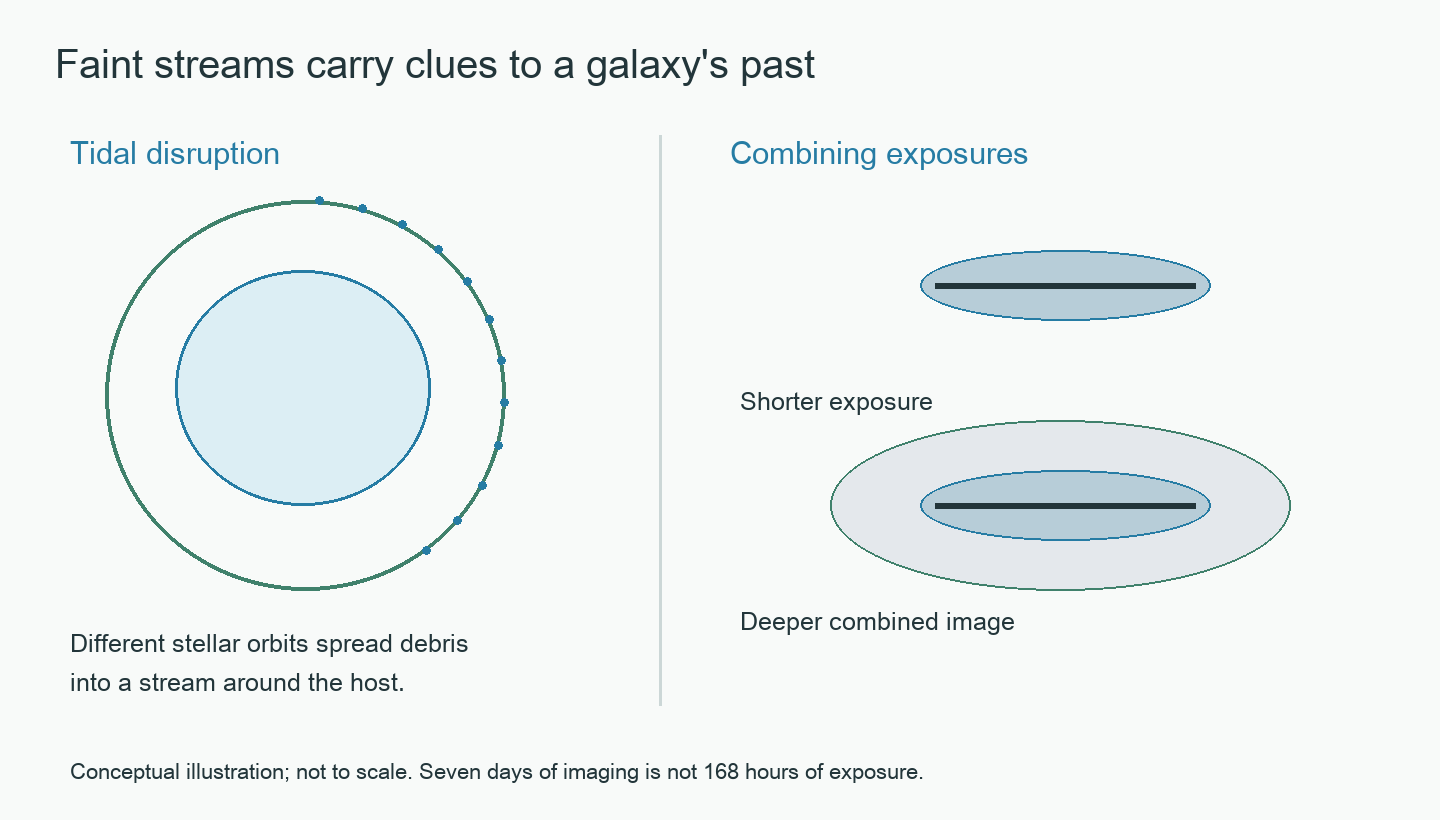
Diagram: The Daily Backstory. Conceptual illustration, not to scale; the exposure comparison is not a reconstruction of Vollmer's observing sequence.
Finding the Right Air
Namibia offers dark locations for astronomical observing, including the internationally recognized NamibRand reserve. NASA identifies the country where Vollmer took the photograph, not the exact site; it would be a guess to place his telescope inside that reserve.
Choosing a site involves more than escaping city lights. Clear skies, stable air and low water vapor all matter. A measured example is Saishiteng Mountain near Lenghu, in China's Qinghai Province.
A team led by Licai Deng studied the area's observing conditions over three years. Their results appeared in Nature in August 2021. At a site around 4,200 meters above sea level, they measured median seeing of 0.75 arcseconds, comparable with leading observatory sites.
Seeing describes how atmospheric turbulence blurs a star's image. The twinkling we enjoy from the ground becomes a limit on the detail a telescope can resolve.
The study also reported precipitable water vapor below two millimeters for 55% of nighttime. Low water vapor is especially useful for infrared observing. These are measured statistics, not a promise that every night will have the same conditions.
There is a practical connection between that mountain and this photograph from another continent. Before astronomers can study faint light, they must find conditions in which it survives the trip through our own atmosphere.
The bright brim and the nearly hidden stream belong to the same galaxy. Collecting a better signal changes how much of its history we can read.
Sources
NASA: Original page; NASA: Hubble and the Sombrero's halo; Martinez-Delgado et al.: A Feather on the Hat (2021); DarkSky International: NamibRand; Chinese Academy of Sciences: Lenghu site measurements (Chinese); Deng et al.: Lenghu as an astronomical observing site, Nature (2021).