
The man surrounded by fans taking selfies had traveled farther from Earth than any human before him just five months earlier.

Image: NASA Image of the Day | Image credit: NASA/Bill Ingalls | Original page
A stadium stand, a cluster of phones, a crowd of broad smiles. The man in the dark jacket, holding a phone a little higher to fit everyone into the frame, is Reid Wiseman.
It is Sunday, September 20, 2026, at M&T Bank Stadium in Baltimore. The Ravens are playing the New Orleans Saints at home.
Five months earlier, the same man was 406,771 kilometers from Earth, looking through a spacecraft window at the far side of the Moon.
Where He Went
At 6:35 p.m. Eastern Daylight Time on April 1, 2026, or 6:35 a.m. on April 2 in Beijing, an SLS rocket lifted off from Kennedy Space Center's Launch Pad 39B. It carried four people aboard an Orion spacecraft named Integrity, bound for the Moon.
For the first time since 1972, humans were leaving low Earth orbit.
Apollo 17 launched on December 7, 1972. The interval to April 1, 2026, was 19,473 days, or 53 years and four months.
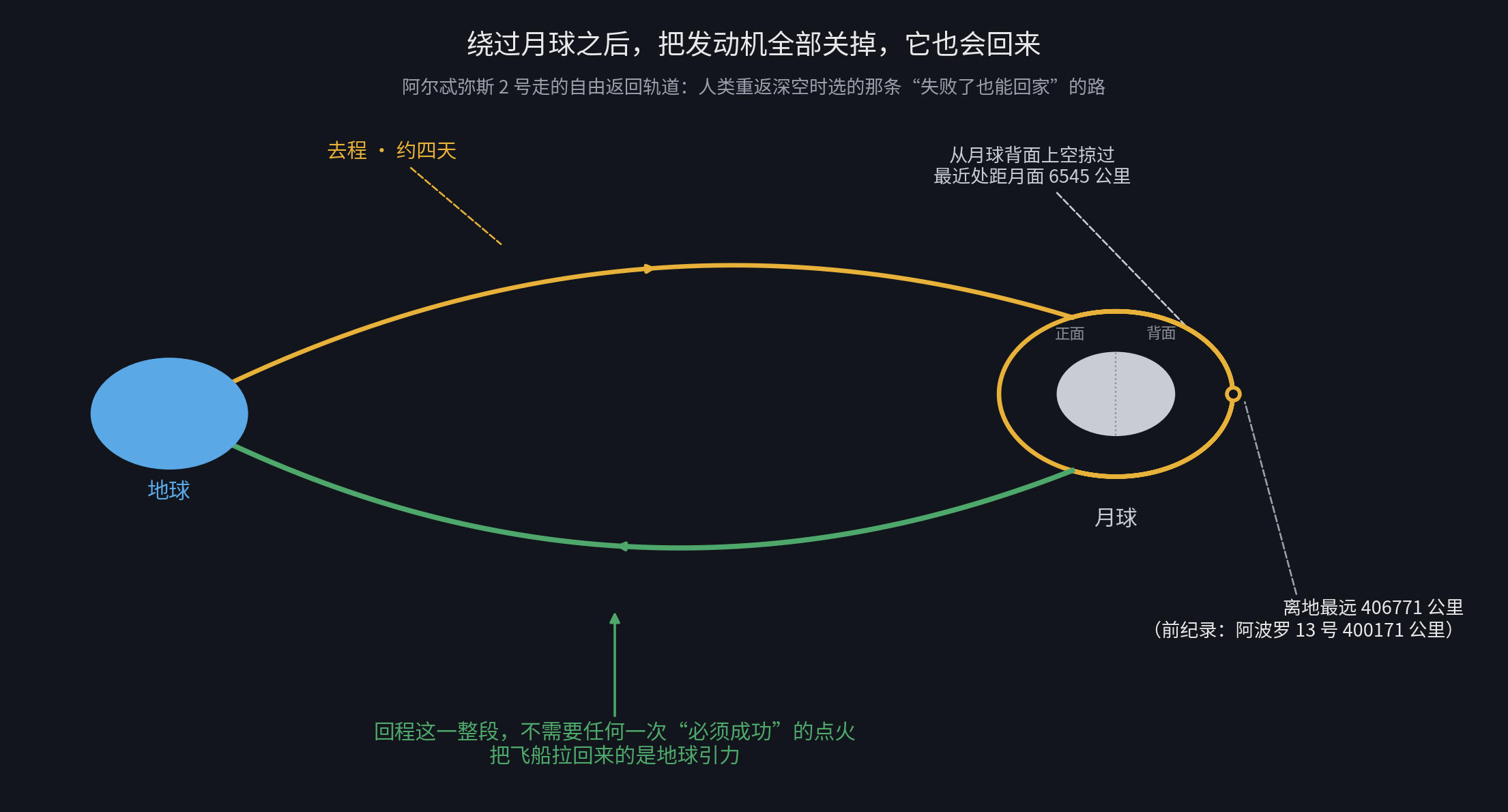
The flight lasted nine days, one hour and 32 minutes, the precise duration behind NASA's more conversational "nearly 10 days." At 7 p.m. Eastern time on April 6, or 7 a.m. on April 7 in Beijing, Orion swept behind the Moon, coming within about 6,545 kilometers of its surface.
Two minutes later, it reached its farthest point from Earth: 406,771 kilometers.
That broke a record held for 56 years. Apollo 13 had carried humans 400,171 kilometers from Earth in 1970. Artemis II exceeded that distance by about 6,600 kilometers.
As the crew crossed the mark, Jeremy Hansen said from the cabin: "As we surpass the farthest distance humans have ever traveled from planet Earth, we do so in honoring the extraordinary efforts and feats of our predecessors."
The four crew members were commander Reid Wiseman, pilot Victor Glover, mission specialist Christina Koch and Jeremy Hansen of the Canadian Space Agency. NASA described the crew as including the first woman, first person of color and first Canadian to undertake a lunar mission.
At 5:07 p.m. Pacific time on April 10, Orion splashed down in the Pacific Ocean off San Diego. The total journey covered 1.118 million kilometers.
They Did Not Land on the Moon
Artemis II made no lunar landing. It did not even enter lunar orbit.
The distinction has often been lost in Chinese coverage. Xinhua devoted a news analysis to why Artemis II would fly around the Moon without landing. Its explanation was that key equipment, including the lunar lander and spacesuits for extravehicular activity, was not yet ready. The mission's central purpose was to validate the complete system for crewed deep-space flight.
NASA's term is flyby.
Even NASA has muddled the distinction. A September 9 news release called the crew the first humans to enter lunar orbit in more than 50 years. That was inaccurate. They never performed a lunar orbit insertion burn and never entered orbit around the Moon. Some Chinese references to entering lunar orbit may derive from that sentence.
The mission sequence has changed, too. Artemis III is no longer scheduled to make the first crewed landing. Under NASA's June announcement, Artemis III in 2027 will demonstrate rendezvous and docking with the Human Landing System in low Earth orbit. The first crewed landing at the lunar south pole has moved to Artemis IV in 2028.
What Brought Them Home?
The key was gravity.
Artemis II followed a free-return trajectory. NASA's mission press kit describes it this way:
With no propulsion required on the return, this fuel-efficient trajectory uses the Earth-Moon gravity field to ensure that Orion is naturally pulled back by Earth's gravity during the mission's free-return portion.
The Canadian Space Agency puts it more directly: after a lunar flyby on a free-return trajectory, Earth's gravity naturally brings Orion home.
Xinhua's explanation makes the same point: "During the return phase, the spacecraft will use the Earth-Moon gravitational field to return naturally to Earth under Earth's gravitational pull, without restarting the propulsion system."
The basic idea is simple: send the spacecraft along a special figure-eight path, and after it swings around the far side of the Moon, it can come home even if the main engine fails completely.
That is why this route was chosen for humanity's first return to deep space. It is not the fastest route or the one that takes the least time. It is a route with a way home built into its geometry.
Apollo 13 Had to Get Back onto That Route
A common account online in Chinese says Apollo 13 happened to be on a free-return trajectory when disaster struck, which allowed it to swing around the Moon and return.
That leaves out the crucial maneuver.
NASA's account records a routine midcourse correction at 30 hours and 40 minutes into the mission, before the explosion. That correction had deliberately taken Apollo 13 off its free-return trajectory and onto a lunar landing course, aimed at the Fra Mauro site.
When an oxygen tank exploded at 9:08 p.m. on April 13, 1970, the ground team therefore had to find a way back onto a free-return trajectory. NASA describes a 35-second burn, calculated on the ground and performed five hours after the explosion.
The fallback route had to be recovered. Leaving it and then fighting to regain it is an essential part of the Apollo 13 story.
Free Return Does Not Mean No Burns
A free-return mission still uses its engines.
NASA's published Artemis II sequence includes perigee-raising, apogee-raising and translunar injection burns, plus three outbound and three inbound trajectory corrections.
The precise meaning of free return is that after rounding the Moon, there is no critical major burn whose failure would prevent the crew from coming home. The correction burns make small adjustments to line up the reentry corridor, and a failed correction leaves room for recovery. A failed lunar orbit insertion burn could prevent a safe return; Artemis II did not include that maneuver at all.
This is a fundamental difference from the Apollo landing missions.
Seven Hours by the Moon
NASA's flight-day blog records what the crew saw during those seven hours.
They watched Earthset and Earthrise, as Earth slipped below the lunar limb and came back into view.
They experienced a solar eclipse lasting nearly an hour, with the Sun's corona visible.
During that eclipse, they saw six flashes from meteoroids striking the lunar surface, with their own eyes.
They also observed craters, ancient lava flows, fractures and ridges.
NASA's materials offer a useful sense of scale: from about 250,000 miles away from Earth, the Moon looked roughly the size of a basketball held at arm's length.
The flight also had a less glamorous episode. On the first day, just before the apogee-raising burn, the crew reported a blinking fault light on Orion's toilet. The Houston team analyzed telemetry and worked through the problem with the astronauts. Once it was fixed, the crew slept for four hours.
NASA devoted a blog entry to the repair. The first problem requiring a ground-team response on a crewed journey to the Moon was the toilet, a detail that captures real spaceflight better than a promotional film.
Why a Football Stadium?
Wiseman was there for NASA's Inspiration Tour.
Led by the NASA administrator, the tour began in Pittsburgh on September 13 and spans five consecutive Sundays at NFL stadiums in Pittsburgh, Baltimore, Cleveland, Philadelphia and East Rutherford. Events include NASA aircraft flyovers and an interactive area inside the stadiums.
NASA explained its purpose this way:
We are returning to the Moon, building a lunar base, advancing fission-powered spacecraft, and pushing the boundaries of aeronautics, science and discovery. Achieving these ambitions requires America's best, and partnering with the NFL gives us an excellent platform to inspire the next generation.
The idea is to bring astronauts to places people already gather, including the stands where children spend their weekends.
For Wiseman, Baltimore was also home.
NASA's caption calls him "a Baltimore native." More precisely, he attended high school in Timonium, in Baltimore County; Smithsonian describes him as coming from the Baltimore suburbs.
The city connects this photograph to two other stories.
During the Battle of Baltimore, September 12-14, 1814, a British fleet bombarded Fort McHenry for 25 hours. On September 14, Francis Scott Key stood aboard an American truce vessel and saw the fort's enormous 30-by-42-foot garrison flag flying. He wrote a four-stanza poem originally titled "Defence of Fort M'Henry." It became the U.S. national anthem only in 1931, 117 years later. The poem and its adoption as the anthem are separate events, often collapsed into one.
The Ravens, meanwhile, take their name from Edgar Allan Poe's 1845 poem "The Raven." Poe is buried in Baltimore's Westminster burial ground. On March 29, 1996, a telephone poll organized by The Baltimore Sun drew a record 33,748 calls in 24 hours. Ravens won with 22,463 votes. The team's account of its name still quotes the poem.
A Baltimore man returns from the Moon to a stadium in the city that inspired the national anthem, to watch a team named for another poem.
The home team lost that day, 17-24.
What "Emeritus" Means Here
By the time this photograph was taken, Wiseman's status at NASA had changed.
On September 9, NASA announced that Wiseman and Glover were moving into emeritus status that September. Some English-language headlines called it retirement. NASA's definition is more specific:
In emeritus positions, people with extensive technical and professional expertise can continue supporting the agency, volunteering their time to train and mentor current employees. The arrangement retains outstanding talent in a dedicated advisory role, while allowing individuals the flexibility to pursue other opportunities.
The important terms are volunteer time and an advisory role. The director of Johnson Space Center made the continuity explicit: "We are pleased that this is not the end of their journey with the agency."
Wiseman will pass on his flight experience to colleagues preparing for Artemis III's rendezvous and docking mission in low Earth orbit.
NASA's caption still identifies him as a NASA astronaut and Artemis II commander.
Behind the Camera
The credit reads NASA/Bill Ingalls.
Ingalls has photographed for NASA since 1989, more than three decades; nasa.gov calls him NASA's senior photographer. He has photographed NASA robots inside active Alaskan volcanoes, flown through hurricanes aboard a DC-8, and covered at least 75 Soyuz capsule recoveries in Kazakhstan.
He is also known for a spectacular mishap. On May 22, 2018, a Falcon 9 launched a pair of NASA satellites from Vandenberg. A brush fire ignited by the launch destroyed one of his cameras, positioned about 400 meters from the pad. Ingalls described the remote camera as having been found "a bit toasty." Its memory card survived, with all the photographs intact, including the last frame before flames engulfed the camera.
A different famous launch picture is often wrongly attributed to him: the "photobombing frog" was captured during the September 2013 LADEE launch by a sound-triggered remote camera at NASA's Wallops Flight Facility. The credit belongs to Chris Perry.
Ingalls has offered an observation that helps explain the stadium selfie photograph. While covering the space shuttle's retirement, he realized that the real story was the people on the ground, pointing upward and staring open-mouthed at the sky.
NASA imagery also comes with a few qualifications. Its images, audio and video are generally not copyrighted in the United States, allowing direct linking to official originals. Four restrictions still matter: NASA's insignia and logotypes are not in the public domain; uses must not imply NASA endorses a product; commercial uses of recognizable people may require separate permission because of publicity rights, especially relevant to a photograph full of fans' faces; and NASA prohibits its insignia from appearing with AI-generated imagery.
China Is Rehearsing Failures, Too
One principle runs through Artemis II: before sending people, work through the ways things can fail. The free-return trajectory addresses one of them, failure of the main engine.
China has completed three tests built around the same logic, all documented in official announcements.
On August 6, 2025, the Lanyue lunar lander's integrated landing and takeoff test was completed at the extraterrestrial-body landing test site in Huailai, Hebei. The China Manned Space Agency called it China's first test of a crewed spacecraft's landing and takeoff on an extraterrestrial body. It validated the overall landing and takeoff design, control scheme, engine shutdown on lunar contact, and compatibility between the guidance, navigation and control, propulsion and other subsystems.
At 11 a.m. on February 11, 2026, the Wenchang launch site hosted both a low-altitude demonstration of the Long March 10 rocket and a maximum-dynamic-pressure abort flight test of the Mengzhou crewed spacecraft. The official account is measured:
The rocket ignited and lifted off. On reaching the spacecraft's maximum-dynamic-pressure abort conditions, the spacecraft received the rocket's abort command and successfully separated and escaped. The rocket's first stage and the spacecraft's return capsule then made controlled, safe splashdowns in their designated sea areas as planned.
They launched a rocket to pull the spacecraft away at the moment when escape would be hardest.
Mengzhou had previously completed a zero-altitude abort test, simulating an emergency on the launch pad in which the spacecraft would have to pull its crew clear from a standing start.
One lander test and two escape tests. In its February work-conference announcement, the China Manned Space Agency restated the goal of a first Chinese crewed lunar landing before 2030, and reported steady progress on the Long March 10, Mengzhou, Lanyue and other major flight hardware.
Two countries, different hardware, the same principle: work through every foreseeable failure before people fly.
Sources
NASA Image of the Day, September 21, 2026; NASA news releases, "Liftoff! NASA Launches Astronauts on Historic Artemis Moon Mission," "NASA Welcomes Record-Setting Artemis II Moonfarers Back to Earth," and "NASA's Artemis II Crew Eclipses Record for Farthest Human Spaceflight"; NASA Artemis II press kit; NASA flight-day blogs, April 2 toilet troubleshooting and April 6 lunar flyby; NASA news releases, "NASA Names Two Artemis II Astronauts to Emeritus Program" and "NASA Marches Toward Artemis III Mission in 2027, Names Crew Members"; NASA Space Launch System reference page; NASA Apollo 13 and Apollo 17 mission pages; Canadian Space Agency, Artemis II in-flight milestones; NASA, Reid Wiseman's official biography; NASA Brand Center, imagery-use guidance; NASA and NFL partnership news release; NASA 2026 International Observe the Moon Night lunar map; Xinhua, analysis of why Artemis II flies around the Moon without landing, and April 2, 2026 launch report; National Park Service, Fort McHenry and Francis Scott Key pages; Baltimore Ravens, official account of the team's name; Poe Baltimore, Westminster burial ground page; New Orleans Saints, official 2026 Week 2 game recap; Space.com reports on emeritus status and the camera burned in 2018; Smithsonian Air & Space, Bill Ingalls interview; China Manned Space Agency announcements of August 7, 2025 on Lanyue's integrated landing and takeoff test, February 11, 2026 on the Long March 10 low-altitude demonstration and Mengzhou maximum-dynamic-pressure abort test, and February 27, 2026 on its work conference; Science Popularization China, article debunking lunar-landing misinformation.