
A physicist from Harvard Medical School spent eight months living on the International Space Station. Shortly after landing, a NASA photographer captured this smile.
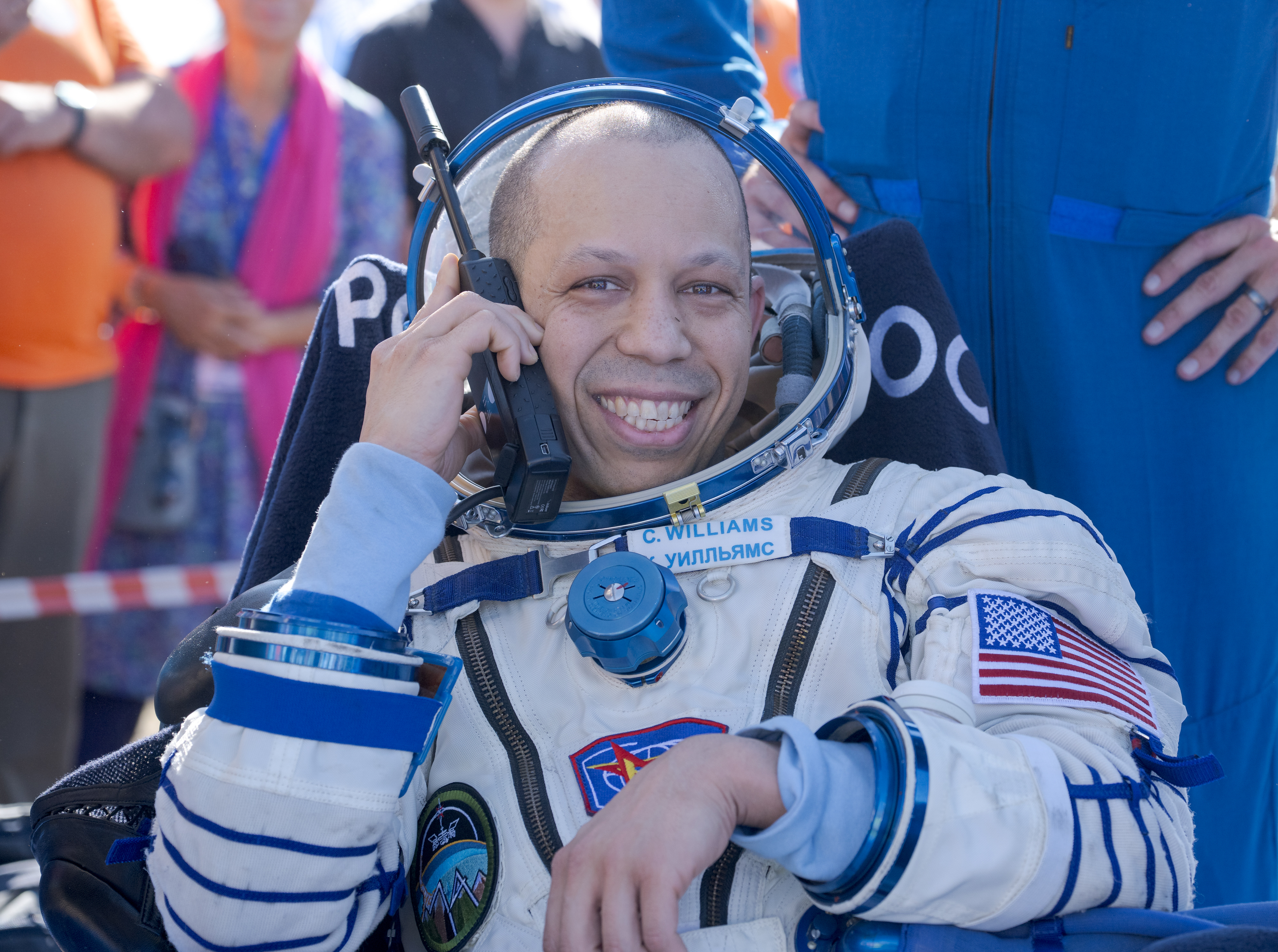
Image: NASA Image of the Day · Image credit: NASA/Bill Ingalls · Image page https://www.nasa.gov/image-article/nasa-astronaut-chris-williams-returns-to-earth/
Open the "Image of the Day" section on NASA's website, and on July 27 there's no nebula, no rocket—just a human face: a man in a blue-and-white flight suit covered in patches, helmet open, one hand pressing a walkie-talkie to his ear, smiling without reservation. Behind him are workers in blue coveralls; further back, a circle of onlookers gathers beyond red-and-white caution tape.
A few hours before this photo was taken, he was still up there.
The Man Who Fell from the Sky
His name is Chris Williams, NASA astronaut. On July 26, the Soyuz MS-28 spacecraft carried him and two Russian cosmonauts—Sergei Kud-Sverchkov and Sergei Mikayev, yes, both named Sergei—under open parachutes down to the steppe southeast of Dzhezkazgan, Kazakhstan, at 3:27 p.m. local time.
This trip, they spent 241 days in space. Over eight months, the spacecraft orbited Earth 3,856 times, averaging 16 orbits per day; altogether they traveled more than 160 million kilometers—farther than the distance from Earth to the Sun. And this was Williams' first spaceflight: when he launched on November 27, 2025, he was a rookie; by the time he returned, he had completed two spacewalks.
His Day Job? Fighting Cancer
Here's the remarkable thing: this man who just came back from the sky holds a ground-based identity as a medical physicist at Harvard Medical School. Before being selected as an astronaut, he worked at the Dana-Farber Cancer Institute and Brigham and Women's Hospital in Boston, delivering precisely calculated doses of radiation into tumors—physics, in his hands, was a tool for healing. Before that, while earning his doctorate at MIT, he studied astrophysics, traveling to the Australian outback to help build a radio telescope array, listening for faint signals from the universe's infancy.
You see, a person who once gazed up at the earliest light of the cosmos and then looked down to treat the sick—this time he went to space himself. According to NASA, the research he supported on the station included, fittingly, novel cancer therapies, as well as manufacturing materials needed for high-performance computers in microgravity. Having come full circle, he continued doing at an altitude of four hundred kilometers what he'd been doing on the ground.
Even his two spacewalks carried a professional undertone: one was to prepare for a power system upgrade on the station; the other was to replace a malfunctioning joint on the Canadarm2 robotic arm—a man with a medical background, performing "joint replacement surgery" on a mechanical arm.
Behind the Shutter
The photo is credited to NASA photographer Bill Ingalls. For decades, many iconic moments of Soyuz spacecraft touching down on the steppe have come through his lens. This smiling face, captured at the July 26 landing site, was selected the following day as NASA's "Image of the Day" on its website.
As planned, Williams will take a helicopter to Karaganda, then board a NASA plane back to Houston. A body that hasn't borne Earth's gravity for eight months—every step now feels heavy. But look at that smile in the photo—perhaps only someone who has truly left home can smile like that upon coming back.
Sources: NASA Press Release 26-058, "NASA Astronaut Chris Williams, Crewmates Return from Space Station" (July 26, 2026); official NASA biography of astronaut Chris Williams.